Ángel Corella has been at Pennsylvania Ballet’s helm for three productions thus far: a mixed bill of work by George Balanchine, Christopher Wheeldon, Alexei Ratmansky, and Jerome Robbins; George Balanchine’s The Nutcracker; and the current run of one-acts, Balanchine’s The Prodigal Son (1929), Wheeldon’s Polyphonia (2001), and Matthew Neenan’s new Shift to Minor. I can’t address how much Corella’s directorship, announced in late July 2014, influenced this season’s choice of works, but I was curious to see his impact on the company’s dancing: they are looking good, especially the men, and some of the women are not only crisp and clear, but look like they’re loving it.
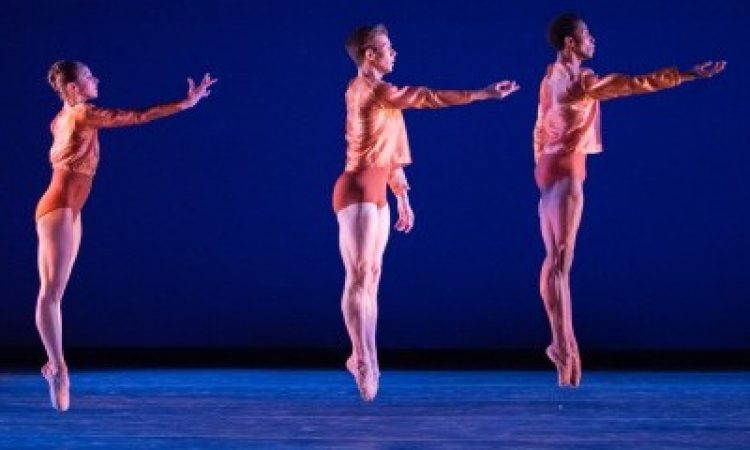
Polyphonia, of the neoclassical flavor that shaped Wheeldon in his career with New York City Ballet, presents the dancers in Holly Hynes’s dark blue-purple leotards, pink tights for the ladies, and black waist belts. The four couples are, in various configurations, always busy on the stage, sharply etched hieroglyphs pressing, stretching, and slicing the space between dancers and between body parts.
György Ligeti’s piano works, played by Martha Koeneman, are sometimes complex, sometimes spacious, and often poetic, giving Wheeldon scope to explore speed, partnering, and moods. I was often reminded of moments in Balanchine’s The Four Temperaments, when the viewer’s eye is drawn to a particular body part flexing or unfurling, to awkwardly beautiful lifts, to men moving women’s bodies into remarkable tangles that elegantly resolve. The dancers were spot-on in all cases, although I would note particularly, in the cast performing Friday, February 6th, Ian Hussey’s perfect partnering, Andrew Daly’s clarity of attack, Brooke Moore’s exuberant precision, and (new to PAB) Oksana Maslova’s elastic encirclings of her own limbs, her partner’s body, and the space through which she danced.
Neenan’s ballet shows him taking a step forward in attention to musicality (the solo musician in Mozart’s Violin Concerto No. 5 was Luigi Mazzocchi—terrific!). Particularly the pas de deux by Mayara Piniero and Alexander Peters and the trio by Lauren Fadeley, Jermel Johnson, and Lorin Mathis floated on or punctuated the music eloquently, just right. These dancers seemed completely comfortable with, and yet engrossed in, their roles; I wanted to look at them, to figure out their relationships, to try to guess their next moves. On the other hand, the corps of ten men and women who filled the stage in various groupings were the foils who hammed, mugged, and shrugged their way through what appeared to be interloping vaudeville acts. In these sections, I felt rather danced-down-to, and the moves struck me as overly familiar, recycled from earlier Neenan works I’ve seen.
And then there is Prodigal, which PAB first performed in 1989. A modernist/ expressionist work with bold scenes and costumes by Georges Rouault and music by Sergei Prokofiev, Prodigal reveals Balanchine as masterful storyteller and social commentator—not the roles in which dance history has remembered him. Again the men, whose numbers dominate this work, were noteworthy: James Ihde’s archetypically unbending Father, the chorus of friends and baldheaded, look-alike revelers, and especially Jermel Johnson’s emotionally malleable Son. A good boy who slips off to a maniacal fraternity party where he is intoxicated, stripped, robbed, beaten, and even ravished, Johnson’s every movement and expression unfolded his inner life to the audience. The major female role, that of the Siren, is a particularly cruel vision of woman and requires a truly confident dominatrix to convince us that she can hold her own against the gaggle of thugs who attack the good boy. Amy Holihan did not quite get there at Friday night’s performance, but she did project the slinky evil of sexual allure that dominated the drinking-hall set.
It is too early to make pronouncements on the PAB board’s announcement of Corella as “a leader with vision, energy and creativity to excite audiences.” But I’m convinced that, under his leadership, the company is well worth watching.
Prodigal Son, Pennsylvania Ballet, Merriam Theater, February 5-18, http://www.paballet.org/prodigal-son