Since first seeing Pilobolus Dance Theater perform in the ‘90’s, I have struggled to adequately define the aesthetics of the company and what they do.
Is it only a dance company?
Is it performance art?
Are they all gymnasts?
Are they contortionists?
Are they entertainers who rely on tricks and technology to dazzle an audience?
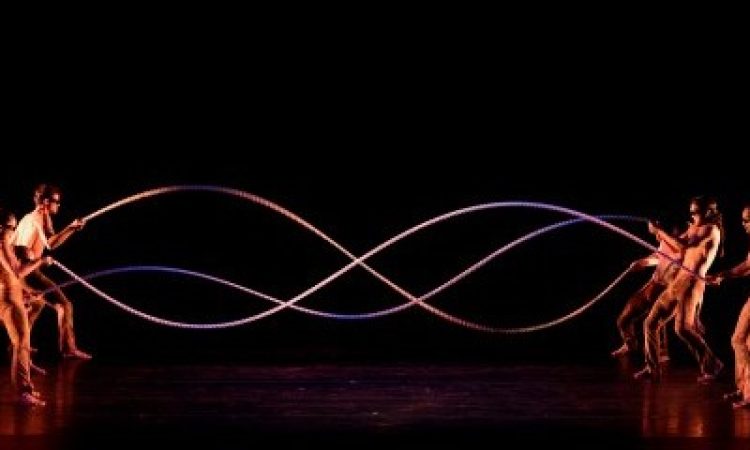
Founded by a group of Dartmouth College students in 1971, Pilobolus has been integrating video, animation, circus art, and mime into its performances for years. Led by Artistic Directors Robby Barnett and Michael Tracy and Associate Directors Matt Kent and Renee Jaworski, Pilobolus brought five pieces to Dance Celebration at the Annenberg Center.
On The Nature of Things (2014) was a reminder of my early memory of the group, making use of gymnastics and a circus skill known as equilibristics. A raised round column stood center stage as dancer Mike Tyus walked into the space carrying Shawn Fitzgerald Ahern across his shoulders. Tyus placed Ahern on the column and left, returning with Jordan Kriston. He positioned her legs on Ahern’s chest as she strategically steadied herself atop his torso. Their strength and stability intertwined to produce carefully manipulated transitions.
Tyus used Ahern’s feet as his point of contact to begin turning the table. There were undertones of desire as Tyus watched their spinning duet from a distance. Wearing only thong dance belts and panties, Ahern and Kriston entangled their partially nude bodies before making room for Tyus, inviting him onto the column and into their compact space.
The trio worked to remain balanced while sharing each other’s weight. They lifted, hung from, and supported one another. At one striking moment, Ahern’s full weight was balanced on Tyus’ foot – nape of neck to ankle. Power, agility, and control (which I would call the essence of Pilobolus), made this piece a spectacular opener and, for me, the stand-out of the night.
The Transformation (2009), excerpted from a larger work, Shadowland, was created in collaboration with the lead writers for the animated series SpongeBob SquarePants. A theatre piece, whose actions unfolded through shadows, told the story of a young girl’s imaginative world as it came to life using actors who are concealed behind a screen the entire time. An oversized hand reached down and awakened a sleeping girl who stood facing the hand and reacted to its fingers poking her. She twitched, she squirmed, she fidgeted. The hand erased her head, turned her into a dog, then back to a human. The transformation theme continued—the hand morphed into a male figure. Their brief interaction ended with him handing her a bindle before growing as he moved towards the audience. This short but highly impactful piece left the audience ‘oooohhhing’ and ‘aaaahhhhing.’
Trying to categorize Pilobolus was even more confounding when the second act opened with a magic show. Co-created with the noted illusionists Penn &Teller, [esc] (2013) delivered cliché magic tricks that were highly predictable. Benjamin Coalter was tied in a bag and then sealed inside a wooden box (built with the help of two volunteers from the audience). The volunteers checked to ensure its solidity but were we to believe that he was actually “locked” inside the box and wouldn’t escape?
Short films were interspersed throughout the production and played before each piece (animation meets technology). Approximately two minutes in length, they failed, in my opinion, to form a direct connection to the works they preceded.
Maybe Pilobolus Dance Theater doesn’t need to be categorized at all. They stand at the intersection of dance, gymnastics, technology and theatre arts. I have no doubt they will continue to wow crowds worldwide with their perfectly sculpted bodies, awesome partnering, and eye-catching human sculptures, built using directions from a team of creative masterminds and powered by the dancers’ physical strength. Pilobolus isn’t any one thing – it is a synthesis of many highly appealing things.
Pilobolus Dance Theater, Annenberg Center for the Performing Arts, May 7th – 10th, www.pilobolus.com