Revolutionizing the look of classical ballet, American born choreographer William Forsythe’s work can be seen as an extension of Balanchine’s aesthetics. He reorients classical ballet from the fundamentals of a 400-year tradition to create room for multiple possibilities, employing a neo-classical sensibility.
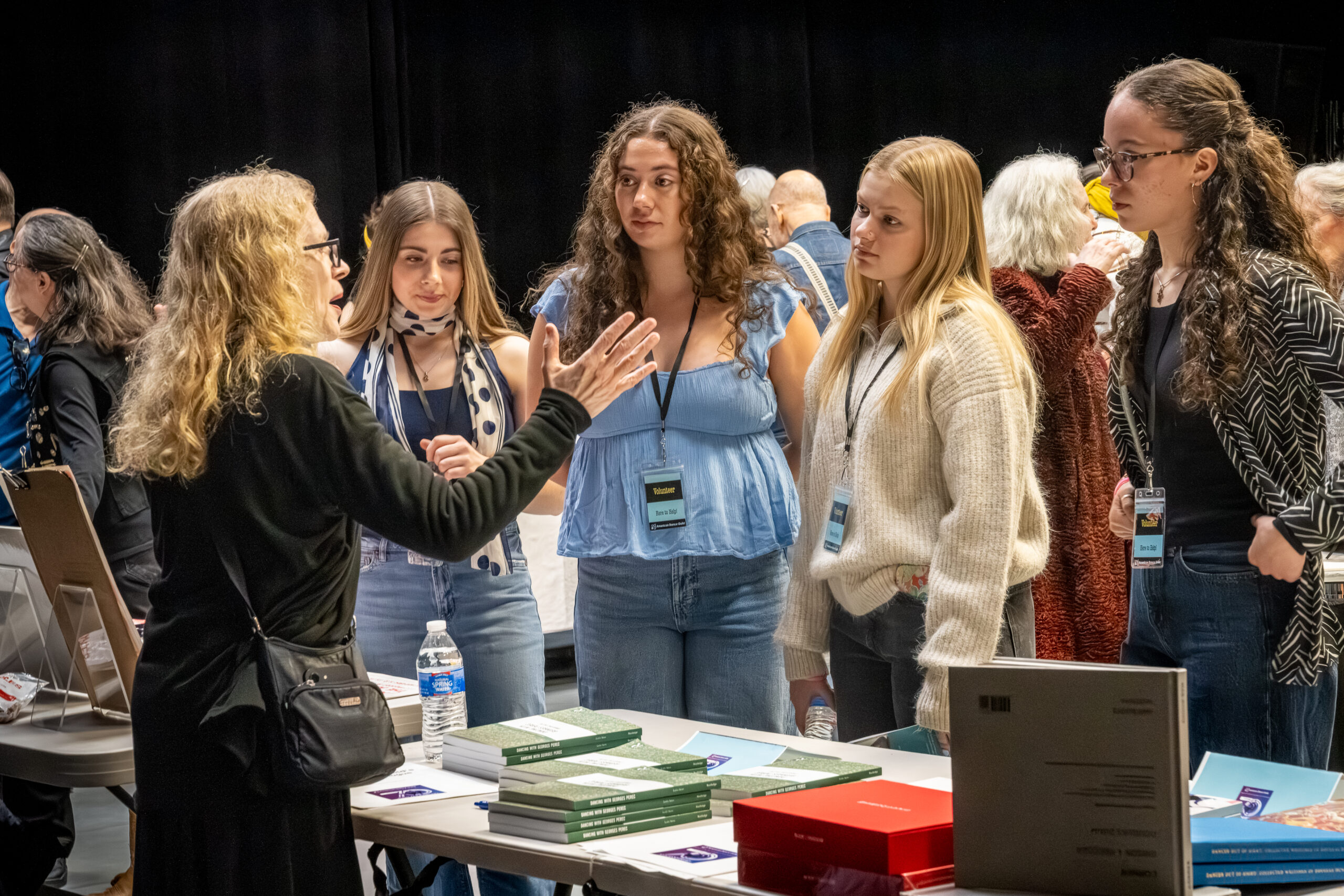
Dr. Linda Caruso Haviland served as moderator at a symposium presenting Forsythe that was supported by the Pew Center for Arts and Heritage at the Arts Bank in Philadelphia. Haviland introduced him as a “curious polymath with a voracious mind and huge appetite for how and why people move.” She initiated the conversation by stating that he was in Philadelphia to rehearse Pennsylvania Ballet dancers as they prepare to premiere his ballet The Second Detail. Though new to Philly, The Second Detail has been performed worldwide since its creation for the National Ballet of Canada in 1991. Forsythe took time to peel back the layers of his process and explained the complexities and adversities he faces when re-staging a ballet. Forsythe divulged that there are about twelve incarnations of The Second Detail and that these iterations come about when working with new dancers who bring new ideas. I surmised that he allows the uniqueness of each dancer to provide new insight into the work; as a result, no two re-stagings are the same.
The conversation switched to queries about neo-classicism: “What is it?” Haviland asked. Forsythe used that question as the launch-pad to explain neo-classicism in the context of his work. He began by explaining that he was a “ballet guy” and that he had a teacher whose combinations often appeared to move backwards. He quickly came to the realization that really good ballet went in reverse; in the symposium, Forsythe alluded to the fact that neo-classicism had the sensibility of backward ballet and allowed room to examine the effects of where movements can end up with different initiations.
On the day of the symposium, a colleague and former soloist with Ballet Frankfurt, Ramon Flowers, was visiting Philadelphia. Our conversation turned to his time with Forsythe; he commented that Forsythe’s neo-classical aesthetic is revealed through the use of improvisation, which is essential to Forsythe’s process and ultimately crucial to his ballets. “I have never performed a piece that didn’t have some form of improvisation,” he said. “Oh wait, The Second Detail had no improvisation.” Flowers clarified that The Second Detail had two sections: The Second Detail and The Loss of Small Detail. He described The Loss of Small Detail as the section with improvisation and explained that it was added to make an evening-length work.
Most of Forsythe’s improvisation is based on épaulement, the oppositional torsion of the shoulder and waist to produce a three-dimensional quality in the dancer’s body. Forsythe further describes how he uses épaulement to explore ways of organizing the body so that the rotation can create new positions – “a concept that allows for freedom in experimentation,” he said.
Forsythe’s exploratory method is multi-faceted and complex. He expounds that neo-classicism within structured improvisation is a permissive form of allowance. His dancers are welcome collaborators, expected to contribute to each process so that everyone owns the material. Intrinsically, he believes that their proprietorship becomes far more valuable than performing any step.
Forsythe’s description of his process reminded me of the act of crumbling a sheet of paper – each time a certain amount of pressure is applied, the piece of paper’s final form assumes a different structure.
Somewhat of an enigma, Forsythe spoke knowledgeably, with comical undertones. Almost as if creating in the studio, his body language was that of a leader, a teacher, an art maker. He was meticulous with his words, as if directing a mover, and he gesticulated with his arms, as if demonstrating a step.
Forsythe is a curious choreographer who seems to always be asking the question, “What if?”— a question that can only be answered if you’re willing to be just as curious.
The Pennsylvania Ballet is set to premier “The Second Detail” at The Merriam Theater on Thursday June 11th, 2015.