Generally I’d be content to never again see a male/female duet that tracks one couple’s attraction, repulsion, power plays, boredom, confusion, and all the rest. It’s a too-familiar trope that artists keep mining. But who could blame them? What could be more fundamentally human than the dynamics of two people in a relationship?
The Border transcends most of the hackneyed ploys of the duet genre. While parts hearken back to ‘80s Euro thrash, its intelligent mix of the literal (with spoken word narrative plus traceable story line and naturalistic set) and the abstract (with expressive movement and languages that seem to slide from gibberish to more distinct Norwegian and Russian) sets it apart.
Jo Strømgren Kompani is a true FringeArts favorite, with three productions in this year’s Festival. The Border’s hybrid nature, paralleling developments in Philadelphia’s performance scene, may well explain why. The featured players, Ida Holten Worsoe and Ivar Sverrisson, are equally adept at facial and vocal expression and full body movement.
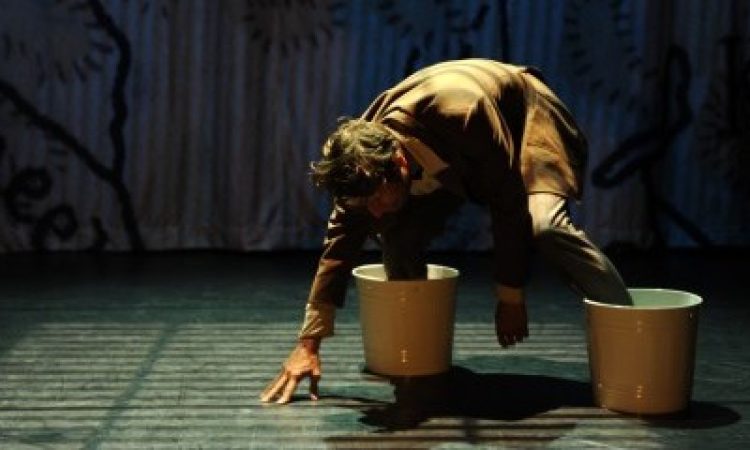
The story here concerns two officemates, each with particular quirks. She has porno on her cubicle wall and, we’re told in the English language voice-over, had an overly short childhood. He had a long childhood, we’re told, and an unquenchable thirst which we see him satisfy with multiple bottles of water. They find their way across whatever borders separate them in fits and starts, ending up a team.
An old-fashioned map with Scandinavian-type place names occupies the back wall. At one point she drapes it around her shoulders, swaying the whole image side to side. Similar big visual gestures refresh the scene. They slide his desk center stage, flanking it for a face off. They scrunch up inside a wooden box to portray their cramped train journey.
Strømgren does a lot with slow motion. An affecting mimed moment comes when the man exits the shared office into a blaring gale. His hunched, effortful crossing of the stage recalls every struggle any human ever had, and by itself is worth seeing the show for. Likewise the torso-thrashing and looping legs of a sex scene are drawn in long slow-mo arcs, hair flying.
Every physical action—folding a piece of paper, opening a letter, is etched with awareness and clarity. The two, having lost their jobs and deciding to journey far away by train, evoke cramped long-distance travel with little bumpy shakes set to train sound. It works perfectly.
Strømgren’s characters are goofy and relatable. Like Chaplin’s Little Man, they’ve been buffeted about, and, making it through intact, we root for them. Or even cheer.
The Border, Jo Strømgren Kompani, FringeArts, September 9-12. http://fringearts.com/event/the-border/