Careful Injuries commenced in an aluminum foil covered room reeking of mold with a twelve-person audience. The little bit of ventilation came from two window air conditioner units, which were powered off, covered with more tin foil, and secured with duct tape by two of the three dancers. The music sang, “Don’t know what we’re doin’. Don’t know what we’ve done.” To be honest, I didn’t really either.
Other Case Notes Ensemble is one of the resident artists at Mascher Space Co-Op and they attribute equal leadership to each female member, Jessieh Ruth Averitt, Maggie Donoghue, and Samantha Jolene Orr. Their curiosity is driven by the psychological and physical reactions of individuals in severe situations.
From the twenty minute pre-show and into the first part of the hour-long program, the full cast blankly paced the stage, as if following a grid. The first of eight blackouts, which signified section breaks, dissipated to reveal a blindfolded woman, alone and tightly gripping a gun. Carefully, and with heavy breath, she stepped backwards upon a rectangular stretch of bubble wrap. Amidst growing apprehension, the first big “POP” under her foot startled most of the audience. Her vigilant steps disclosed fear, courage, and eventually an emotional breakdown. Face unmasked, she cried on the bare ground and slid the gun across the floor.
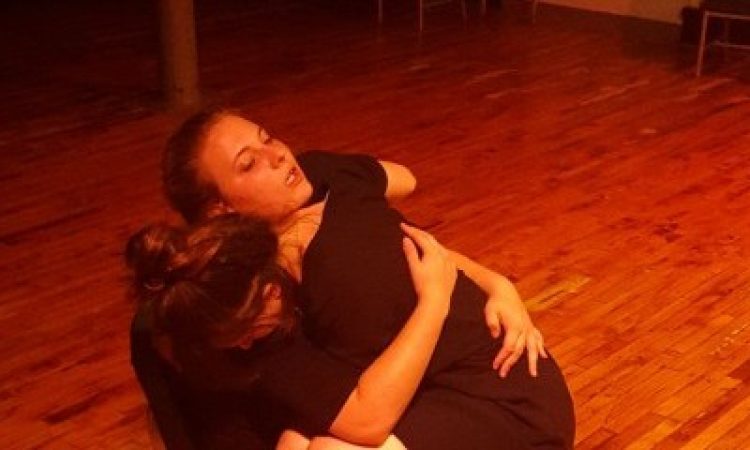
The three dancers returned to the gridded walk, though this time they began to wander in both gaze and footing. They observed one another, interacting and touching. They initiated a common improvisational exercise. One slowed to stillness, yet remained malleable. Her role was to adjust as the other two repositioned her. In this section, the shape of her body was accentuated, but often attention was brought to primping her hair and face.
The theme of traumatic experiences gradually emerged: obeying as a non-questioning member in society, walking through life in fear of harm, or being molded into an “ideal” woman. Speaking with fellow viewers, I found we were all able to generate meaning from the performance, yet each interpretation was vastly different. This was the power of Careful Injuries, or perhaps its ambiguity. Each human response to trauma is subjective, including how we perceive and connect to artistic work about such experiences. The way we choose to move forward and share those stories with others is ultimately the most impactful response of all.
Careful Injuries, Other Case Notes Ensemble, Mascher Space Cooperative, September 11-12.