Two thINKingDANCE authors intertwine their takes on performances at the NowHere Festival of Free Improvisation.
“What is free improvisation?” asks a sign on the wall. Around it, festival participants and attendees offer their thoughts on Post-it notes, stuck to the wall of the performance space.
_________________________
Post-it #1: Free improvisation is
“a utopian thought that together,
on the ground, we can
investigate an aesthetic ideal.”
________________________
ZS: For me “free” improvisation means a constant interrogation of the situation and the ability of the performers to illuminate their internal and external experience, which includes us—the audience—and the world at large. Asimina Chremos did exactly this, speaking a playful and political stream of consciousness, her body revealing the power dynamics in the room. Other performers did a commendable job, though they often got stuck on trying to build something cohesive, either in expression or story. While successful in creating a beautiful improvised performance, I’m not certain that it was necessarily “free” improvisation. But, what does “free” mean? NowHere Festival’s Friday night show had a European flare: dim string lights, homemade food, and drinks served between each of the four sets. Almost three hours long, the work presented was engaging, interesting, and at times brilliant.
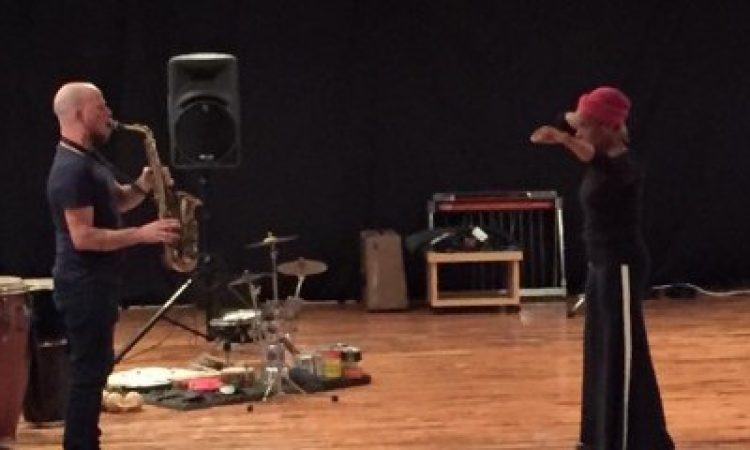
Friday Set 1: Dancer and Philly legend, Germaine Ingram, danced and sounded along with saxophonist Keir Neuringer. He crouched, resonating his saxophone toward the floorboards – filling the space with traveling sound. Germaine towered over him. She sang with her soul, vibrating her being outward. When they finally made eye contact, the energy in the room solidified into a brilliant cohesion.
LMB: Sunday, set 1: In stillness they all stand—and we sit—aware of ambient clicks and roars within and without the space. Softly, motion emerges. They are listening, sensing in three (four?) dimensions: a forest of people-creatures. I am drawn to the musicians’ movements, as much as the dancers’: What is he stroking on his drum? Why does that guy have his guitar on his head? A quiet violinist struts. And why are the dancers all upstage? Leah Stein rises, stretches herself along a floor-to-ceiling pole, leans a long slant against it, then sinks to the floor. She’s funny, mysterious, directed, following the walls toward the musicians’ circle. I enjoy the quiet, the beauty, the alert attention among performers. Sensitized to their process, I listen, look, and feel the form take shape, come full circle.
_________________________
Post-it #2: Free improvisation is
“a safe place to fall apart and
put yourself back together again.”
_________________________
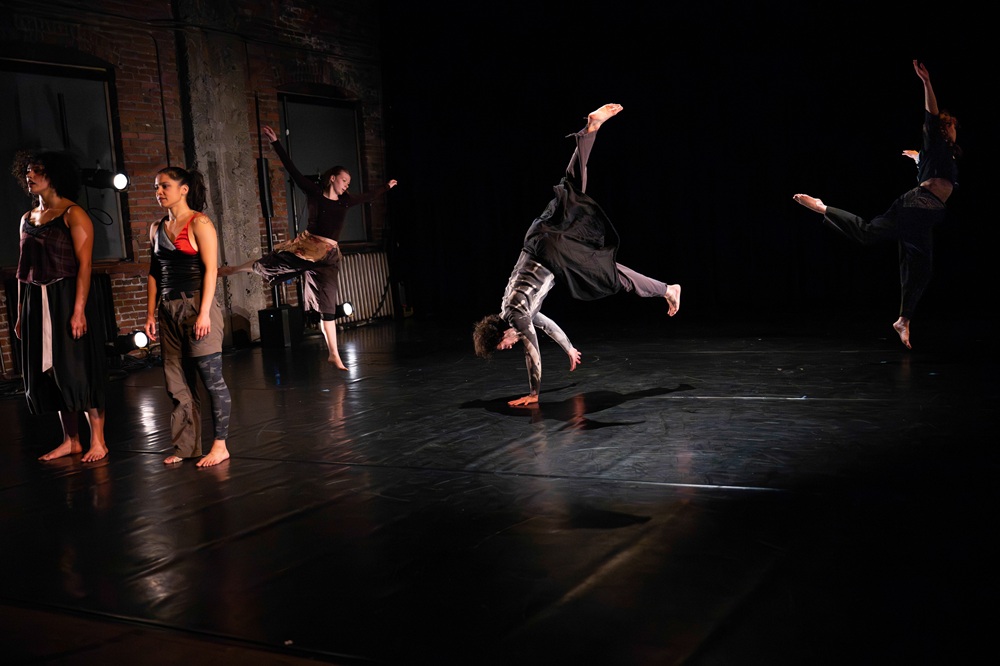
LMB: Sunday, set 2: The musicians start with a fanfare that softens to reveal many textures. Dancer Joe Burgio sidles in, like the floor is hot lava. The musicians move to shrill-and-squeak mode, the dancer to sink-and-roll, his range flat. The musicians seem to attack him; violinist LaDonna Smith comes forward, usurping not just Joe’s space, but his role. She dances around him, talks at him, dominates the piece. It descends into screaming and screeching—kids in a food fight. The audience applauds: it’s over for us.
ZS: Friday, set 3: Four musicians—Susan Alcorn, pedal steel guitar; Bhob Rainey saxophone; LaDonna Smith, violin; and Travis Woodson, guitar; and two dancers—Eun Jung Choi and Ayako Kataoka. I had never before seen miscommunication and refusal to join resolved in such a beautiful way. Sitting in a shallow diagonal, heads moving in unison, the musicians followed every movement of the dancers, like a flock of birds following a leader. Eun Jung’s body wanted to move the space around itself, lifting limbs and spiraling up and down from the floor. Ayako was feminine, expressive, her Butoh-inspired movement slow and distorted. Neither seemed to do what they wanted, nor did they agree on anything; they moved by themselves, glancing towards one another, each a soloist.
This disagreement and frustration became a narrative. As the piece progressed they found each other’s bodies and embraced awkwardly. They stayed in contact, Eun Jung with her abstract movement and Ayako with her expressive face and distorted body. It ended. They did not speak to one another, exiting in opposite directions offstage.
So, when is it time to end an improvisation? I think it never ends, but rather the performers choose a good time to stop. Then they exit, continuing their “free improvisation” of existence elsewhere in the world. That was evident in the body language of Eun Jung and Ayako.
_____________
Post-it #3: Free improvisation is
“Knowing when to hold them,
knowing when to fold them.”
____________
LMB: Sunday, set 3: A loud cloud of frantic energy, amid which Michele Tantoco runs, momentarily quieting the roar, which soon explodes to shrill pain. She balances, her body waving like a flag of surrender in the midst of battle. As the five musicians thunder on, Michele gently rolls toy cars down her leg and across the stage. She follows a car to the seating cushions on the floor, takes one, and covers her head with it. My ears hurt, even with plugs in. Michele stands, walks to saxophonist Elliott Levin’s mic and blows a “shuuuushshshsh” into it. No matter, the musicians continue at 11 on the dial. She claps her belly, her hands, signaling an end, to no avail, then steps forward and makes tiny talky-talk finger mudras, whispering a conversation between her hands. The hands soon scream at one another, propelled by the sound-roar. She collects the toy cars, the pillows, makes neat stacks, as if closing down the space, and exits to grab her water bottle. The roar goes on. My seatmate and I choose to depart, still hearing the thunder of sound as we walk a block off to our car. Too bad it was so late, so loud, that we had to exit and miss set 4.
_____________
Post-it #4: Free improvisation is
“sharee dooby dooby,
Bop whooooooooooooo,
Poink! Poink! Ploink!
Doink Doink wheam,
BlupppppPPP”
_____________
ZS: What do the performers “owe” the audience? They owe them their true self at every moment, full exposure to their emotions and expressiveness, plus their compositional and artistic expertise in that moment. They owe them an openness and invitation to be seen and heard. Otherwise why have an audience at all?
What the audience “owes” the performers, I believe, is simply empathy.
LMB: Empathy goes both ways.
NowHere Festival of Free Improvisation in Sound and Movement, Mascher Space Cooperative, Oct. 19-25. http://www.impermanentsociety.com/
Tags: NowHere, free improvisation