This past Sunday, I saw the ridiculous and the sublime in dance. A pause for dinner intervened, but harder to digest was the contrast between the matinee and evening shows I saw.
The Zellerbach Theatre at the Annenberg Center was perhaps three-fourths full at the Sunday matinee of the Twyla Tharp 50th Anniversary Tour. Families and dance fans occupied the seats: the seven-year-old girl next to me was excited to see, on the stage, the dance moves she was learning in her home studio.
After First Fanfare (loud brass music by John Zorn), the Tharp company of remarkable technicians sprang into the main work of the show, Preludes and Fugues, to a recording of J. S. Bach’s Well-Tempered Clavier. This music is a kind of primer in style, theory, and technique that moves with inexorable logic through all the keys of Western music. This range may have inspired Tharp to expose the capabilities of her dancers, who can do just about anything the human body is capable of. In the course of this quite long (at least, long-seeming) work, Tharp’s dancers, clad stylishly in Santo Loquasto’s earth-toned and gold-trimmed outfits, do it all: beats, leaps, extensions, lifts, falls, carries, waltzing, hip rolls, pirouettes, fouetté turns, Sufi spins, body waves, head shakes, foot flexions (and points), jumps, pedestrian(-ish) walks, hand and arm gestures, and a lot of smiling, frowning, and facial mugging at one another and the audience. My young seat-neighbor climbed onto her mom’s lap and they both giggled at the silly moments, signaled by the dancers’ exaggerated faces, head- or hip-shakes, and tossed-off gestures drawn from everyday actions and appearing alongside virtuosic dancing.
It went on. We’d seen a lot. We’d seen it all. And it repeated until the closing movement’s quiet circle of steps and attitudes brought the dancers into a friendly folkdance. For me, and my adult companion at the show, the end was a relief. I had long dropped my pen and glazed over, as the dancers flung themselves across the stage and sold themselves, over and over, to us. My youthful companion curled quietly on her mom’s lap.
After dinner, the sublime.
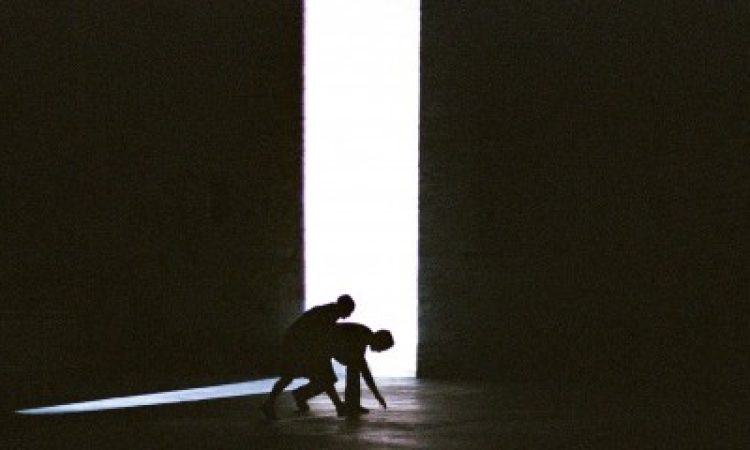
The darkened, stripped-down black-box at FringeArts was packed, except for an occasional empty seat here or there. Violinist Amandine Beyer entered, like a shade on the unlit stage, and played through the entire (except for a bit of the last movement) Partita No. 2 by J. S. Bach. Beyer is among today’s highest-level Baroque musicians, teaching at the renowned Schola Cantorum Basiliensis (Switzerland). She exited in darkness; then a bright shaft of light exposed the upstage right wall. Anne Teresa De Keersmaeker and Boris Charmatz entered from stage left, dressed in what appeared to be street clothes (by Anne-Catherine Kunz) and sneakers. De Keersmaeker is small, dark, mid-50s, utterly elegant in her deep commitment to each moment of presence on the stage. Charmatz is tall, fair, early 40s, relaxed, but with an air of contained power, like a purring engine. No music now, just the rhythmic slap of sneakers on ground, dancers breathing, occasionally humming.
I observed that the stage floor was marked with symmetric series of large white-chalk circles intersecting, overlapping, creating a geometric cosmos on the floor. The dancers skipped, did a stepping phrase in canon, walk-run-turn, jump, bend, hold, and melt. They danced together but also alone to their silent music in quiet phrases that were distinct for each dancer but rhythmically connected, observing cadences as they came to stillness.
I noticed that the light shaft was moving across the stage, toward center, then left. This caught them at one point as Charmatz supported De Keersmaeker to walk horizontally across the back wall. In the course of the chaconne, the work’s darkly beautiful closing movement, he paced in a circle around himself as she lay on the floor, her feet aslant against his, following with her “steps” every one of his, as she pivoted on her side along the floor, each in their planetary circle. And then she rose, he sank, and their circling roles reversed.
They exited downstage right, returned with Beyer, and repeated the entire dance with the entire music, together and through to the end. The hall was perfectly still in the course of this hour-plus performance, but after the quiet of the closing moment, we erupted into a hearty standing ovation. I experienced art as transformation: sound, space, and movement in absolute and austere harmony, a contemporary music of the spheres.
___
For other reflections on Partita 2, read Megan Bridge’s review here and Kat Sullivan’s ode here.
Twyla Tharp: 50th Anniversary Tour, Annenberg Center, Nov. 1, http://www.annenbergcenter.org/event/twyla-tharp
Partita 2, Anne Teresa De Keersmaeker and Boris Charmatz, FringeArts, Nov. 1, http://fringearts.com/event/partita-2/