Part 1 ended.
The end, but not the end.
I kept wanting a bow—an acknowledgement of my patronage.
Instead, I got a screaming Miguel Gutierrez asking me to leave.
Unsure if that was a part of the performance, I looked around nonplussed, while others awkwardly gathered their belongings and exited house left.
It felt personal.
Knowing that Part 2 was three days away, the offense I conjured was replaced with some amount of acceptance. I told myself that his insolent demand was more of an abortive way of ending a show that wasn’t really ending—that his outburst was an ellipsis.
That was the end of Part 1; this is the beginning.
A cavernous white box with pink strips of tape moving downstage from an apex housed the 43-year-old Gutierrez and his 24-year-old performance partner Mickey Mahar. They appeared to be warming up—preparing to offer up their physicality. Dressed in a pink women’s bathing suit and a horizontal stripe of pink across his eyes, Gutierrez was a meatier version of his pinched-framed partner, who was dressed in shorts and a t-shirt as if he were prepared for gym class.
The bass thumping house music directed them as they vogued in unison. From runway walks to duckwalks and tutting, the duo moved in unison—downstage, on the diagonal, and in circles.
Gutierrez added mundane gestures (finger snaps, crotch touching, wrist twisting, all done with a campy composition) to the duality of his appearance (male body, female attire). Media exposure has made these gestures, combined with their heightened peppy delivery, cultural shorthand for gay. Watching took me back to the darkened halls of club Twilo in New York City, where I witnessed pill popping, powder snorting, and alcohol consumption as aids for club-goers to keep dancing all night.
Where Gutierrez succeeds, at least in Part 1, is in deepening perspectives by adorning the male body in stereotypically specific female attire, colored in pink. The choreography is understood in terms of the physical body that dances it. The work, combined with the audience’s reception of it, brings about the questioning of gender norms.
Where Gutierrez fails is appearing to have cast a not-so-sound Mahar as a partner—he appeared slightly inexpert and was at times dead in the eyes. Ostensibly the background to Gutierrez’ foreground, some will say it was a duet. I would rebut that by pointing to the program notes: Gutierrez’s bio is a half-page proclamation, while Mahar’s credentials are consolidated into one sentence.
Framing his work in a pre-show oration, Gutierrez talked about getting older and being queer; I interpreted this as an exploration of queerness and where it intersected with age-inflected concerns such as achievements, failures, and insecurities. But it ended up looking more like a middle-aged man, physicalizing his queerness. It started tasting like a drink garnished with self-indulgence.
Age & Beauty Part 2: Asian Beauty @ the Werq Meeting or The Choreographer & Her Muse or &:@&, presented Gutierrez’s character in the same tulle-over-bathing-suit attire, and offered more pink—much more.
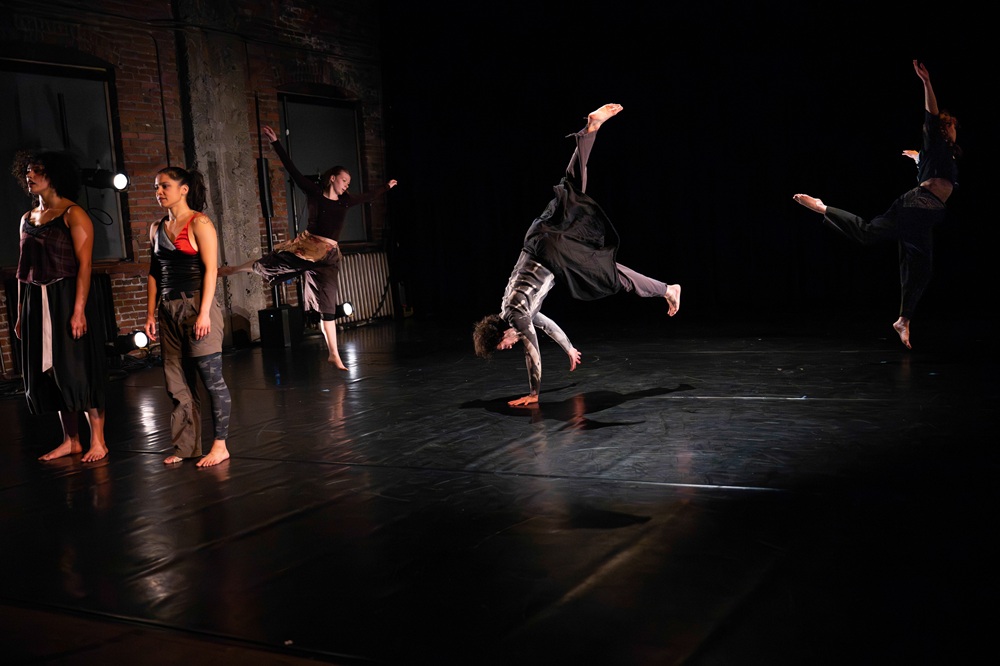
This part focused the relationship between Gutierrez (played by Jamie Maseda), his manager Thomas Benjamin Snapp Pryor (played by himself), and dancer Michelle Boulé. This relationship was unveiled at a rectangular table that was situated center stage, making it the focal point. Shifting from friendly banter to professional discourse, the dialogue between Gutierrez and his manager served as the metaphoric room Boulé would enter and leave. At one moment she lay on the table between both men, hiked her pelvis and lifted her torso before closing the laptop on the table by sitting on it. Animated, agile, and beautifully chaotic at times, Boulé effortlessly used her legs to slice through the air—sometimes with care, other times in frantic indifference. A moment of comedic discomfort showed Boulé on the floor, rigidly percussive while blindfolded and bound—shake, stop.
Set up to break the fourth wall, the audience eavesdropped on the meetings between Gutierrez and his manager, allowing us to become an extension of the work.
Entertaining as it was, I could not relate to Gutierrez’ middle-aged fantasy of a pink-induced drag-a-rama. I was glad to have seen it, but it left me unmoved.
Miguel Gutierrez, Age & Beauty Part 1: Mid-Career Artist/Suicide Note or &:-/, Age & Beauty Part 2: Asian Beauty @ the Werq Meeting or The Choreographer & Her Muse or &:@&, FringeArts, 140 N. Columbus Blvd., November 10 – 11, 13 – 14. www.fringearts.com