The Sundance Kid is Beautiful, Christopher Knowles’ performance, presented in tandem with a survey of his visual art at the Institute for Contemporary Art, brings us fully into his world, one that’s precise, repetitive, forthright, fantastical, and perhaps obsessive. His mind, affected by a diagnosis described as possible brain damage and/or being on the autism spectrum, works in ways that I can’t fathom. That’s part of what makes him so very interesting.
Knowles’ talent was recognized by theater director Robert Wilson when he was a teenager. In addition to providing text for and performing in many of Wilson’s signal works, the two artists are good friends. Wilson is seen on video in the installation giving a tender reading of some of Knowles’ looping, Gertrude Stein-like prose.
I shared a loft in the ’70s with an artist who also worked with Wilson, so met Knowles then. Seeing him perform now, I wanted to write him a letter:
Dear Christopher,
I loved watching your show. Are you the Sundance Kid? I think so. I think your performance shows us different ways in which you’re beautiful, and you seem to have quite a good time doing it.
You are a man now, not a boy any more. And this piece looks like one you have been doing for a long, long time, because there are pictures of you doing it when you were many years younger.
Still, there are things that remind me of childhood in your piece. They are playful, like Curious George is playful in your long text Curious George Goes to the Hospital. This isn’t in the performance, it’s in the installation, but it shares something with the performance. I remember this story from when my children were small. You tell it in your own way, repeating some things and skipping through others. Then at the very end you write, “And there was the piece that caused all the trouble. And now we can finish the puzzle!” Thank you for that sprightly ending.

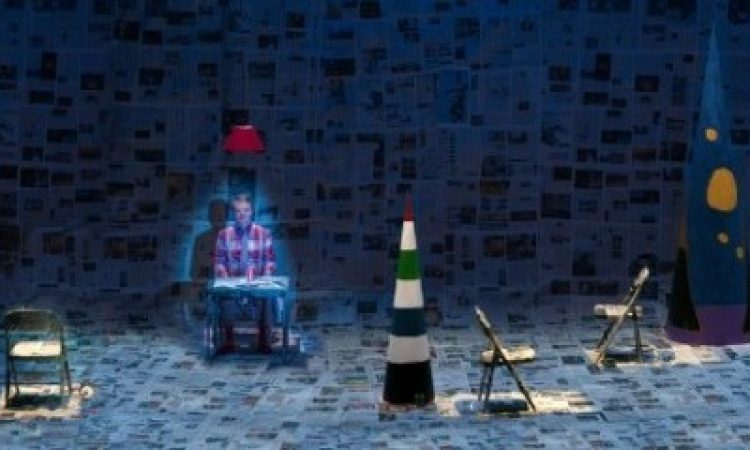
You surprise me! How great to cover those three tall walls of your performance area with the New York Times with one whole page that was red, and one whole page with the word NO in block letters. Then your cones. Tall, taller, tallest. Hand drawn—a self-portrait! Rainbow stripes! Alarm clock drawings! And alarm clocks everywhere. You wrote in one of your letters that Bob Wilson gave you an alarm clock for your birthday, so I guess you love them. They make a great sound, a little ominous, when many of them are ticking at the beginning of your performance.
It’s funny to see you stand and point at a cassette recorder before pressing “play.” You are still a lot. But your stillness is not nothing. It’s a time when we can be with the fullness of what might happen in this interesting room and with what we imagine you are thinking.
I wonder about it when you raise one arm as if in a Nazi salute. But then you raise the other arm and you become a sleepwalker!
I know the stage is a place for feeling alive in a very particular way. And the eyes of the audience can be marvelous. They concentrate the mind and they make sharing an image delightful. I see how you enjoy this.
When you spin I think about Andy DeGroat* and the Byrd Hoffman School of Byrds** and how spinning was part of what was done way back then. It’s also a way for you to be inside that intense rock song, with those words that keep repeating, “We can make each other happy.” You even lip synched them. I guess those words are ones you really want us to hear—that song even played twice.
You said:
“This is Chris is, this is Chris is, this is Chris is, this is Chris is…”
“Chris is this, Chris is this, Chris is this…”
Yes. That was you. Here is what I got from watching your performance: you love to repeat phrases, but then change them up and repeat them in the new way. You sometimes circle back to what you did before, and everything that happens piles up, one event on the next so you’ve left different kinds of marks and feelings on the space. You love clocks, and Coca Cola, and just being there. You are older, not a boy any more. You surprise me.
You invest more than 100% in whatever idea. And this is something I think is a difference between greater and lesser artists. You want “much of a muchness.”
I am glad that you showed this performance, and I’m grateful to the people at the ICA who invited you. Thank you, Christopher. I’m happy that you have shown your work around the world and continue to enjoy making and sharing it.
Yours truly,
Lisa
The Sundance Kid is Beautiful, Christopher Knowles, Institute for Contemporary Art, November 11-12. The visual art installation, Christopher Knowles: In a Word continues through December 27. http://icaphila.org/exhibitions/7472/christopher-knowles-in-a-word
*A choreographer who collaborated with Robert Wilson whose work included extended Sufi-style spinning.
** A cadre of performers living in an artist community formed by Robert Wilson in NY’s Soho. They took part in many of Wilson’s early productions.