In a pre-show greeting and acknowledgment, Group Motion’s executive and artistic director Manfred Fischbeck described EN-TRANCE as an entry point into works in progress. Fischbeck curated an eclectic program comprised of four short pieces. Each dance, distinct in theme and choreography, stood valiantly on its own merit and added to the collective Group Motion experience.
Da·Da·Dance Project choreographers and performers Guillermo Orgtega-Tanus and Eun Jung Choi explored the “intersection between our two bodies through both the senses and a mathematical structure” in their duet Where To. I found this program note puzzling because I saw very little connection between the dancers in the course of the work. While they held the same space on stage, they were doing their own individual movement with little relation to one another. They both danced wonderfully, with intricate phrases that suited their styles: Ortega-Tanus more pedestrian in his approach and Choi more technical. Maybe this was exactly their intent: to be physically together but emotionally separate.
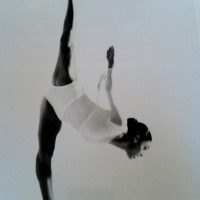
Solo Not Alone, a developing work choreographed and performed by Aura Fischbeck, quirkily revealed the insecurities of an isolated performer and her relationship with the audience. Running, sliding, and turning with a loose form, Fischbeck began the solo neatly moving across the space in a familiar postmodern style. The transformative shift in the work came when she stopped dancing and plainly stood facing front, fidgeting with her hands and torso as a self-conscious performer might do as she danced. Using comedic coping mechanisms such as making jokes, taking selfies, and singing an ’80s love ballad, Fischbeck examined her discomfort at being scrutinized by the audience. Humble and honest, Aura Fischbeck drew me into her world.
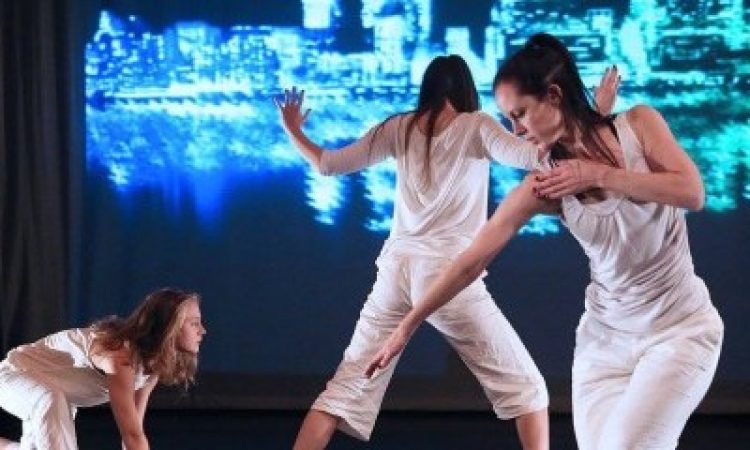
En-Trance, the work that gave this edition of Spiel Uhr its title, was written and directed by Manfred Fischbeck as a structured improvisation. This complex work included a video projection, a poem, and musical compositions by Andrea Clearfield, The Music Group of Philadelphia, Aphex Twin, and Fischbeck himself. Seven female dancers dressed in all white danced through a visual progression of natural elements into a nighttime cityscape. One of the women took leadership of the group and guided the dancers in both intent and choreography. The projection, developed by Fischbeck, added to the written script in the program notes by reiterating the shift from peaceful serenity to rough urbanity.
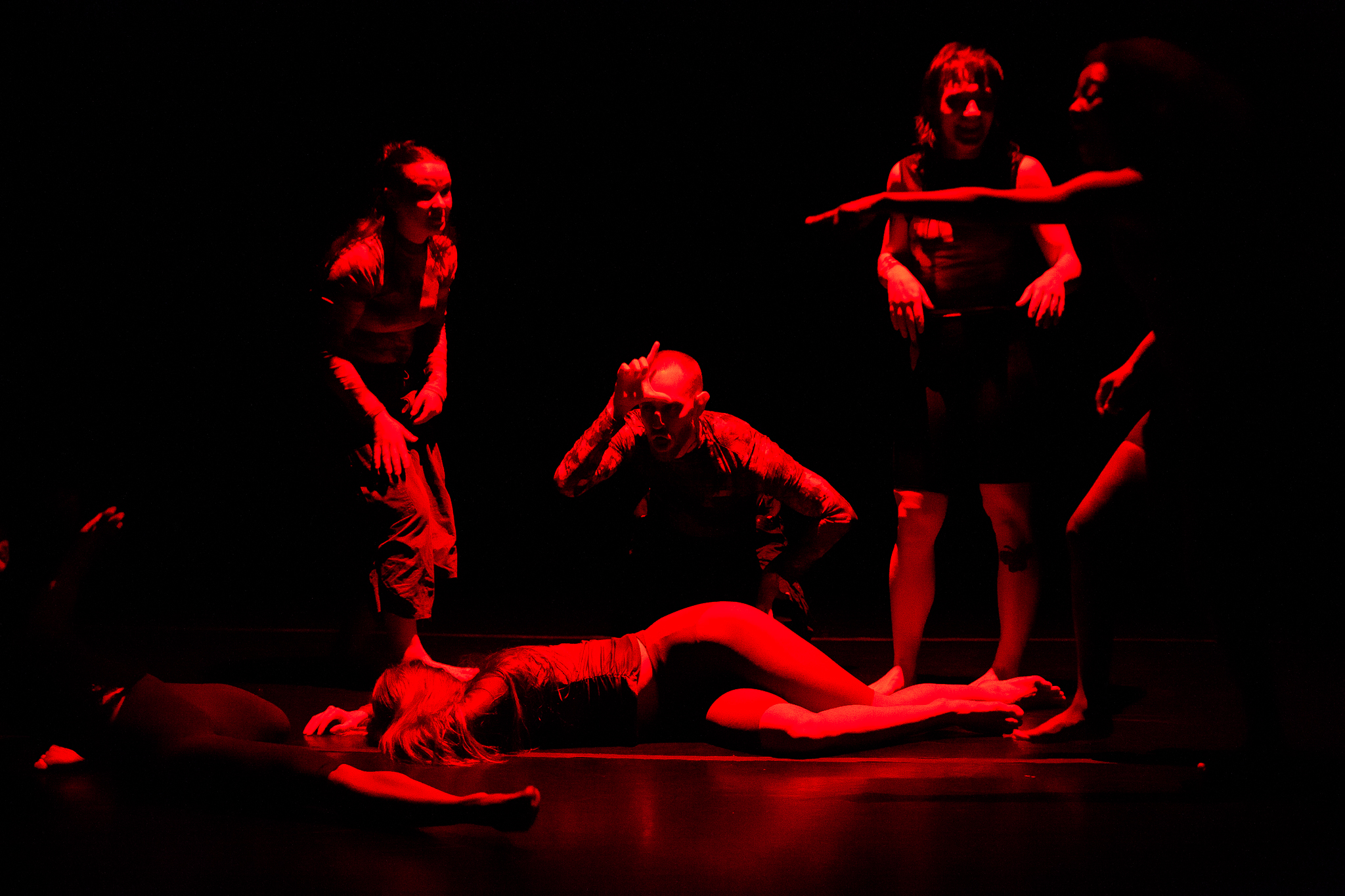
Shannon Murphy closed the program with Feet Amass. This was the only dance of the evening presented as “complete.” The casually dressed cast of five journeyed from intense relationships into moments of playfulness, ending in a heavy-breathing supportive grouping with the four women holding the lone man as he collapsed in fatigue. Steve Surgalski’s dynamic music added to the driving rhythm of the visually and physically aggressive choreography: slides to the floor, high jumps, and weighty lunges. Murphy describes this piece in the program notes as “a physical representation of how special a moment of harmony or UNISON can be.” Yet I witnessed more individuality than collectivity in this work. The dancers were on stage together performing either different choreography or the same phrase at different times.
All but one of these works was advertised in the program and in Fishbeck’s opening remarks as “works in progress.” But because they appeared to me completed, I had to remind myself that these were not all finished dances. I am curious about where these chorographers will take their creations. How much will change? —or stay the same?
Speil Uhr Fall 2015: EN-TRANCE, Group Motion, Community Education Center, Nov. 21-22