Listen to the full article here.
Choreographer Joanna Kotze’s this is the beginning, this is the end begins without warning and without dancing.
Eight performers march onstage. Two of them (musicians Ryan Seaton and Maralie Armstrong-Rial) occupy themselves in front of two separate sound decks, hitting buttons to activate heavy pre-programmed synths and loud electronic drums, layering high-pitched vocals and distorted guitar in real time. Meanwhile, the others (Kotze, along with Lena Engelstein, Wendell Gray II, Molly Heller, Symara Sarai, and Hsiao-Jou Tang) rearrange waist-high metal fences. They place them, stand motionless for a moment, then move the objects again. As the wall of sound continues, the dancers keep moving the metal barriers, pieces of an unfinished maze. Just as a pattern becomes legible, it is discarded for a new one. Repeat.
When the music does eventually stop, the silence is loud. Tang is now alone in the far corner, suspended on the balls of her feet with her arms extended shoulder-height; she looks at the audience, perhaps to make sure we are paying attention. She crouches low while circling her head with one arm, and then slides backwards along the floor on her left side.
Kotze re-enters, and immediately goes to where Tang started a few minutes ago. The choreographer repeats her dancer’s phrase, move for move. The two interpretations are slightly different, but there’s a satisfaction in recognizing the same vocabulary and getting to see it anew. Two dancers, one movement phrase, staggered in time, using the same material to create something different.
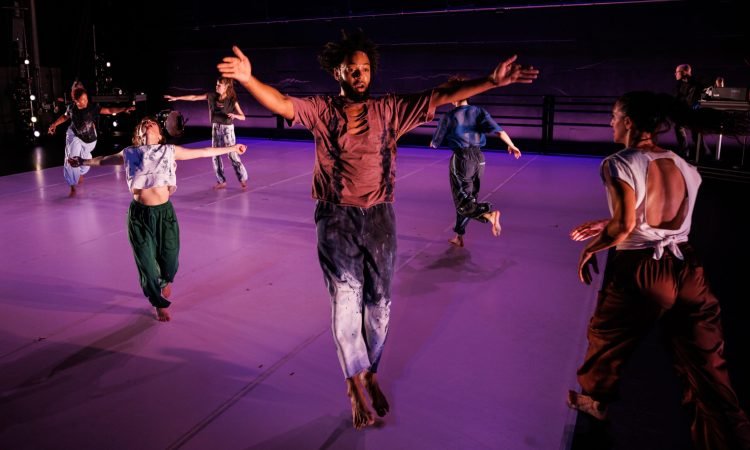
Then Engelstein returns onstage, assuming that same spot Kotze and Tang occupied earlier. Is Kotze investigating how history repeats itself? As it unfolds, the movement language of this is the beginning, this is the end appears quirky and idiosyncratic. A dancer swivels a hip, executes a tiny ripple through the spine, then walks determinedly forward. Another kicks an extended leg high, the foot thudding onto the floor. One drapes their bent arms languidly over their skull. Each dancer’s focus is deep, intent on their own extensive movement pathway, each person adding to the intricate pattern of the whole. Echoes of the original phrase flash in and out of recognition, but the trio has made it more complex, as well as more fun.
The musicians remain poised in the wings. The silence lengthens, and in it my awareness of the layers of detail grows.
But then the rules change once more. Blocks of sound reappear in the second half of this is the beginning, this is the end, forming new connections between what is seen and what is heard. Passages of sound and silence alternate as all six dancers reappear at the downstage corner, stepping forward while stabbing the air with an extended arm in front of them before turning around. They do the same movement, over and over, but are out of sync, creating discordant unison.
There’s something compelling about seeing a body work in a state of intense physicality. Kotze keeps everyone moving in prolonged repetition, their skin glistening with sweat, their muscles pushed to new limits. And then they explode into chaos, moving throughout the space in unfamiliar patterns and embodying new phrases. Sometimes I glimpsed brief references to the original movement phrase, but the quality and environment have evolved so dramatically that the images that I remember seem like they came from another dimension.
Seaton and Armstrong-Rial’s powerful soundscore might be too loud for some (NYLA offers free earplugs to audience members at the door), but I found it transcendent. Kotze’s dancers move with greater abandon through the space in this world of dense sound. At one point, the dancers literally climb the walls around the audience and step over chairs to re-enter the stage. Even when they hold still, their bodies contorted forward, lying on the floor, standing on inverted legs, the pulse of their hearts and the waves of their breath are still felt, as if the dancers’ inner energy is barely contained.
Inside Kotze’s dynamic artistic vision, patterns exist everywhere. By the time this is the beginning, this is the end reaches its moving conclusion, simplified binaries dissolve. Intuitive connections are traced between stillness and motion, silence and sound, individuality and repetition, emotion and intellect. The dance ends as it began, without warning, but it keeps moving with you long after you leave the theater.
this is the beginning, this is the end, Joanna Kotze in collaboration with the performers, New York Live Arts, November 6-7 & 11-14.