The audience slowly files into EMP Collective, a multi-use arts and performance space near Baltimore’s Inner Harbor. After walking through a mass of caution tape, we find spots on the floor around the bed in the middle of the dimly lit space populated with campy relics of evil—plastic skulls, an unidentified bone that looks real, incense. Tutus hang on the wall; a ballet barre is at an angle in the corner. We are in someone’s dark, winking headspace.
The room silences itself as Alex D’Agostino, EMP resident artist and creator of The Swan: A Serial Killer Ballet, enters. Wearing a doll mask and layers of yellowed petticoats, he arrives with jabbing bourrées, his long, dirty ponytail trailing along the floor. He holds a length of chain attached to a glass and metal star that drags across the hardwoods. The image is total and arresting, straight out of some unholy communion of Pan’s Labyrinth and The Cell.
The being—what else could we call him in this moment?—undresses to reveal our partially-nude protagonist, who promptly opens the star and fishes out a bloody rubber phallus. He tosses it into a pile of clothespins and starts speaking as if nothing is out of the ordinary. We are in his bedroom, after all. Over the course of the night we will see two murders, submissive bootlicking, and a massive severed swan head. And while it’s dubbed a serial killer ballet, The Swan is more a monologue-driven work of performance art. It is dark, arch storytelling.
D’Agostino, now in a jock strap, offers cookies and explains his process of taking a good photo for Grindr, his medium for finding victims: selfie sticks are helpful; consider carefully the amount of perineum shown.
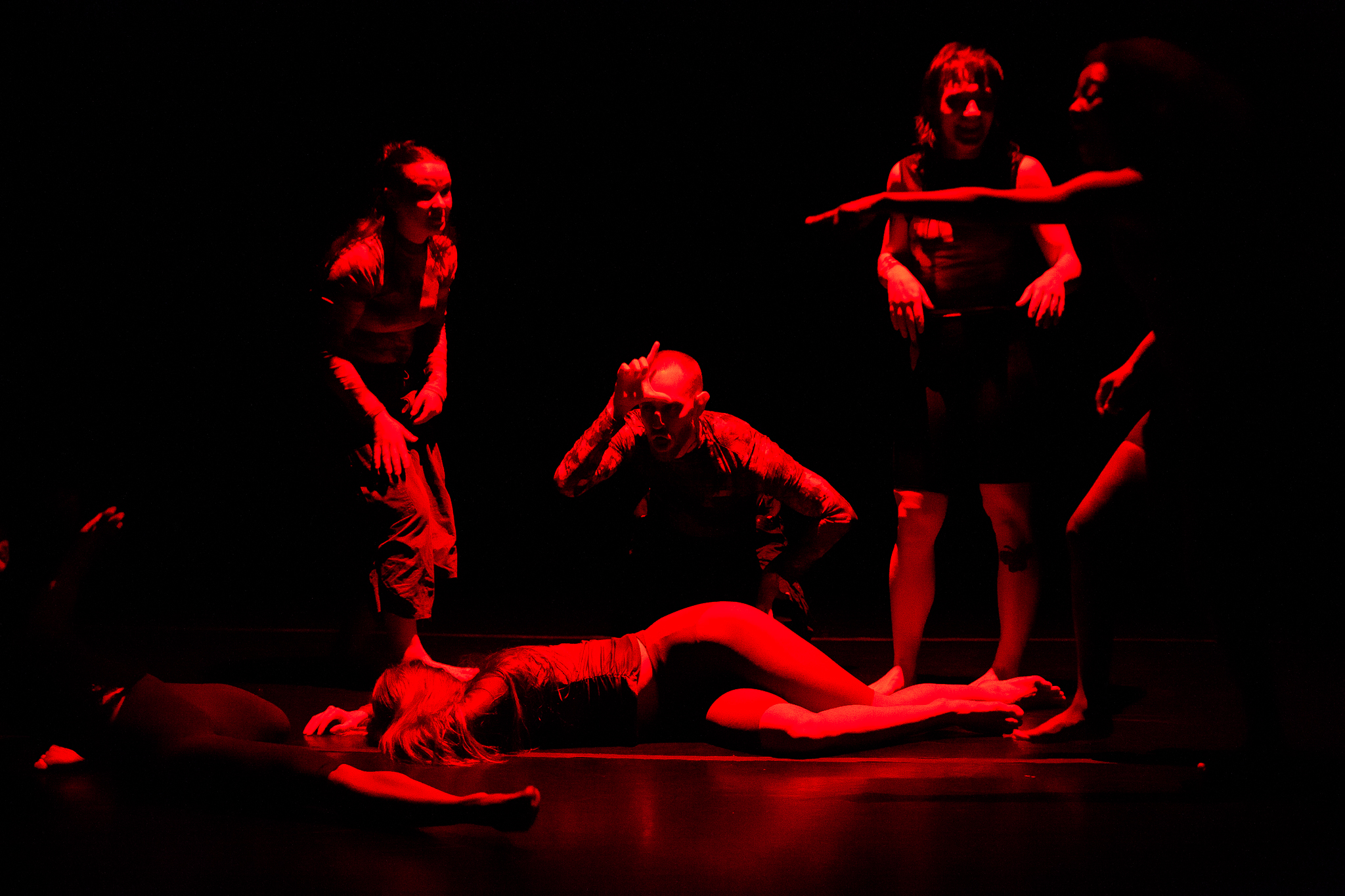
Victim 1 comes over. He billed himself as “discreet” in his profile. And D’Agostino, mocking and threatening, throws the word back at him as the two start having sex. Smoothly and efficiently, Victim 1 is poisoned via a cookie, his penis removed with a knife. It’s disconcerting: the murder scene unfolds ten feet from your face; you can see individual body hairs matted with blood and hear every breath. This is camp, but it’s also visceral.
“The closet of sexualities that don’t fit into a heteronormative are always evolving and adapting,” D’Agostino said in an email conversation. “Queer survival if you will. So in thinking about this, and reading Men, Women, and Chain Saws: Gender in the Modern Horror Film, I started to craft the story of a radical queer activist who used Craigslist to seduce and kill men he felt were halting the progress of LGBT persons by hiding in discretion.”
The audience is led into a second room draped in black tarp with a large wooden altar on one end. D’Agostino’s monologue continues and we are brought deeper into his motives. He recounts violence from his youth— witnessing a man behead a swan; seeing queer kids ridiculed and assaulted—and underlying his story is a deep, violent anger that finds purchase with his next target. Victim 2 calls him a sissy during submissive roleplay, enraging him. D’Agostino tracks him down offstage and cuts his penis off, leading to terrifyingly real screams. Another trophy is thrown across the room in pique.
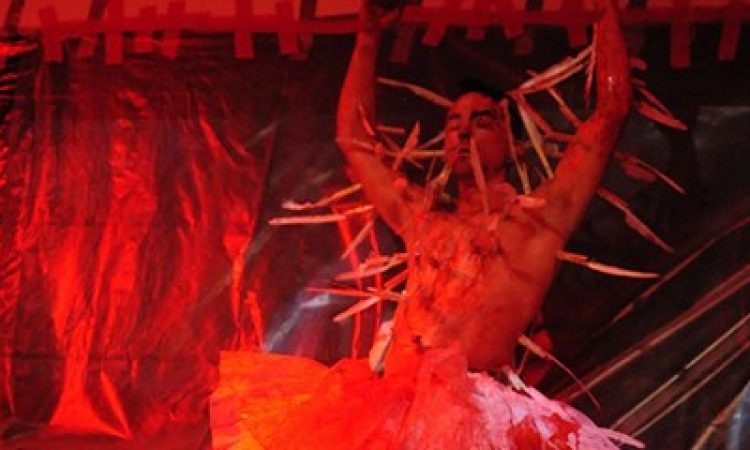
The Swan is a packed linear progression that occasionally speeds past resonant moments and images. Shock and subversion have the edge over contemplation. While some of the themes of gender and sexuality could have used a little breathing room, the scale of the work is audacious and at times beautiful in its terror. The visual impact from the beginning is repeated near the end as audience members are invited to attach clothespins to D’Agostino’s near naked body. With a feather glued on each pin and real-world sirens screaming outside, a bloodied figure—half swan, half St. Sebastian—emerges in grotesque triumph.
The Swan: A Serial Killer Ballet, Alex D’Agostino, EMP Collective, Baltimore, MD. Dec. 12-13, Empcollective.org