At lights up I check The Kitchen program notes to verify the title of Tere O’Connor’s latest work and surprisingly acknowledge my unintentional exchange of a vowel and a consonant. Seconds later I declare the error fortuitous, for The Goodbye Studies, true title of O’Connor’s latest delving into movement and its possible complexities, is also about making Stories. Akin to repeating a word, sound, or phlegmatic gesture until multiple meanings surface, Tere O’Connor’s persistent probing of time, space, and action yields material rich enough to invoke narrative. Through cleverly plotted play with gesture, posture, attitude, sound, and movement, the scene before us fills with clues and propositions that encourage all watching to connect the dots as they see fit or, at the very least, to wonder at it all.
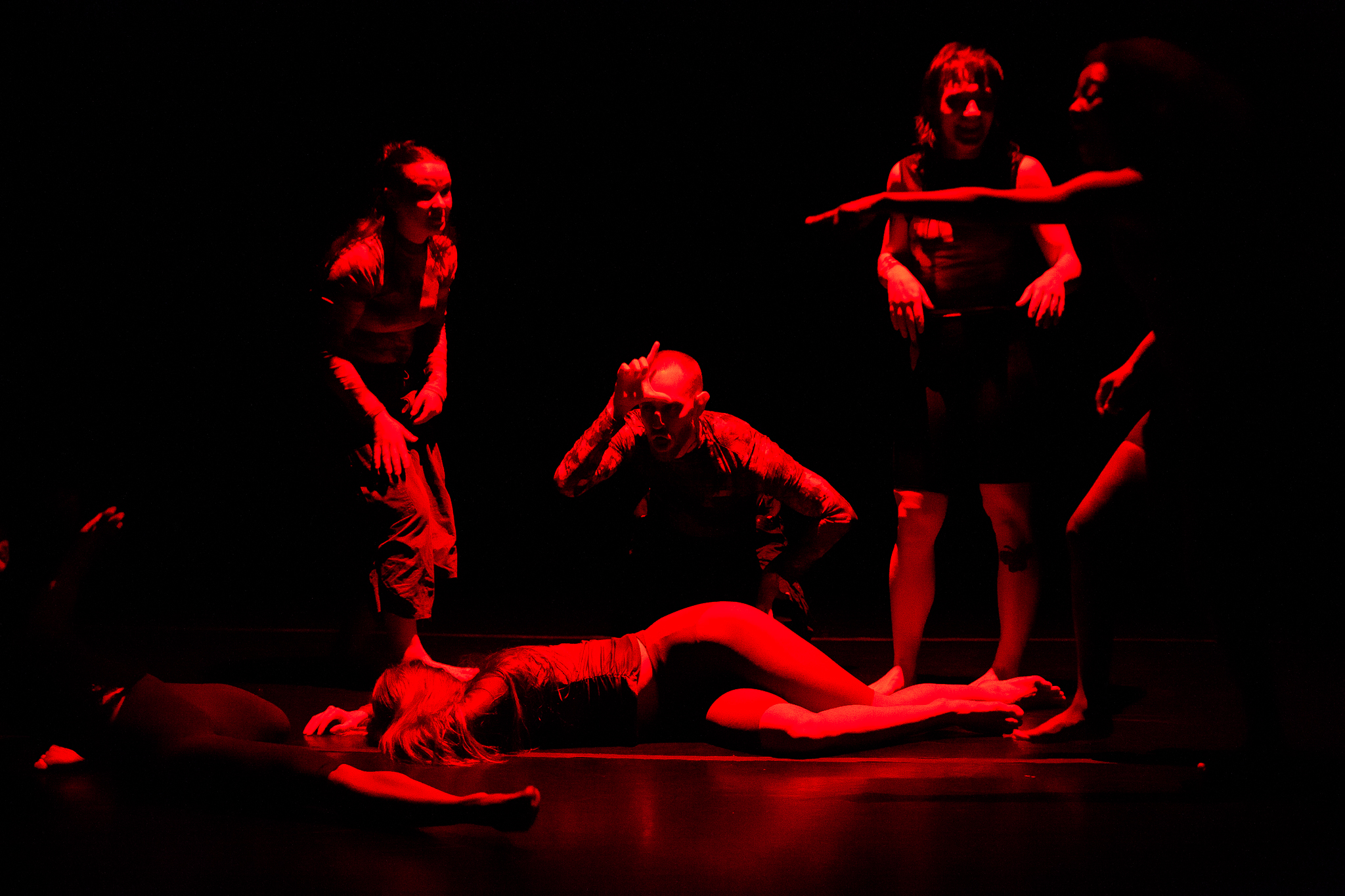
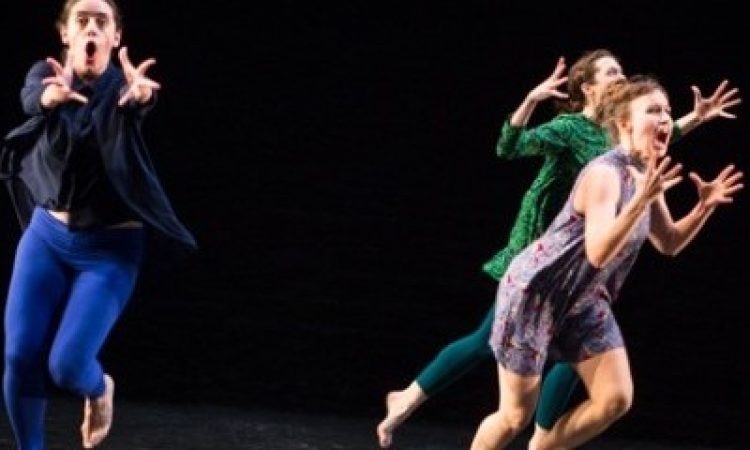
The Goodbye Studies opens with twelve exceptionally able and diversely-built dancers making their way into the performance space first one by one, then a few at a time. It’s a slow build as they walk, stop, and gaze toward the public, each in their own way. The scene’s simplicity adds an uncanny edge, urging viewers toward a state of hyperawareness, a preparation for expecting the unexpected. Slight modifications in gait—straight walk to limp, trot, or run—create considerable variation in the shape and intensity of all action. Swiftly moving dancers suddenly freeze, then dramatically change body posture in reaction to some invisible, compelling incident, and a different “story” erupts. One dancer stomps his foot and others follow suit; from the rhythm and sound O’Connor’s deft movers doggedly conjure up a new place. Intermittent sound collages, be it church bells, an Italian dialogue, or sounds of spring, add layers of clues pointing in all possible directions.
O’Connor has long embraced the notion of “meaning” as a collaborative, mobile, and fluid relationship among creator, performer, and viewer, embracing the personal and shared experiential realities of all three. This new work clearly illustrates his fierce determination and choice to investigate movement and space in the biggest and smallest of ways and perhaps, in the process, to discover what situations these two elements themselves might invoke or suggest. Acquiescing to our ineluctable propensity for “making sense” of things, O’Connor focuses on exercising and at times exhausting the movement itself, leaving the storytelling, if any, to us. He skillfully mingles codified, formal dance vocabulary—high-speed petit battement and grand jeté variations—with gestures, posturing, and attitude à go-go—grimaces transformed into idyllic, seemingly drug-induced smiles. The chance and circumstance of the human experience wiggle their way forth to tickle the memory, jostle and jolt the senses, soften or harden the heart.
O’Connor’s notably individualistic dancers weave phrases and construct situations that continually emerge or dissolve. Disparate activities—a body rolling along the floor, for instance, while all others execute a series of steps toward a distant diagonal—somehow create spatial relationship and in some wonderfully unfingerable way tell or remind us of a lived experience. I watch, listen, take it all in, and think to myself, “Isn’t this how life happens?”
Where does The Goodbye Studies end? How does it all finish? In infinitely different places. I can only speak for myself: in the spirit of the dance, I acknowledge and embrace my participation in the “making sense of it” by allowing all of O’Connor’s inklings and triggers to lead me toward not beginning-to-end stories, mind you, but to doors provokingly opened, then torn asunder in both body and soul.
The Goodbye Studies, Tere O’Connor, The Kitchen, NYC, December 2-12, 2015.