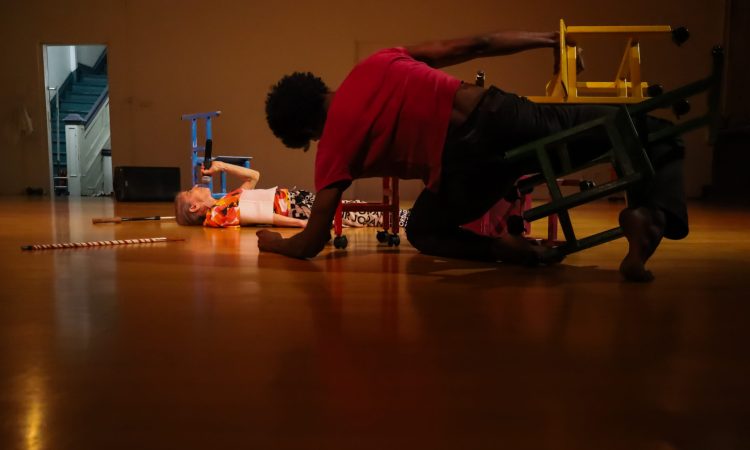
One night, multimedia artist and curator Cathy Weis declared Simone Forti “the best-kept secret in New York City” while standing in front of an audience packed into a hodgepodge of mismatched chairs. The following week, she did so while rolling around on the floor with David Guzman in a slow Contact-y duet as Zo Williams framed them with tiny chairs–first a line, then a half circle–before piling them on top of their moving bodies.
Such playful irreverence and warm informality infused Sundays on Broadway, an experimental platform for downtown dance artists to perform new and unconventional work held in Forti’s loft at 537 Broadway in Soho. For three out of the four weekends of the series, we huffed up three steep flights of stairs into a bright open dance space where the community vibe was palpable. Daniel Lepkoff handed everyone a fan on the way in, and we sat next to Ishmael Houston-Jones and Sally Silvers as Guzman got in place to live-stream the performance to Forti in California. In its 12th year, Sundays was a quiet rebellion against the rampant capitalism and greed infecting America–a chance for dancers to explore without the pressure to emphasize their marketability and commercial viability.
With this series, Weis argued that creative “messing around” was in the walls, going back to 1868 and PT Barnum, whose American Museum was once here. She explicitly connected Forti with George Maciunas, the founder of Fluxus, who purchased 16 buildings, including this one, in Soho back in 1976. “I don’t know how he did that,” Weis confessed impishly. “The guy never had a spare nickel.” But for Forti and her postmodern peers—David Gordon, Lucinda Childs, Yoshi Wada, among many others—having a large open space to live and work in (that was cheap) proved critical to forming new ways of making and presenting work. As choreographer Trisha Brown said: “What was great about this place back then was that you could do whatever you could imagine.”
The artists Weis selected represented multiple generations and backgrounds, suggesting that being a “downtown artist” is ultimately a state of mind. Some pieces felt like sketches, while others were more fully realized; yet precision and craft held throughout, whether the work was improvised, choreographed, or somewhere in between. Some dancers spoke, and some used projections; some invited the audience to participate by singing, speaking, or spanking another performer on the butt with a mic stand. Each night at the loft was a surprise.
The first Sunday crystallized the notion of lineage. Three dance videos from Forti were screened onto the wall, including a solo from the ’80s at Dance Theater Workshop (now New York Live Arts), and another filmed more recently along the Southern California coast. Forti danced like she was drawing into the air and on every surface around her. She transformed and manipulated stacks of newspapers: reading them, standing on them, covering herself with them like a blanket, protecting them from the incoming tide. In one film, she spoke to a puppet before giving it a voice. In all of them, Forti (who turned 91 in March) was always unequivocally herself, asking questions or making jokes, then hopscotching from one topic to the next. Her repetitive phrases and self-interrupting stutters created a trip and ripple cadence to her effortless movement. In one film she said, “It’s all right. We’re all right,” while unfolding a canvas and extending a tilted, gentle squirm into the air above her. Just as she improvised movement with her body, Forti invented fresh ways of capturing her racing thoughts.
This sense of capture has been a feature of the New York downtown dance scene for decades. Beginning in the 1960s, the postmoderns removed showmanship from dance and interrogated the meaning of virtuosity, at least in the strict or more traditional sense. Instead of feeling obligated to forward presentations of their work, their work played with the fourth wall and deconstructed theatrical artifice. Dancers mumbled and wandered around, improvised as well as executed choreography, and played with objects and repetitions. New methods of generating movement were born, and even where dance could occur was questioned (see Brown’s dancers walking down the sides of buildings). Dance was remade inside the studio loft because play and discovery reigned.
Were all of these postmodern experiments “good”? No. It’s easy to romanticize Soho and idolize the 1970s, but we don’t need to. That’s the tension with this history and in these spaces. What we should still lift up, perhaps, is the essence of the approach to process, to create environments for serious play to happen more often today.
Following the three videos was a live solo by KJ Holmes, who also brought out a stack of newspapers, perhaps signaling her relationship with Forti (the two danced together for many years). Holmes’ solo embodied significant outrage at the current world’s political climate, making her dance feel both personal and universal. Her piece also expressed a lot of gratitude and humility for her mentor, especially when she improvised to a vocal soundtrack Forti had recorded. By the end, we all heartedly obliged Holmes to conduct us in singing along with Forti’s “Al Di La.” We sang with Simone, and for Simone; Holmes’s solo went from a duet with her mentor to a group piece that all of us could participate in.
Another essence of this downtown scene worth noting is beginnings. Weis talked about Forti and the Fluxus artists in a manner that reminded us of the Beat generation: artists who all know each other, pulling from a similar well of ideas; and while each expressed their art differently, they all seemed attuned to the same vibe. “Downtown dance” may be uneven, but its myth retains an attractive Eden-esque quality. What is the purpose of this mythology? Why keep it alive? Just as the hippies built upon some things from Kerouac, Ginsberg, and the other Beats, so too are we cherry-picking what matters to us from the past to build our present vocabulary.
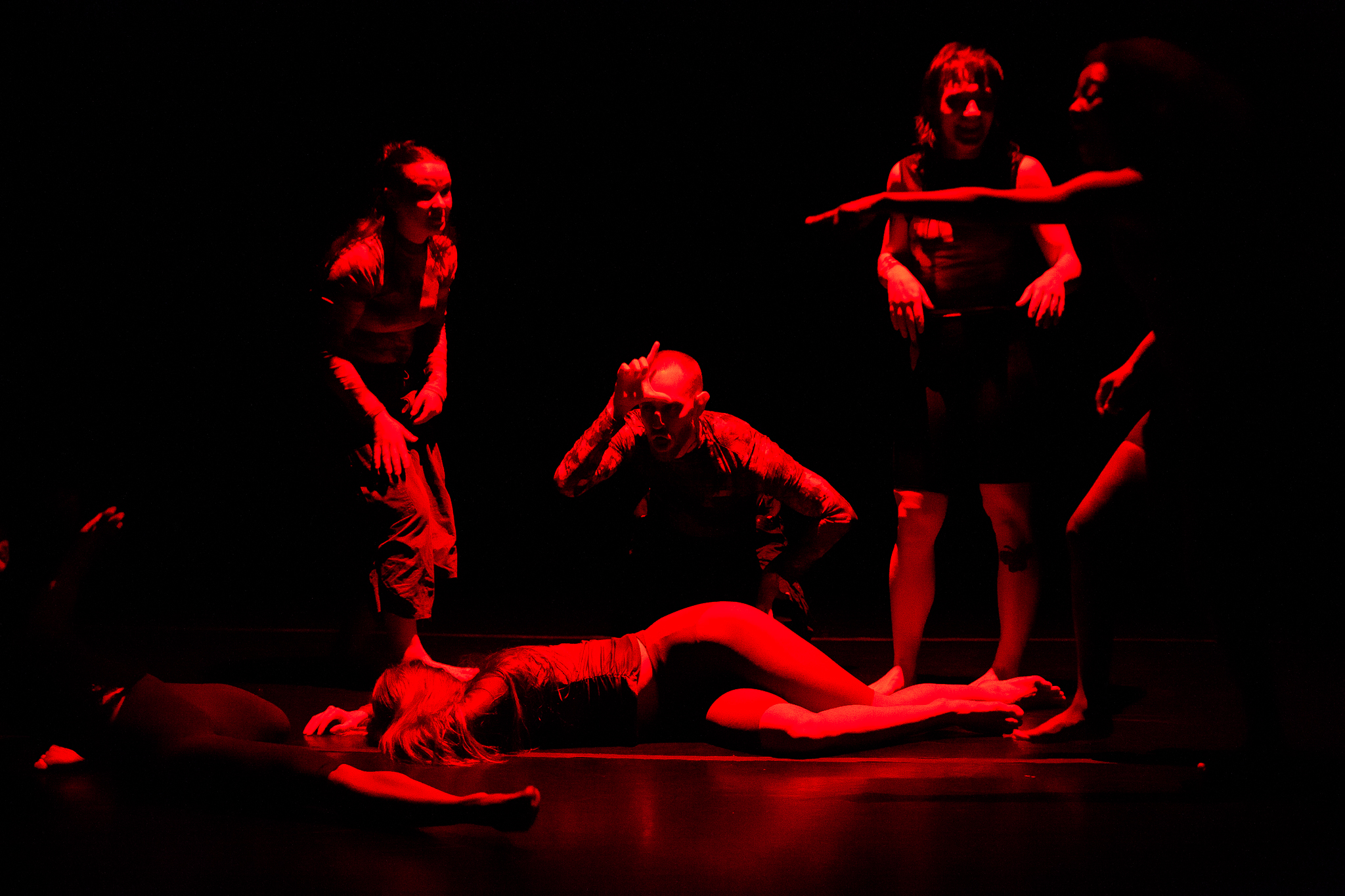
One exciting example of a more finished work was Leave Me Alone, a commission performed by Sondra Loring to choreography by Stephen Petronio, his first piece since closing his company at Jacob’s Pillow last summer. His work is most often seen on younger dancers, so to witness his signature lyricism fully inhabited by one of his peers was electric. Petronio’s movement vocabulary was densely packed with sculptural elegance. Loring evoked Achilles on the battlefield, cradling a slain lover, and later with both arms raised above her head, she echoed the sensual vulnerability of St. Sebastian impaled by a volley of arrows. Melancholia infused and enriched this piece.
The essence here is evocation. Perhaps we can look at the way art has passed down images to itself from earlier sections culled from its total life span–dancers in a Soho loft in 2026 can reach back to the inspirations and histories of older dancers, and then go even further back from there. This method–of pulling from and referring to–is vital information for current makers on process, and why studying the greats of the past can ignite new pathways in the present.
Other works in the Sundays felt less polished or fully fleshed out, yet still showcased clever ideas and artistic intentions. Fabio Tavares’s wry I Wish I Was a Thundercat blended physical theatre with unusual spoken text. Within each of the solo’s three parts, he limited himself to a specific number of movement patterns. The results were gently humorous. In contrast, the jokes in the work-in-progress by Alex Tatarsky had more bite. A clown whose work also draws from performance art, at one point she mused that “landlords are the greatest conceptual artists” (because they own buildings with rent so high no one can afford to live there). Her observation was one that any New Yorker could laugh at in grim recognition.
Some pieces seemed to be in an exploratory phase of development. Amelia Heintzelman appeared to be researching the clumsy elegance of combining wrestling with Contact Improvisation in her duet. She mic’d up the floor to amplify and distort the sound of each fall, grunt, and exhalation, but that was about it. The piece plateaued, as if refusing to do anything further. Similarly, Luis Lara Malvacias’s work was an assemblage of multiple disjointed moments. A jagged crown and a giant plastic ribbon concealed his body while startling images and words were projected onto the wall and ceiling. We weren’t sure what he was attempting to communicate, but glimpsing the concepts felt like the priority here.
When artists and audiences alike sink into this “process over product” format, along with the inherent dialogue between the pieces, we have something more powerful to experience than a 30-second video on social media. Yes, that post may garner a lot of “likes,” but does it feed into the larger zeitgeist?
Perhaps the desire to untether public showing from commodity and to trade “complete” for “ready enough” is what drives Sundays on Broadway as a series. Weis purchased the loft from Forti in 2005 so that it “stays in the dance community.” And this kind of performance work–unfinished, informal, often improvised, and/or frequently defying categorization–is a welcome balm to the New York scene of 2026. Sure, there’s some mythologizing about what it was like to be making work in the 1970s, but one thing is clear: we need more places like Forti’s, more people like Cathy Weis.
Maybe all mythologies are just stylized ways of passing down how to build something that can hold your moment up. Or maybe we’re overanalyzing the simple act of climbing a few flights of stairs, taking off our shoes, and sitting on the floor.
Sundays on Broadway, Curated by Cathy Weis with David Guzman and Zo Williams, 537 Broadway, 3rd floor, April 19 & 26, May 3 & 17, 2026.
* On 9/30/2026, a correction was made to when and how Weis procured the loft. – editor