Artistic Director Angel Corella reveals his distinct vision for Pennsylvania Ballet in the mixed-bill shows he’s programmed for 2015-16, his first season choosing works for the company. In October, he surrounded George Balanchine’s Concerto Barocco (1940) with ballets by two of today’s hot choreographers, Wayne McGregor and Christopher Wheeldon. For the current program, he capped off the line-up of Nacho Duato, Justin Peck, and Wheeldon with Jerome Robbins’s New York Export: Opus Jazz (1958). In each of these programs, the established masters—Balanchine and Robbins—reminded the audience of where and how the innovations of later generations took root, and of how deftly new balletic material can be interwoven with the dance form’s core principles and values.
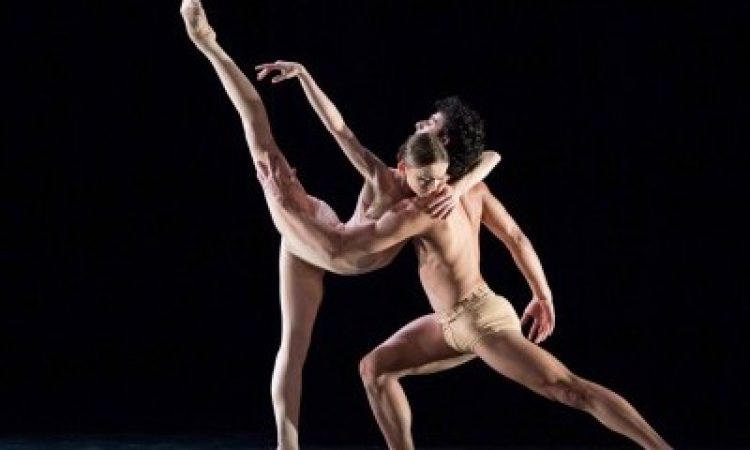
Duato comes from the Jiří Kylián school of European modern ballet. Having become a Kylián fan while living in the Netherlands, I’m predisposed to enjoy the luscious longing and poignant pathos of this kind of work. For music, Duato chose a series of Schubert songs, reduced to cello-piano renditions—thus, the work’s title, Without Words (1998). But the musical sameness gave a mournful tone to the entire ballet, further flattened by the dominant use of the male-female pas de deux, organized by various pairings of the eight dancers. No one duet seemed particularly different from another, although I appreciated the primer in partnering Duato provided here. Each duet was clearly difficult to execute, with unusual holds, rising and falling from air to floor, and precarious counter-tensions. The similarities among these pas de deux was broken, in the end, by the stunningly seamless pairing of Oksana Maslova and Arian Molina Soca, who melted together, rebounded, and recoiled with an etched emotional clarity that matched their physical prowess. Theirs is a promising partnership.
Chutes and Ladders (2013), a company premiere, brings the work of the young Justin Peck, resident choreographer for New York City Ballet, to PAB’s stage. Alexandra Hughes and Ian Hussey’s playful duet, to a string quartet by Benjamin Britten, showed Peck’s take on the pas de deux—a friendly, attentive, here-and-now elegance that embraced the dancers, the audience, and the musicians who performed on stage with Hughes and Hussey. This was a dance about people dancing, and enjoying it.
A technical highpoint of the evening was Christopher Wheeldon’s For Four, originally (2006) set on four male virtuosi from around the world, including Corella. Setting this work on four PAB men set the bar high, and they met it. All danced beautifully, but distinctly. Principal Jermel Johnson was the long-limbed danseur noble of the quartet, while corps members Andrew Daly and Amir Yogev displayed their distinct strengths: Daly through his etched use of space, turns, and extensions, and Yogev in his leaps and poised presence. Peter Weil, listed in the program as an apprentice, was stunning in his spitfire beats and spins. What I most appreciated about this clearly bravura piece—also set to Schubert (Death and the Maiden) and played by a string quartet, this time from the pit—was that Wheeldon took it seriously as choreography. The men’s performances were captivating, the steps were hard and showy, but the work was intricately, richly, yet clearly laid out, respecting the ballet’s integrity and resisting blatant appeals for audience applause.
The quality of the evening’s choreography culminated with Robbins’s 1958 masterpiece. If you know and love West Side Story, you’ll also love New York Export: Opus Jazz, with its familiar ranks of sneaker-clad teenagers showing off amid backdrops of television antennas, roof pipes, playground fences, and graffiti. His deft intermixing of popular dance, jazz, and ballet includes finger-snapping, hip swivels, swing-dancing, flirtation, flinging, flaunting, and a lot of fun. The dancers were radiant, throwing themselves into the party with both precision and play. The central duet, by husband-wife pair Lauren Fadeley and Francis Veyette, was a grounding, if dark, reminder that youth has its very real heart aches, but the closing group dance brought back the pizzazz and power of young people buoyantly pouring their souls out in dance.
Pennsylvania Ballet, Merriam Theater, February 4-7, https://www.paballet.org/upcoming-programs