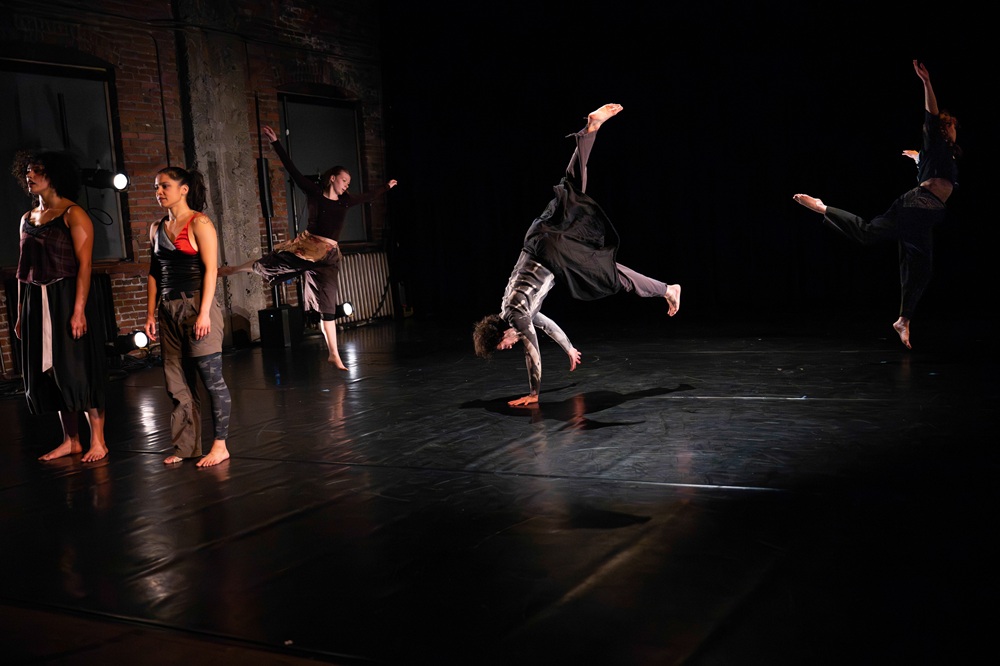
A surprisingly large number of duets I have seen follow a tired and predictable form: male/female; stock partnering; his strength, her grace; vague, overwrought, and clichéd romantic affect. So it was with some trepidation that I attended Evening of Duets, an annual event curated and produced by Melissa Chisena, which features accomplished local and regional choreographers. This year included 11 duets, eight of which were male/female. None were male/male. A few lived up to my fears. But in spite of this imbalance and a bit of cliché, the evening was diverse in style, thematic content, and approach to the duet form.
In Angie Moon Dance Theatre’s Stockholm the dancers’ energy and focus are directed towards each other. The piece utilizes a conversational rhythm and a series of gestures that seem communicative, but defy explicit interpretation in their oddity and abstraction. In contrast, “the antidote” by Malayaworks provides a more interpretable theatricality, though much of the content serves to highlight the performers’ virtuosity rather than developing their characters or relationship. Jessica C. Warchal-King’s Unspoken includes a recurring image of one dancer looking searchingly at the audience and mouthing words, while the other dances in the background. Rather than portraying a relationship, the dancers highlight and illuminate each other, but seem to exist in different realms.
Initiate, by Tara Madsen Robbins, is a male/female duet, but the dancers are closely matched in physical size and in the athletic execution of pulsing isolations and circular Capoeira-like inversions. Emphasis is on tight unison and intricate counterpoint, rather than a narrative relationship between the dancers.
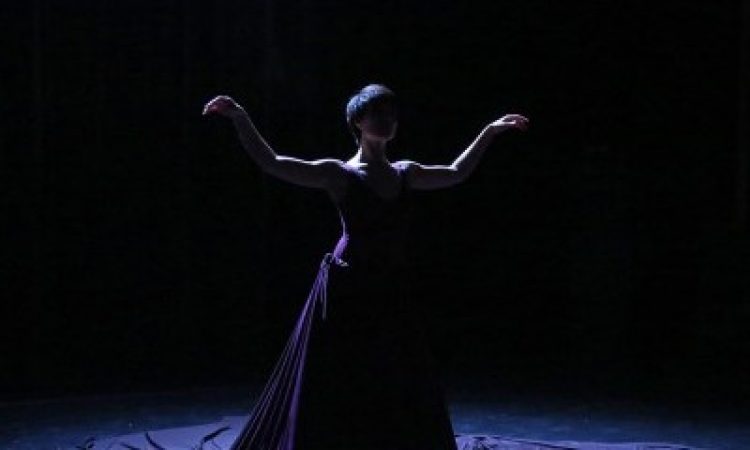
Both Melissa Chisena’s Entangle and Almanac Dance Theater’s Fountain Pedaling use partnering to create illusion. In Entangle, Chisena and Marie Brown remain back to back in a huge skirt that flows across the stage. They manipulate the skirt and support each other to create striking and fantastical images. Fountain Pedaling has an entertaining and intriguing sci-fi/fantasy feel and uses acrobatic partnering to suspend reality.
Conversations, by Brandi Ou Dance, is a refreshing take on the romantic duet, pairing physical intensity with the casual comfort of long-term intimacy. Brief and softly spoken conversation, resembling pillow talk in its tone and content, punctuates the dancing. Casual costuming (both dancers wear loose pants and tee shirts) and earnest, straightforward delivery makes this piece feel more true-to-life than many of the more stylized and formal presentations.
The final duet, Falling in Fancy Clothes, by Meredith Stapleton and Joseph Ahmed, leaves me thoroughly satisfied with the evening as a study of the duet form. Stapleton and Ahmed interact in recognizable, human ways, yet manage to transcend the confines of narrative or character. Like the day dreams we don’t talk about, they pause at odd moments and stay for awkward amounts of time. Their sincerity and absurd antics engage the audience so closely that I am keenly aware that there are more than two people in the room. It is a nuanced piece that is more about dredging up questions than about representation or statement.
Evening of Duets, curated and produced by Melissa Chisena with Almanac Dance Circus Theatre, Angie Conte/Angie Moon Dance Theatre, Annielille Gavino-Kollman/Malayaworks, Brandi Ou Dance, Chisena Danza, Company E, Jessica C. Warchal-King: The Embodiment Project, JDY Dance, Julia Mayo, Meredith Stapleton & Joseph Ahmed, and Tara Madsen Robbins. Community Education Center, February 5-7. eveningofduets.com