He was a Great Name in the dance world when I was growing up, yet I never had the opportunity to see José Limón himself dance. I regret it. Over the years of my training, I studied his technique and saw his company, but without him. I have also seen The Moor’s Pavane, Limón’s best-known work, performed by several ballet companies. Thus, it was a great pleasure to see this dance at the Prince Theater, performed by the Limón Dance Company as part of its 70th anniversary tour.
In her pre-show remarks, company director Carla Maxwell told the audience that Pavane is often used as a model for teaching dance composition. Its tight structure, referencing courtly dancing and returning repeatedly to the couple formations of the Renaissance, reveals the power of constrained form channeling explosive emotion. Francisco Ruvalcaba, as the forceful, seething, and insecure Moor (Othello in the Shakespeare play), began the fateful cycle of the story by presenting a lacy white handkerchief as a gift to his sweetly loving bride (Desdemona in the play), danced here by Logan Kruger. Othello’s slimy friend (Iago), performed by the lyrical Ross Katen—perhaps too lyrical for this piercing role—famously seduces his wife (Amelia, danced by Kathryn Alter) into spiriting the handkerchief away from Desdemona. We see this bit of lace, in the course of an intertwining dance for the quartet, pass from her hands to Amelia’s, and soon to Iago’s, where it serves to enflame the Moor’s suspicions of his wife’s infidelities. I’m sure I need not report the ending, but despite its inevitable conclusion and the familiarity of The Moor’s Pavane, the work remains gripping, living up to its reputation as a masterpiece. Clearly some in the audience—too sparse, as it was—came only to see that famous dance, exiting at the intermission that separated it from The Winged, the show’s closing work.
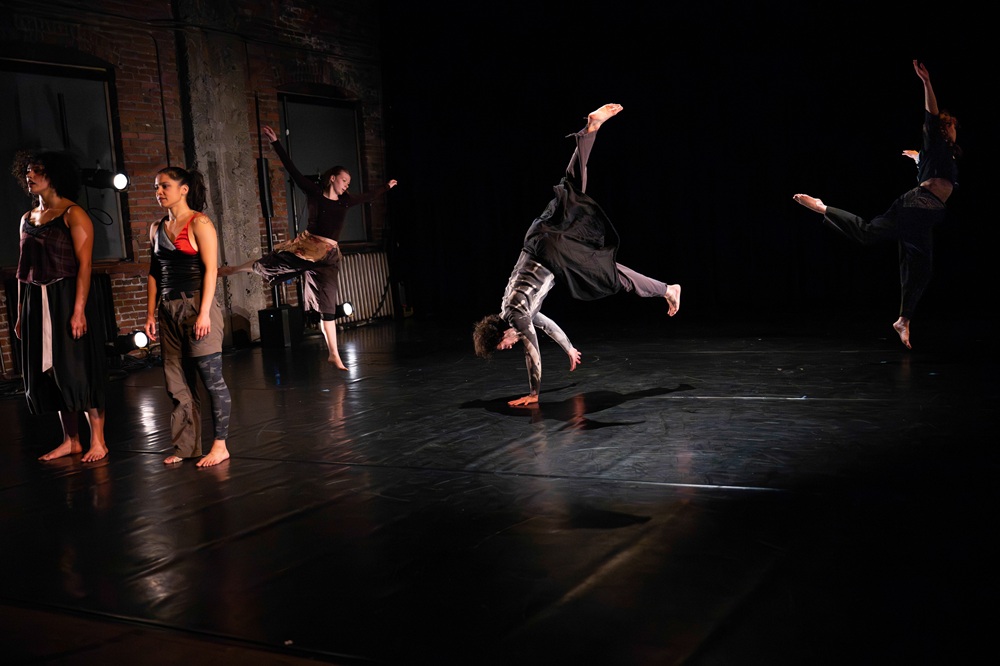
The Winged (1966) was created originally with no music, as Limón experimented with dance creating its own rhythms, form, and propulsion. Later, sparse music by Hank Johnson was added, and in 1995, The Juilliard School commissioned a new score by Jon Magnussen, still in use. I wish I could have seen The Winged in silence, as I suspected that each section—solos, duets, trios, and larger groupings—had its own sensitive inner life, breath, and drive. I found the wash and drama of Magnussen’s score overbearing to the dancers’ delicate and specific gestures of beating wings, fluttering, and skimming through the space; the music even overwhelmed the excitement of dueling displays that some of the male dancing represented.
The show opened with Limón’s 1958 Mazurkas, created after his company had toured Eastern Europe under the auspices of the U.S. State Department, part of an early diplomatic effort to crack the Iron Curtain. Impressed by the determination of the Poles to rebuild their still war-devastated nation, Limón chose Chopin’s piano works to embody what he understood as the Polish determination to endure. The movement hints at character dancing, with heel-clicks, arms akimbo, stamps, and thigh slapping. Yet the work is also elegantly gracious, as dancers hold a partner’s hand or arm, bow and smile formally, support or follow one another with courtesy and warmth. All the signature Limón elements are there—breath-filled suspensions (here Katen was a stand-out), tilts and asymmetries of the torso, arms carving into and out of the body’s center, upwardly arched torsos, and bent-legged, floor-devouring bourrées. From the moment the dancers entered the stage and the first notes played, I thought of Jerome Robbins’s Dances at a Gathering, which also features a group of young men and women dancing delightedly to Chopin’s music. But Robbins’s work dates from 1969, causing me to wonder if the ballet master was inspired by the Limón suite. In any case, Mazurkas is a lovely dance that highlights the qualities not only of Limón’s work, but also of the beautiful dancers in the current company. I’m so glad I saw them. I wish more Philadelphians had.
Limón Dance Company, March 9-13, Prince Theater, http://princetheater.org/events/limon