I was first introduced to Seán Curran’s choreography while studying at American University. While the title of the ballet is not etched into my memory, the contrast of carving arms and quick footwork that were held in the grip of some classical ballet vocabulary never left my memory. Years later I was eager to revisit the visual pleasures of Curran’s robust choreography, hoping to relive his nuanced accents and careful attention to musicality.
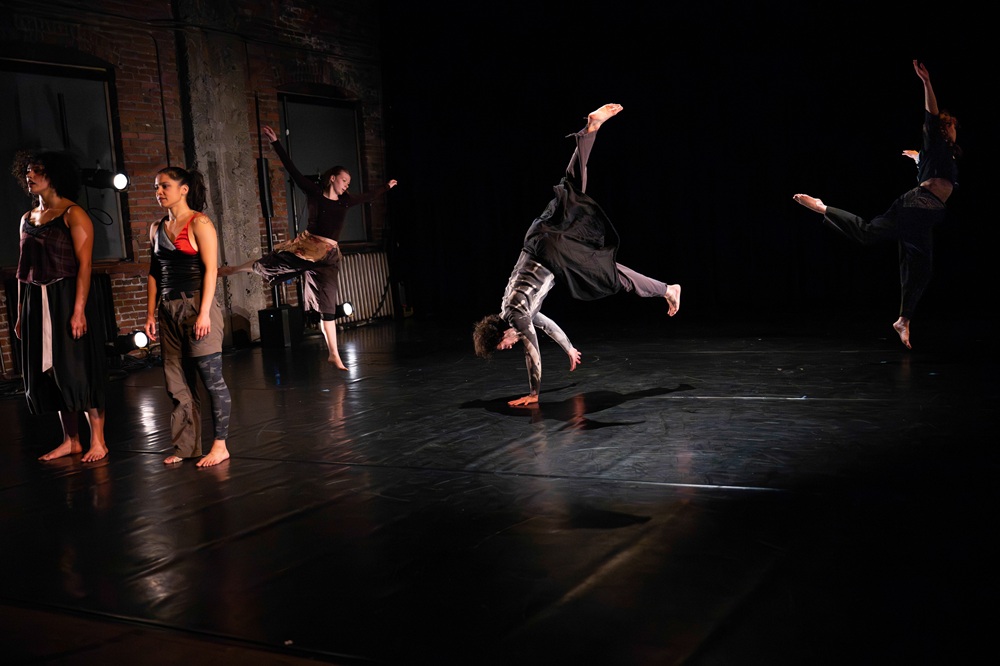
Presented as part of Dance Affiliates’ NextMove series, Seán Curran Company energized the Philadelphia audience with two works designed to showcase the technical versatility of his dancers as they used their athleticism to accentuate subtleties from each musical score.
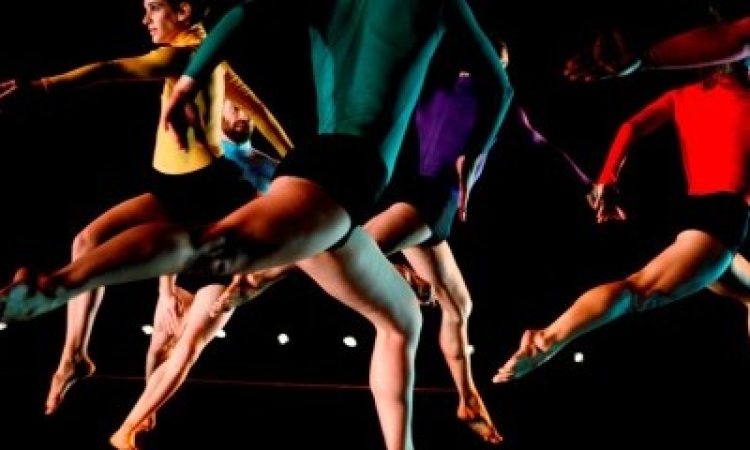
Opening the show was Social Discourse (2007), which was a colorful display of bodies in motion. An illustration of Curran’s choreographic aesthetic, Discourse combined his familiar wavy torsos with geometric lines to emphasize movement opposition.
Moving with detailed specificity, the dancers in Discourse swirled to the driving musical composition of Thom Yorke and Radiohead, with speedy determination. Their buoyant leaps and intimidating inversions always settled into a vertical grounded position with an assertive pedestrian disposition.
Many pathways were investigated in Discourse, but I questioned Curran’s choice to have dancer Aaron R. White walk the periphery of the stage to get to his final destination instead of taking six forward steps. Was it random, or an intentional composition choice to add depth and complexity to the work?
Social Discourse contained hints of the choreographic sensibilities of Bill T. Jones, the artistic director and choreographer with whom Curran worked for years. As a result, I could smell the essence that inspired him.
Wearing a yellow leotard, Jin Ju Song-Begin was both angular and curvy, a perfect parade of Curran’s vocabulary. Song-Begin delivered each arabesque with meticulous lines that were accompanied by a relaxed freedom, making her easy to watch as she barraged the stage with her lithe body, performing tricky transitions and lively level changes.
The intermission came quickly, after the fifteen-minute first half, forcing me to query the length of the program. As patrons mulled around, the curtains rose to reveal a bare stage.
The house lights … on.
The stage lights… on.
The viewers tamed their conversations allowing their intermission activities to subside as the faint sound of chiming bells shifted our focus to the still empty stage.
Buddhism, Catholicism, and Judaism, among other religions, were represented using appropriately fashioned costumes in the opening scene of Left Exit: Faith, Doubt, and Reason (2010). One by one, the stage became saturated with the representations of nine faiths as the accumulated group performed Tai-Chi in a solemn homage to integration—the unification of otherness as all nine faiths banded together in breath.
Amidst the active group sections of Exit, Curran offered a solo that demonstrated the aesthetic of his company as only he could perform. Half miming, half dancing, he was both austere and comedic. Each finger gesture, each pas de basque, and each pause, allowed Curran to tickle the audience while the words of a theologian, Jonathan Miller from the “The Atheism Tapes,” rippled in the voiceover. While I found pleasure in the maturity Curran brought, I sometimes have trouble with text during live performances.
Am I to listen to the text and allow the dance to fade into the background?
Am I to watch the dance and allow the text to become an afterthought?
Or am I to find a way to watch the dance, while listening to the text, investing in both equally?
The two works demonstrated the range of the company’s repertory. And the fact that some of the company members are Curran’s former students from New York University only enriched the uniformity of the company and Curran’s post-modern style.
Seán Curran, Seán Curran Company, Dance Affiliates, April 6-10th, The Prince Theatre, www.danceaffiates.org, www.seancurrancompany.com