In the fall of 2003, a colleague invited me to the showing of a new company, Phrenic New Ballet, at the Fiorella H. LaGuardia High School near Lincoln Center. I remember my colleague telling me about having danced with the new company’s directors, Christine Cox, Matthew Neenan, and Amanda Miller. The fourth director, Tobin Rothlein, was a filmmaker and his inclusion was indicative of the types of collaboration on which the company would embark.* I can’t say I remember any of the choreography from that showing, but I remember the technical proficiency of the dancers—all from Pennsylvania Ballet.
Years later, under the direction of Neenan and Cox, with a new name, fifty-eight world premieres, thirty-one choreographers, and two hundred ballets, BalletX has established itself as one of Philadelphia’s staple dance companies.
BalletX’s spring season opened the vault to ten years of ballets, revealing the company’s artistic evolution and commitment to providing complete theatrical experiences. From the wing-wearing dancers in Frequencies (Matthew Neenan 2005) to the speedy virtuosity of Gran Partita (Jorma Elo 2014), Cox and Neenan’s ability to locate and collaborate with artists of diverse choreographic backgrounds is impressive.
Watching excerpts of the company’s ten-year history, it became more clear to me that BalletX was not just about the steps; it was about how those steps are brought to life using all things theatrical.
I like you different (Cox and Neenan 2007) was a suggestive duet with a pinch of comedy. This playful duet, danced by Francesca Forcella and Zachary Kapeluck, showcased a relaxed physicality. From the frisky foot play to the energetic pelvic thrusts performed by Kapeluck, the audience expressed its appreciation in the form of loud chuckles. The work climaxed when Forcella sat with her back to the audience while Kapeluck stood facing her. Upon turning to face front, Forcella wiped her mouth, sending the audience into uproarious laughter.
Columbian–Belgian choreographer Annabelle Lopez Ochoa had two pieces on the program: Still@Life (2008) and Castrati (2010). Both were crafted to showcase Ochoa’s experience working in opera and theatre. Her efficacious use of props added a layer of excitement to the visuals of her luscious choreography, performed by some of Philadelphia’s finest dancers. Wearing all black, the dancers in Still@Life carried, tossed, and stuffed green apples into their mouths. Reminiscent of Jiri Kylián’s Sweet Dreams, Still@Life was wrapped up in the sensibilities of J.S. Bach’s Baroque music, allowing the dancers to barrel through the space with technical precision.
Jodie Gates’ Delicate Balance (2013) was a moving conversation. She used familiar ballet vocabulary, but I found it like listening to someone with a foreign accent saying mundane words; it makes it sound so much better (at least to me). Dancers Gary Jeter and Chloe Felesina spun a web of movement poetry. Out of every turn, Jeter folded himself around Felesina as if to remind her of his closeness. At one point he supported her neck while she performed a penché; she gave in to him and he provided just enough support to hold her without taking away the risk.
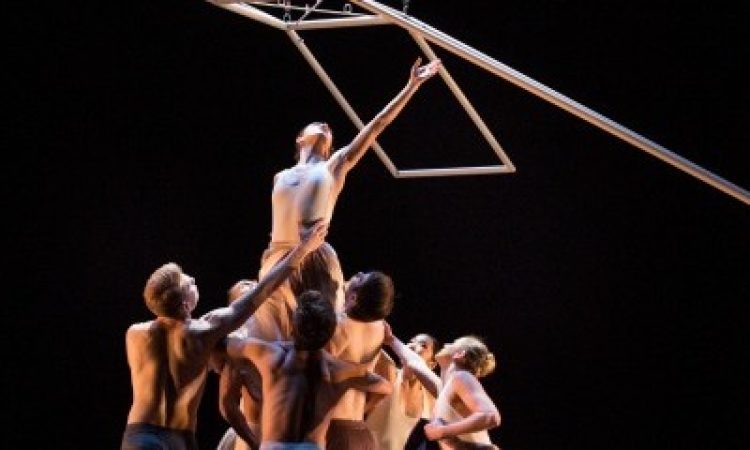
Kevin O’Day’s world premiere, Time Curve, was performed to newly commissioned music by John King, played live by cellist Wendy Sutter. The opening picture of Felesina sitting on the stage, wrapped in the fabric of her ballroom-style skirt, was striking. The female dancers brought the skirts to life with a tussle, a brush, or a faint sweep of the fabric’s outer layer. Set designer Thomas Mika created an abstract “X” hanging center stage, which needed constant boosts from dancers hoisted aloft to set it spinning. I’ve long been a fan of the wide range of physical and technical delights each choreographer has added to BalletX’s rich repertory, but for me, Time Curve stood still—never really reaching a peak.
Nonetheless, the company’s ten-year celebration of edgy works, well-balanced theatricality, and flawless dancers was a thank-you note to the city, reminding Philadelphia of BalletX’s continued commitment to creative and artistic excellence.
**Miller and Rothlein formed MIRO Company in 2004 “in order to realize their unique creative vision, and explore the intersections of contemporary dance, video, and visual art.”
BalletX, Wilma Theater, April 20-24, www.balletx.org