Quick, what do the words “home entertainment” conjure up? Charades? Sing-alongs? Cleared furniture making space for rollicking dancing? At Cliveden, the historic Germantown mansion, Home Entertainment meant a mix of arts—dance, music, theater, performance, visual installations and video—offered in a homespun, indoor-outdoor, distinctly summertime way. MCs Ed Miller and Josh McIlvain, Home Entertainment’s mastermind, alluded to the old-timey versions of home entertainment in their patter, but the art itself turned out to be mostly of this moment.
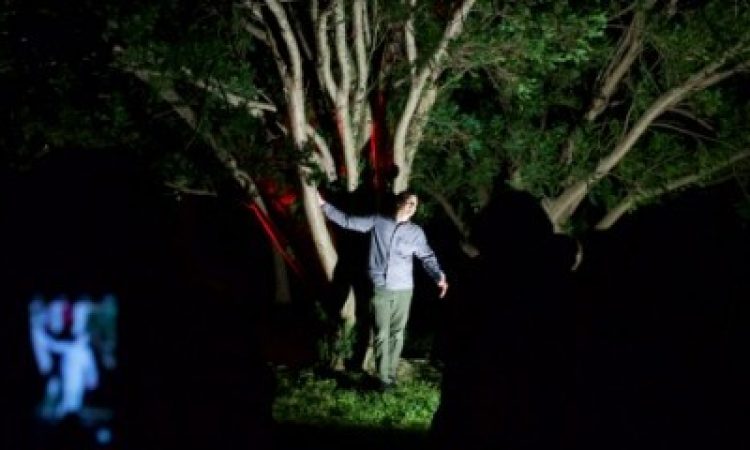
Museums and historic places increasingly value performers who can “animate” their spaces, drawing new interest and traffic. And no wonder—discovering the performances and installations studding this estate’s landscape and interior spaces was like a treasure hunt. You saw the home, grounds and outbuildings in a new way, focusing, for instance, on a single tree, dramatically uplit for a monologue written by John Rosenberg about one tree’s importance. In a courtyard, Iva Fabrikant’s red paper light sculptures, resembling translucent, 3-D origami, stood like so many overgrown chess pieces. In a lush expanse of grass bordered by majestic trees, a fairy ring of Anna Kroll’s photographic collages with accompanying fantastical texts by Rosenberg beckoned with their intriguing (and appropriate) title—The Return of the Rock Museum. In the Kitchen Dependency (the 18th century word for a cookhouse), a tiny conceptual artwork, required kneeling to peep through a hole in the floor.
With light rain falling, the first events of the “Mains” part of the “Menu” (that’s how the program termed it) were held in the old carriage house packed with folding chairs and an SRO crowd. Folk-music duo Chickabiddy played as we filtered in, with Aaron Cromie switching between traditional-sounding banjo and mandolin and Emily Schuman on guitar, their voices melding in sensitively tuned harmonies.
The ensuing variety show included an excerpt from iStand. Lauren Putty White’s two dancers—one female and one male, one black and one white—delivered a mostly-unison string of funky, energized moves riding on Brent White’s eminently danceable recorded music. They joined hands at its close before heading their separate ways.
Intermission was an invitation to wander, checking out the performance of Kitchen, created by the MCs plus Deborah Crocker and Bradley Wrenn. In a perfect 1950’s light teal-colored kitchen, replete with chrome and aluminum cookware, the players’ repetitive cycling through test kitchen-type sandwich-making reminded a companion of Beckett’s Watt with its repetitious deadpan humor.
The outdoors slid into a velvety darkness enhanced by a soft warm wind. How right then to bring the audience back together with Chickabiddy’s gentle sound.
What followed was anything but gentle. Poet Yolanda Wisher’s the ballad of laura nelson was rendered as a video (concept and editing by McIlvain and music by Brent White). Gradually meted out, Wisher’s words were projected in white on a black background, interspersed with just enough images of the 1911 lynching of Nelson and her son to sear into the mind forever. This poem, delivered in this way, on this comfortable summer evening, with a diverse neighborhood crowd out for pleasure, was particularly effective in making racial injustice visceral. I imagined the poem’s images as thoughts coursing through Nelson’s mind before the hanging. The anguish of this mother and her fear for her son resonate powerfully with the events of our day.
Add to this the knowledge that this video was projected on the high stone wall of a space where enslaved people lived and toiled. A neutral theater space could never convey an equally deep experience of this important work.
With the rain, I missed a full viewing of Maybe Rome Did Fall in Day, an installation by Henrick Fergusten, though its two dancers did slink along satiny red bands of fabric indoors. Other “acts” included Ed Miller Listens to a Song, in which he did just that, wryly guiding us through highlights in a Joan Armatrading classic with some personal narrative mixed in; My Yiddische Mommeh, a dance by Asya Zlatina to the eponymous song; Thom Jacand the Caretaker, a short play by McIlvain for two guys navigating a challenging moment; and It’s Jolly, a goofy monologue with horse marionette by Gwendolyn Rooker about Jolly, “the sperm-eating horse.” That must be why the evening had a parental advisory.
Home Entertainment wasn’t the first Automatic Arts event at Cliveden, where the group has presented its Nice and Fresh series several times previously. As a Germantown resident, I walked to it with several neighbors. As a bunch, we were definitely entertained, and moved, and hope there will be more to come.
Home Entertainment produced by Automatic Arts in partnership with Cliveden. August 5 & 6. https://automaticartsco.com/