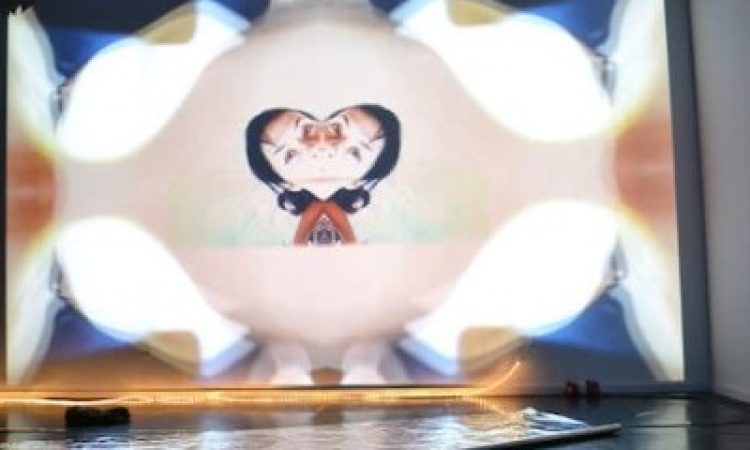
Zornitsa Stoyanova’s solo performance Explicit Female was three years in the making when she produced it at fidget for a single weekend during Philly Tech Week*. The piece is extravagant in its staging, but intimate too. Stoyanova surrounds herself with glittery Mylar, which she stuffs into her clothes before she takes them all off. All the while she converses directly with her audience. It has a chatting-over-coffee feel while remaining theatrical, and incorporating the deconstructive, surrealistic investigations of her striking video and photo work.
Next month Explicit Female breathes a second breath during the FringeArts Festival, this time at AUX Performance Space at Vox Populi. Zornitsa (also a writer for thINKingDANCE), who is currently in Bulgaria having just finished a residency at the Derida Dance Center, chats with me about identity, about making work, and about the realities of the birthing body.
Julius Ferraro: What surprised you about making Explicit Female?
Zornitsa Stoyanova: I was surprised to find out that I was working with personal narratives. I’ve never done that before. I’ve always worked with abstract imagery and internal logics, but never personal narrative.
When Megan [Bridge] invited me to perform at fidget, I wanted so many things for the piece. I wanted to have a moment for the audience to experience the mylar, so I put that in. Little by little I kept adding events and sections that to me didn’t make much sense. Over time, I figured out that the thread was deeply connected to who I was and why I thought my identity was important and exciting.
The through line was really working through my identity as a person, and of course it included my interests, my body, who I was and am, and how I present myself, so the piece really is about identity. Once I figured that out, I shaped it.
JF: Do you think this happened because your identity as an artist and a mother was changing at that time?
ZS: Absolutely. No question about it. I don’t want to use the word changing, per se, because I don’t think it’s accurate enough. The female body is ever-evolving, and not until I became a mother did I realize how much this is true, especially for a dancer where your ever-changing body is your ever-evolving identity around female issues and society.
JF: You mention in your description of Explicit Female that the piece is de-mystifying the birthing body. Could you talk about that?
ZS: I have a grudge with mystification in performance, and making the female body this ideal beauty, this archetype. I don’t like that. I want to present the body as a real, human, social being. When you think of the birthing body, unless you’ve had a kid yourself, your idea about what happens to the body is so incredibly limited. You either think of it as, “Oh my god that’s the most beautiful process on earth, it’s so magical, it’s so amazing.” It becomes this flowery thing. Or else it’s thought of as the opposite: “You become fat, and it’s hard, and it’s the worst thing that can happen to you. Your hormones spike and then you’re going to be depressed and eat whatever and feel horrible.”
So I’m demystifying the birthing body in that I’m not presenting it in those terms. I think that there’s something really beautiful in the fullness of it, in the biological aspects of it. I’m presenting it as it is for me, without apology. That’s how I think of it. This is my body, and it has stretch marks. It has fat on it and it did give birth, and there’s my vagina too, and that was fricking stretched and torn and sewn up. And I am not ashamed by my stretch marked and milk-empty breasts.
JF: You performed this first during Philly Tech Week. What kinds of reactions did you get?
ZS: My favorite response was from a friend who I met in childbirth classes. Her kid is only two days older than my son. She’s very much a mom friend. We talk about the kids and what the kids did; we barely ever talk about what I do. But she came to my show.
When the piece ended she was crying, sobbing, and she gave me a hug and said “I can’t tell you anything right now. This is the reaction that I’m having.” Not until then did I realize, of course I’m not crying, because I made the piece instead of trying to internalize all my experiences of the last two years. Her reaction really touched me.
Not that the piece itself is sad or asking you to cry. There are intense moments and there are funny moments. I just realized that by making this piece, I created this space about all the amazing moments that motherhood is, so that I don’t need to cry in order to process it.
*Read Kat Sullivan’s review of Explicit Female here.
Explicit Female, Zornitsa Stoyanova, AUX Performance Space at Vox Populi, September 17-20, http://fringearts.com/event/explicit-female/