Boris Charmatz identifies this work as a consideration of Barthes’ idea that neutrality is “a desire for the suspension of conflicts.” While this might be a shared desire for humanity, how could it even be attained?
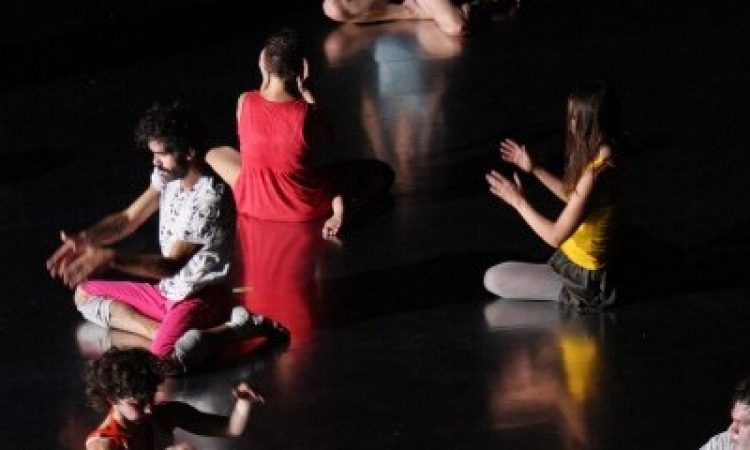
As the show begins, we are surrounded by seemingly infinite darkness, illuminated gently by four huge suspended orbs of light. There is the sound of static. A woman walks intentionally across the square reflective floor and begins the sequence of twenty-five gestures: circling her hand on the floor, putting her head down, raising her butt in the air and sweeping it side to side. Each of twenty-four dancers enters and begins the sequence in canon, until the space is littered with bodies moving.
Each person completes the sequence and then begins again. It repeats relentlessly in different spaces at different timings. I become lost in this surreal landscape; people and moments disappear and reappear as my eyes move across the stage. It is a seeming chaos that depends on highly organized structures. The sound-score swells into a harmonic discord, and then disperses out into spacious tones and breath. As the mass of movement centralizes, the dancers spiral out and back in again, creating a giant whirlpool of bodies.
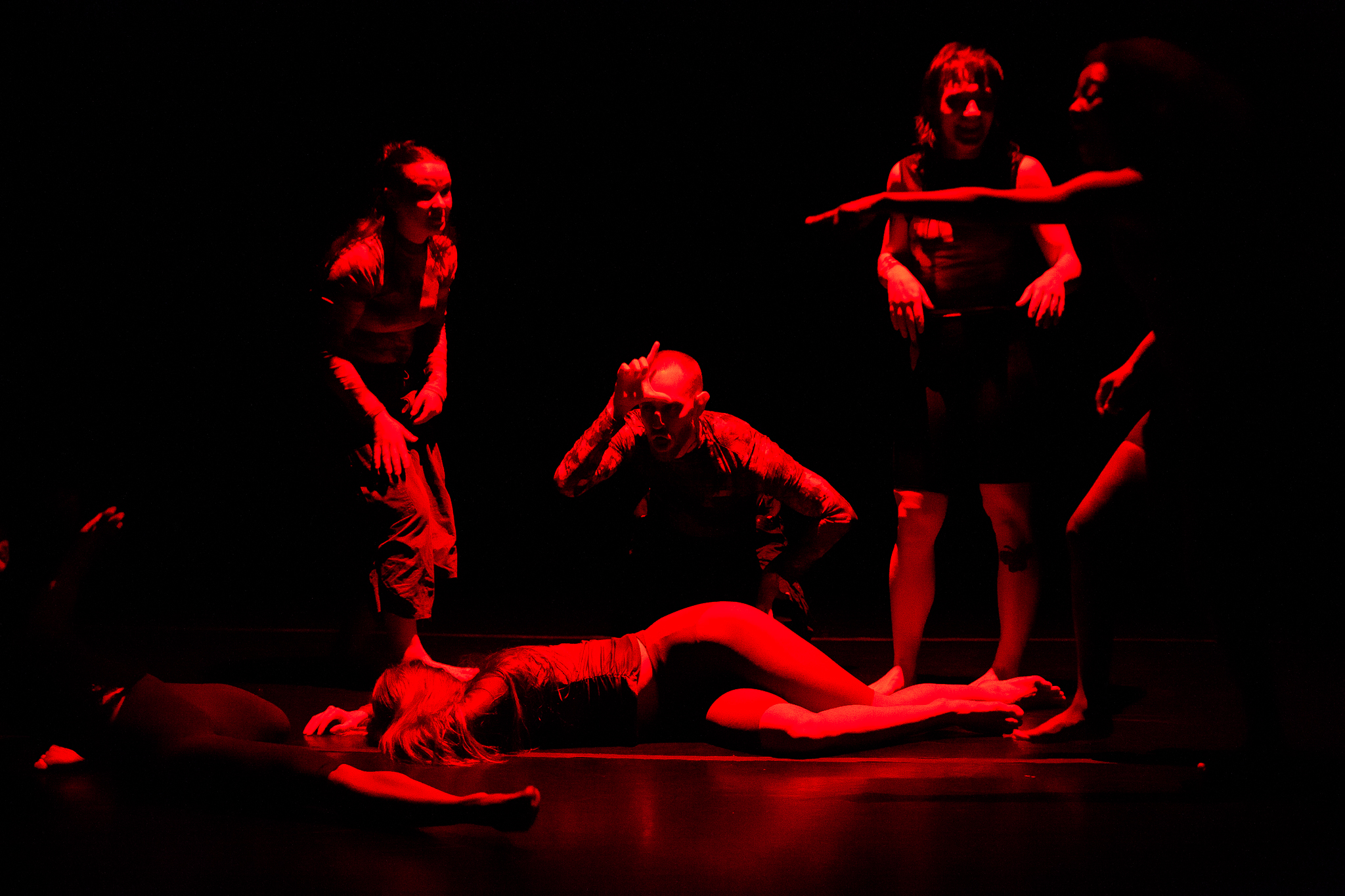
I am brought out of a trance. A pounding of fists lands on a body in front of me, as a male dancer whips his arms, hitting front and back quickly. With our proximity, I feel his struggle—it’s as if it is all he can do to keep going. There is sweat dripping down the tip of his nose and chin. When he is done with this gesture and moves on, another dancer comes to take his place, and then another. Next to this space, dancers take turns raising their hips in the air in a slow grinding motion. They are taking cues from each other, acting in accordance with a connection that is clear and without wanting.
In this exploration of neutrality, there is a simple commitment to each endeavor and exchange without attachment or affectation. It is not boring. It is the full range of humanity—including sex, innocence, and violence—expressed without a put-upon emotional layer.
Like the end of a musical movement, there is a lightening of the load. Each dancer fades off, leaving only a few, then just one soloist, who whirls like a dervish, pushing past limitations. He ends the sequence with a pause and walks out into the darkness.
Levée des conflits, Boris Charmatz, Drexel University Armory September 9th and 10th 8pm. http://fringearts.com/event/levee-des-conflits-2/