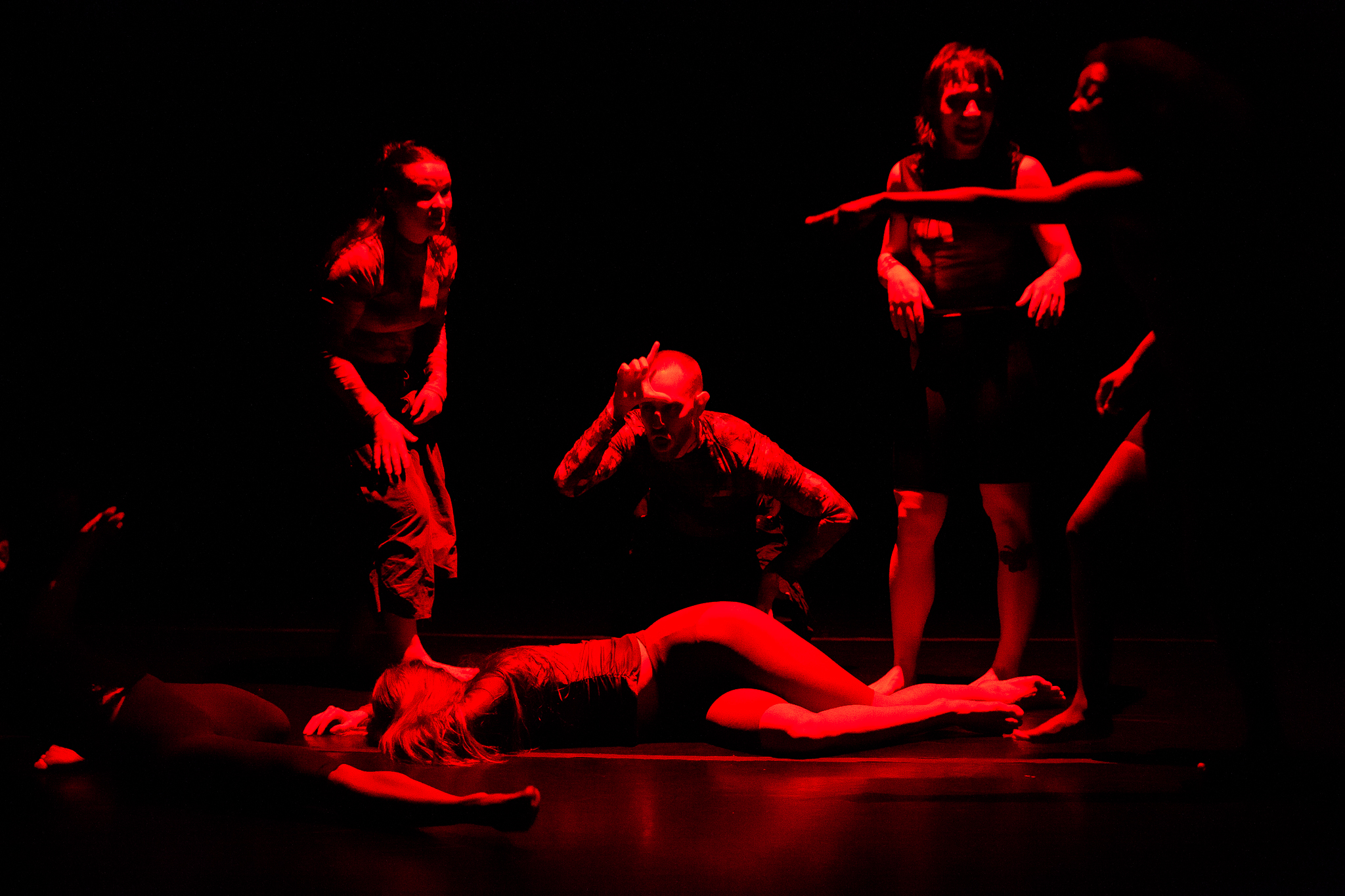
Barry: Mamaloshen in Dance! opened with two dancers in long skirts who seemed to represent an earlier era. These women engaged in sweeping movements that radiated with confidence and ease. One emerged in the background, watching from the shadows amongst a trio of brightly colored, short-skirted dancers who quickly swayed and jumped. The single dancer calmly moved from the darkness, placing her hand on the shoulder of another performer, gently moving her forward to connect with the members of the group. From here she continued to integrate into the dance of the more youthful movers, as if weaving a deeply embedded history into the present experience. They danced with agility and contentedness, calmness and power.
Throughout, the ensemble moved flawlessly between partnered intricacies and group forms where they linked hands or elbows. They held one another’s hearts and heads. They orbited one another’s bodies, stretching apart and migrating, as if undeniably bound by a generational likeness. They held an acceptance of memories both beautiful and dark.
A talkback provided some insight after the show. Comprised mostly of the Barry Sisters, music served as a way to access feelings of nostalgia for audience members, and also helped the performers relate to the concept of the piece and the choreographer’s vision. According to Asya Zlatina, the movement gave color and a tangible realness to the music, which was significant during her childhood. She utilized it to find a way of immortalizing her late grandparents, with whom she was very close. In her struggle to accept their passing, she sought a means to share their greatness with others which also allowed her to hold onto their presence.
Zlatina performed the final solo section of Barry. Movements re-emerged, just as movement patterns travel through generations. She began to run, shifting in uncertainty, but was eventually able to choose a propulsive course that effortlessly carried her past.
Barry: Mamaloshen in Dance!, Asya Zlatina and Dancers, Levitt Auditorium, September 11, http://fringearts.com/event/barry/