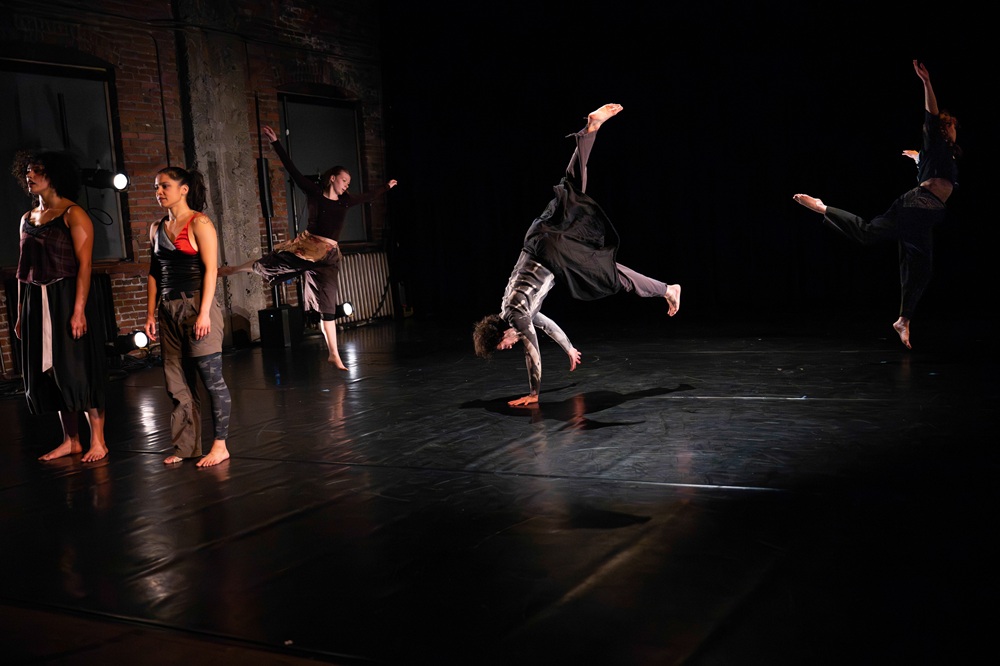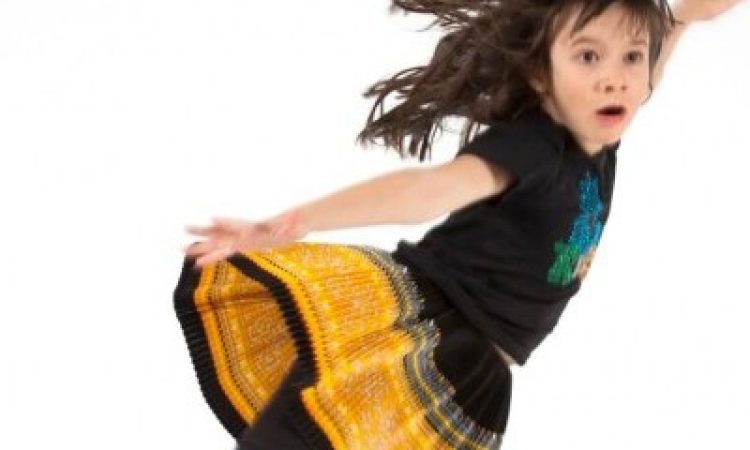
I want to live in a world where nine-year-old Tristan Price dances jubilantly to David Bowie’s “Space Oddity” with a cast of 19 other performers behind him who earnestly attempt to mimic his unreproducible, spontaneous bursts. He jumps off the wall, falls to the floor, races out to the wings, and returns onstage by charging through the upstage curtain with the rest of the performers spilling out behind him.
I want to live in a world where everyone, regardless of age, ability, or experience receives passionate applause for their grand jeté.
I want to live in a world where everyone chooses their own outrageous costume, full of color, glitz, and frills;
a world where Erin McNulty radically challenges stereotypical images of people with Down syndrome by flipping her hair and shaking her hips to a sexy pop song of her choosing with the lyrics “let’s go all the way”;
a world where six-year-old Zachary Ermey leaves the stage in the middle of a performance to use the restroom, then runs back onstage when he’s ready to resume dancing without receiving any negative repercussions;
where Kharrima Stevens struts her gorgeous curves as she moonwalks to Michael Jackson;
where Clayton Sweeney, a person who presents with ambiguous gender (and others who are of the most marginalized groups in society) are leaders, front and center;
where Delano Turnipseed devours space as he propels the wheels of his chair with his arms,
where you see multiple gender configurations in the salsa pairs,
where white men are the few;
where Helen Gassman virtuosically twirls a baton, jumps, turns, splits, and always catches the stick, as performers behind her fail beautifully at reproducing her choreography. The shiny wands that are not caught ricochet across the stage: radiant and delightful mistakes.
Jerome Bel’s Gala is this world.
There is a fabulous contradiction in this dance: while the performers attend to and honor each other with deep respect, they approach their own performances with a light touch. As the performers follow the leader in front, they take the leader very seriously. Yet the task is impossible for most because of their differences in ability, experience, and training.
If only people everywhere would regard each other as thoughtfully as this! If only people were always able to embrace their own imperfections with such compassion and humor!
But I sense a shadow in Jerome Bel’s utopia because the construction of this heaven on earth is too visible. The demographics of the people he has asked local artist Sarah Gladwin Camp to painstakingly assemble are perfect in their diversity. The choreography is extremely legible (in fact there are signs downstage that indicate the kind of dancing that is happening in each section) and repeats the same two formulae for 90 minutes with very little deviation. First, the performers each demonstrate their pirouette, grand jeté, moonwalk, waltz, and bow one at a time. Second, they perform a series of follow-the-leader company dances.
While it is riveting to witness how each performer embodies the same gesture differently, either in solo or ensemble, I’m left wondering how this perfect world would function with more variation in the relationships between the performers. How else might they engage with one another, and at what point might the paradise collapse into something that more closely resembles the world we live in, with all its harmony and discord?
Gala, Jerome Bel, Prince Theater, Sept. 13-15, http://fringearts.com/event/gala-2/.