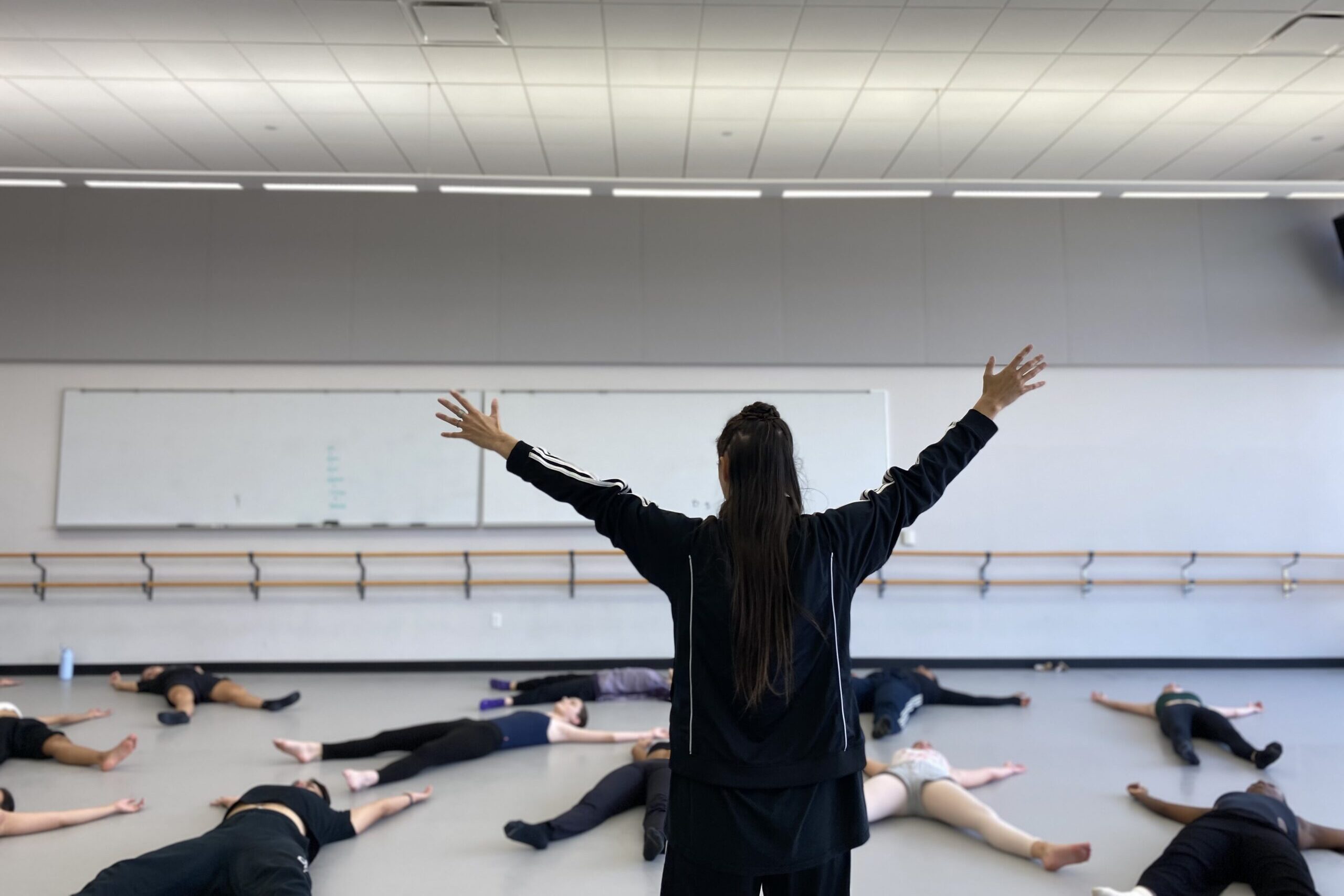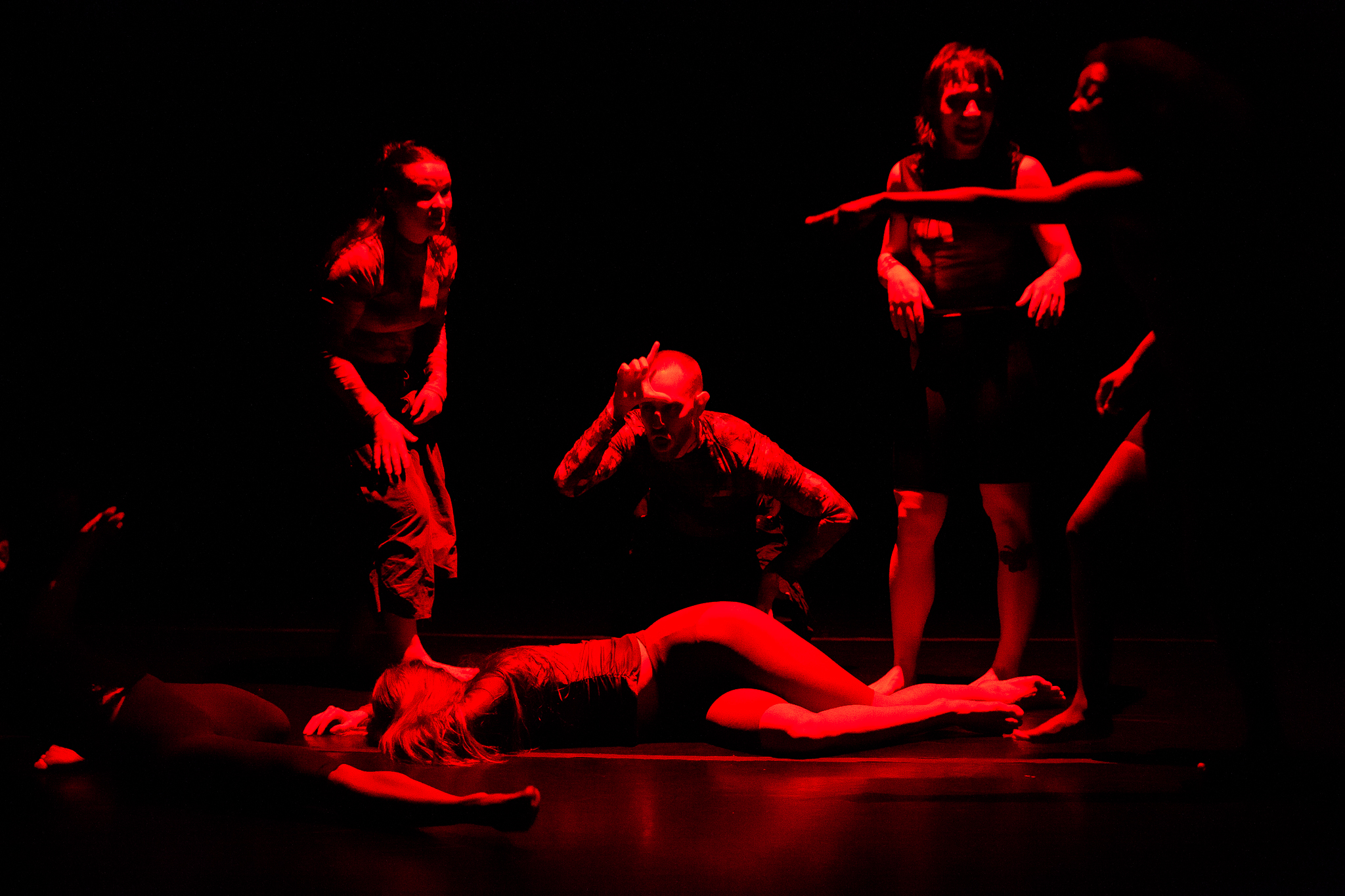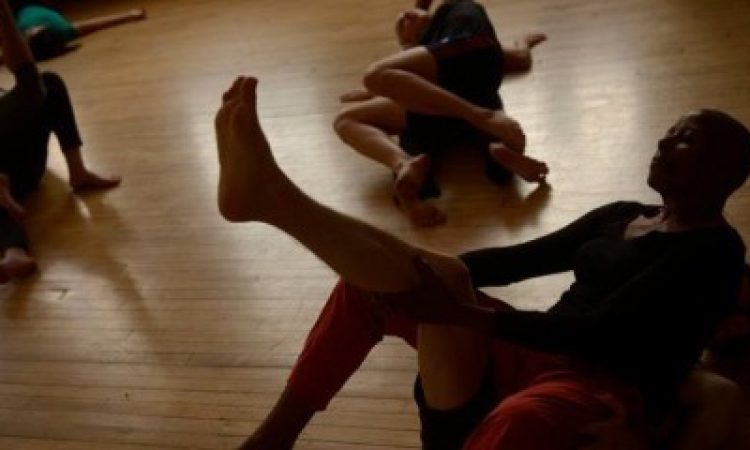
Watching Boris Charmatz’ masterful dancers skillfully perform Levée des Conflits at the Drexel Armory couldn’t be a more satisfying close to the three-day workshop where, along with 23 fellow Philadelphia-area dance artists, I learned the piece’s 25 oscillating movements and postures firsthand. The ten hours of intense mental and physical activity, shared over three days and led by Charmatz himself, has my full body—head, heart and soul—still churning. From my seat in the audience, I ripple, reach, undulate, and relive the morning’s culminating workshop, an alternate proposal of the scene slowly unfolding before me. The exaggerated heat in both the morning and evening venues triggers indelible logistical changes in the environment: the armory is outfitted with huge standing fans in each corner and we viewers are offered water bottles and hand fans. Similar unbearably high temperatures at the Art Museum lure Levée des Conflits workshop participants and dancers off the concrete and directly into the fountain. This piece, still new in my body, is already teaching me life lessons on flexibility of all kinds.
25 movements, non-conformist and uncategorizable, form the raw material for this six-year old work. Each gesture evolves out of a guided yet personal development of the previous one, and since 24 out of 25 of the gestures (the 23rd being the body in total rest) are conceived as cyclical and self-reiterating, the final product is absolutely mesmerizing. As I watch, I flip back and forth between my memories of the Art Museum presentation—the concrete, sun, hot sweat, cool water—and the captivating story unraveling before my eyes. I recognize my heightened perspective of living inside and outside, of watcher and doer.
Fleeting images of beehives, ant colonies, and organized societies, together with my lived experience inside a closely-knit workshop community, all help me decipher and then follow the subtle but stable rhythm and flow of the dancers as they enter one by one and execute the 25 movements in canon. There is a clear, yet accommodating spatial architecture, intentionally ever-changing. Certain zones of the stage have been designated as areas where specific actions take place. I have the impression of having stumbled upon an activity of uninterrupted ritualistic practice, complete with rules that are familiar to me, and others that are outside of my experience. Clear, too, the fact that what I am watching is a solidified and polished rendition of material I have just begun to chew.
Through clever manipulation of time and space, the canon gathers speed and force. Eventually, all bodies tightly occupy center stage, and what ensues is a sort of parade travelling along a densely spaced, counter-clockwise spiral. Each of the movements takes on a life of its own as dancers move across the space, lifting, lowering, turning, jumping, and seemingly acquiescing to chaos in subtly perceptible, followable patterns.
The Charmatz dancers have my unabashed admiration for their resilience, determination, and sheer staying power during this evening-length Levée des Conflits. The workshop, effectively a “taste” of the physicality a work like this requires, was a great way to meet a choreographer and get closer to his questionings and concepts. Verdict? Channeling that same flexibility Boris Charmatz insists upon, the same openness to experiment, attempt, discern and accept discovery, we can face endless possibilities, there for the taking, second wind willing.
Levée des Conflits, Boris Charmatz, Drexel University Armory, Sept. 9 and 10, 8pm; informal showing with professional and community workshop participants, Philadelphia Art Museum, Sept. 10, 10am www.fringearts.com/event/levee-des-conflits