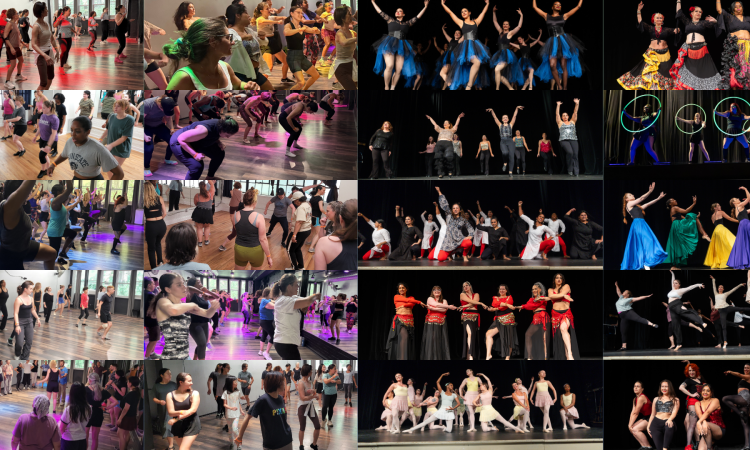
I arrived at Philly Dance Fitness’s Rittenhouse Studio to a packed room of excited attendees ready for Jazz Attack’s free intro to Lindy Hop class, one of many free daytime classes in a variety of genres offered for the 17th annual Philly Dance Day. The joy in the air was palpable as folks chatted, giggled, and studiously attempted to get the steps right. We rotated partners, bouncing in place, syncing up to triple step on the swinging beat, and learning both lead and follow in a non-gendered setting, which I appreciated immensely as a trans woman. This inclusivity continued into a combined Batchata and Cha Cha Cha class taught by Serge Khlystov from Ballroom Bliss. I wished the classes lasted longer than 45 minutes and we could have practiced our moves in a more improvisational, free form setting, but there’s only so much time in one day.
The festivities culminated in a final performance, described on the Philly Dance Day site as showing of “student groups as well as instructors and semi-professional dancers” at the Plays and Players Theater. I waited in a long line full of flowers and anticipation. From numbers and enthusiasm alone, I saw a vibrant community around dance and performance –– a monumental accomplishment in our current arts and economic climate.
With 13 different dances performed by the adult students of Philly Dance Fitness as well as two dances from the semi professional groups, also adult dancers, there was no shortage of genres represented in the showcase: Jazz, Bollywood, “Diva Pop Jazz,” Ballet, Contemporary and Tap were all on the menu. The choreography, however, was unable to match this variety and a formula soon emerged: front facing unison + full cast on stage + moving primarily in place + big smile + pose = dance. This is a typical set up for recitals; I had hoped for more coming from a group in the process of developing semi-professional dancers. As a showcase that was meant to celebrate dance and unite the community, the choreography often highlighted conformity and clung to entertainment value, rather than celebrating the clear effort and unique movement capabilities the dancers had been developing through their weekly classes.
For instance, the jazz piece “Beautiful People” (danced to the song “Beautiful People”) consisted of a group of student performers spaced out evenly across the stage, facing front, doing a mixture of unison turns, plies and kicks. Jazz dance comes from African roots; within the form’s history are embedded qualities of polyrhythm, groundedness, interplay with or against the rhythm of the music, and improvisation, to name a few core elements. A bridge that could have existed between this recital-like formula and expectations in a professional setting would have been to focus more on highlighting this history: playing with or against the musicality as a choreographic choice, or creating movement that was more grounded and less upright. The heavy use of synchronicity can offer a safety net for students to be able to execute movement, but educationally misses some of the nuance in teaching Jazz as a form that highlights individual expression.
The Bollywood piece “Journey Through the Ages” used smaller groups and canons to create timing variations and emphasize beats and lyrics in the songs. Groups of three to four dancers swooned to love stories and filled space with energetic cutesy gestures. The unison moments saw performers arms shooting out on diagonals and straight lines with mudras, eyework and pedestrian gesture work to convey meaning. In the final pose, the front row of dancers knelt and reached out to the audience, revealing the back row with arms reaching upward—a delightful surprise. These elements continued into the semi-professional piece at the end of the showcase, and fit the form of Bollywood being a popular dance meant to entertain and tell stories.
It is vital to see so many adults in different stages of life committed to art and performance, that cannot be understated even with my misgivings about the choreography. The dedication and joy of the performers was evident in each piece. I know that next year the choreography can grow to create a richer viewing experience and better highlight the dancers’ hard work.
Philadelphia Dance Day Showcase, Plays and Players Theater, July 25th.