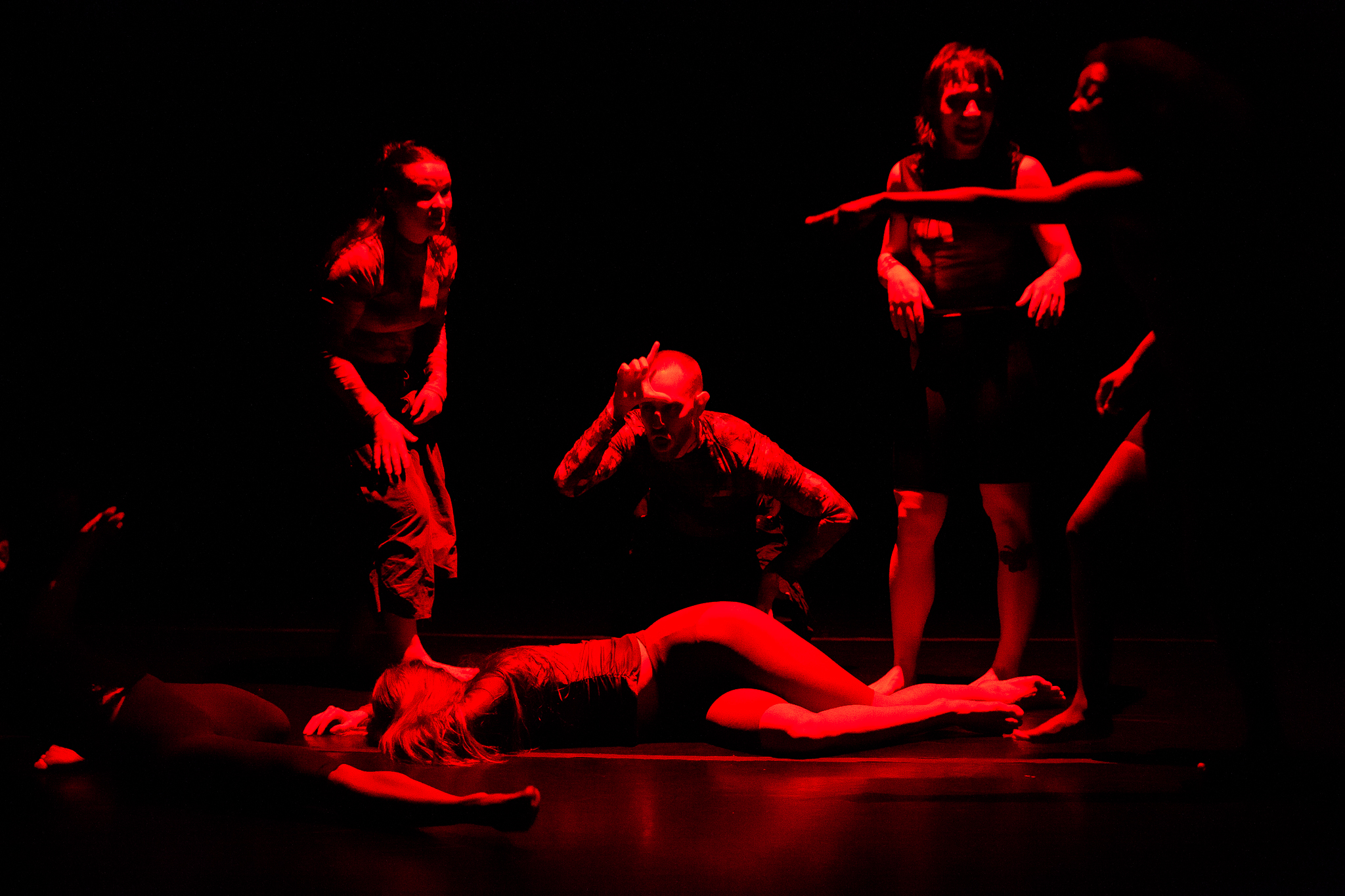
In the initial darkness, which remained throughout most of The Naked Stark’s The One, The Other One, & The Many, lights attached to boots clicked on. Three pairs of dark boots stomped amongst seven other pairs of feet wearing only socks. The rigid and guarded contrasted with the soft and exposed; power with vulnerability. One group, well equipped for rough terrain, marched in circles with force and dominance.
The socked dancers poured in and out of a door on one side of the stage, sliding through and past each other like a spouting water fountain. The booted villains watched amongst the audience, which was sectioned into the four corners of the stage. The set-up made it easy to oversee the action from every angle. Soon the propelling, socked dancers were herded like cattle behind closed doors.
Individuals began confronting one another in primal, circular patterns. The shoeless people developed momentum in their sock sliding that led to a rebellion against the seemingly more powerful characters.
While the socks allowed a freedom to the dancers’ mobility, it hindered their capacity for full expression. At times, there was as much slipping as sliding. The production as a whole choppily blacked out and went silent when transitioning to subsequent scenes. In repetitive movement phrases, the characters swirled, or else thrashed through emotionally expressionless combat. The literality of the story’s presentation lacked creative shaping.
When a hand extended to request help to stand, as happened multiple times in the evening, a choice existed for the action’s recipient: to help or knock down the one who had fallen. At the end of this story, the oppressed—those who chose to lend an empathetic hand—were victorious over the boot-driven automata, a victory the audience witnessed as the last boot light flickered to darkness.
The One, The Other One, & The Many reflected an everlasting struggle, a universal dynamic to shift parochial perspectives through time and evolving relationships. The many create a norm, blindly abiding in fear. One stands up and challenges authority. Another follows. A fight for change has begun.
The One, The Other One, & The Many, The Naked Stark, Mascher Space Cooperative, September 10, 11, 15-16, http://fringearts.com/event/one-one-many-5/