The beginning is awkward, not unlike those first moments of a family gathering. Where to begin, how to get things rolling before the lubrication of familiarity, history warms you like a shot of bitters? We circle around you, the anticipation palpable, and you put us at ease with compliments and chatter, all the while gliding along our perimeter, liquid spine and loose limbs tracing images that trail like potential. Immaterial but present. You situate us in time and space—this gallery, this building, this neighborhood where heritage is namesake and culture, this life—and the significance ripples out like the play of flashlight on shapes and mylar. Accumulating, shifting.
By now I know your body. I have seen it in performance and on film and in the playground, holding, feeding, guiding, cleaning that other body that tore through it, kicking, screaming, angling for light, air, a release from the sea of your fluid. I have witnessed your body change, like my own, expand and collapse, back to something that looks like its old self but never will be.
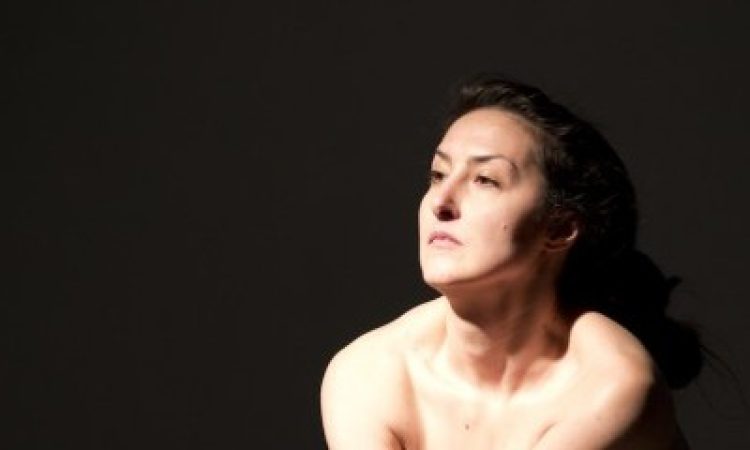
The airline attendant voice recites your datos with chilling distance. Daughter, sister, wife, mother. I stifle my snort at your labor force status: part-time. You strip slowly to the sounds of an Eastern European anthem. Flex like a bodybuilder. Cradle an imaginary infant. Rise like a Communist phoenix. Half off, your shirt smothers your head, your bra hangs from your neck, and you are faceless, everywoman, and an uncanny double of Abu Ghraib prisoners.
There are all kinds of ways to channel and represent experience, but what of our ancestors’ lives gets transmitted in our cells? Lies within us whether we choose to tap it or not? If genotype is to phenotype, what do joy and trauma yield down the line?
Charming and disarming, you keep reminding us even as your naked body fades from the foreground of our experience. You trick us with your sweet bumbling, convince four of us out of our seats and into the space, to sing, light and parachute the tree of life before our eyes, but not until you drop a bomb. Your maternal ancestor was drawn and quartered.
Mounds of silvery foil stuffed into your body sock, you become a mylar mommy monster. The airline attendant voice returns, reminds of the death that is part of birth. We watch as you squash your birthing body. She conjures your little alien and he conjures my own. No longer inside me. Me and not me. Already with a mind of his own. Holding tighter and flying a little further, every day. Bewitching and manipulating.
I love you, mommy. Mommy, you’re my best friend. I’ll put you in jail, mom. I don’t care about you. Hold me.
He jumps up into a restaurant window and the voice that warns, “Down, NOW,” is not my own. It emerges from a well of maternal authority that is fathomless. Were my screams the echo of the women stretching back in my mitochondrial line?
I hug you, congratulate you, compliment you in return, but how can I thank you for making this thing that shimmers with the depths of birth, motherhood, the female experience? We were torn open, sewn up again. But those stitches can’t cork all that we have seen.
We have been doing this from the beginning. In that sense, it is nothing, and yet it is everything. It is life and death. Somewhere along the way, it all became hidden, mysterious, not part of our every day.
What is patriarchy if not a structure born of envy? That is my entry to understanding, but I wonder what will become of our little men in the making.
I want to say this and so much more. Instead I rush out the door so I can buy the milk a little alien in East Kensington will yell for in the morning.
Explicit Female, Zornitsa Stoyanova, AUX Performance Space at Vox Populi Gallery, Sept. 17-20, http://fringearts.com/event/explicit-female-4/.