On arriving at Brendan Tetsuo’s concert, Walk to Topaz, I am struck by the beautifully designed program. It reflects my expectations of a well-composed and polished art work. But as I settle in, I realize that I need to adjust these expectations. This is a rough edged work-in-progress that attempts to embody the question of how the Japanese internment camps of World War II affected succeeding generations. The three short solos on the program render some authentic instincts in an informal setting.
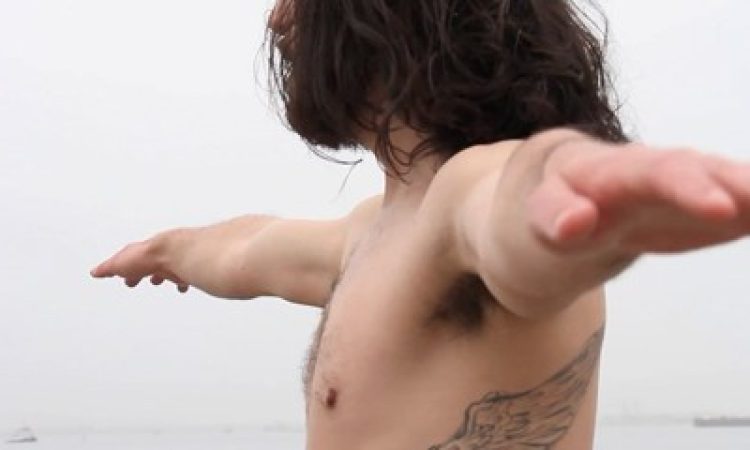
The first solo begins with Tetsuo down stage – his back to the audience – naked. With just enough light for visibility, the sight of this man walking slowly away from us creates a strong impact. I have time to observe his body. He shows us the soles of his feet; sometimes obscured by loss of footing. The walk is mostly engaging, but never captivating. He is only scratching the surface of the power of this image. As I watch, I wonder: is this a walk or a series of lunges? Or, has the walk transformed from a normal stance into a weighted down trudge, due to the heaviness of meaning he is exploring? In this acute image of a naked man walking, the inconstancies become paramount.
In the next solo, titled Kimiko, Tetsuo re-enters in a short green kimono, black spandex shorts and neutral socks. On his toes, he walks delicately forward, his eyes cast downward, articulating fingers from the wrist. The soundscape is a mash of keyboard tones, and words coming out one syllable at a time. It evolves into light music with an air of bluegrassy storytelling. His body is propelled through space by runs, stops, and movement reaching out from the fingertips to something unknown.
In another moment, his hands move slowly down from his face along the centerline of his body, pausing for while at gut level, slowly shifting weight from one foot to the other, drawing deep breaths in with palpable effort. Here, the artist is truly rooted in the presence of the material – I want to see more of this. He swivels again through the space, and ends in a fragile stance moving backwards on toes, beating his chest.
For Kasai, the third solo, he begins facing an upstage corner with a fan, his body low for a long time, allowing the air to puff and suspend the fabric of a striking, long red kimono. As he works his way towards the audience, his body rotating through space, the red kimono seems to be flying. He ends as he turns to face us once again.
There are a few stumbles on this walk, both literally and figuratively. But knowing that this piece is still young in development gives me hope that there will be more investigation and growth for this artist and this story, as he works to articulate the impact of a very complicated past.
Walk to Topaz, Brendan Tetsuo, Mascher Space Cooperative, 155 Cecil B. Moore Ave., September 19-23 9pm, tickets http://fringearts.com/event/walk-to-topaz-2/