Philadelphia Fringe Festival site-specific offerings add dimension to an already rich choice of events; the welcoming, chatter-filled foyer of Mama’s Wellness Joint is an example. The Center City holistic boutique yoga studio and wellness center for women, men, and families is an ideal setting for 2015 UARTS graduates Whitney Casal and Ella Cuda’s Coffee?, a vocal and physical exploration of the “come-to-Jesus” and wake-up calls likely to surface whenever two ladies share time and space over a cup of bitch’s brew.
In more than 40 years of theater-going, this is the first time I’ve actually met and exchanged words with the many spectators waiting for the house—full to capacity at just under 40—to open. I suspect the coffee and wine offered in the anteroom contributed to the mellowness. As we made our barefooted way into the performance space, intimacy abounded.
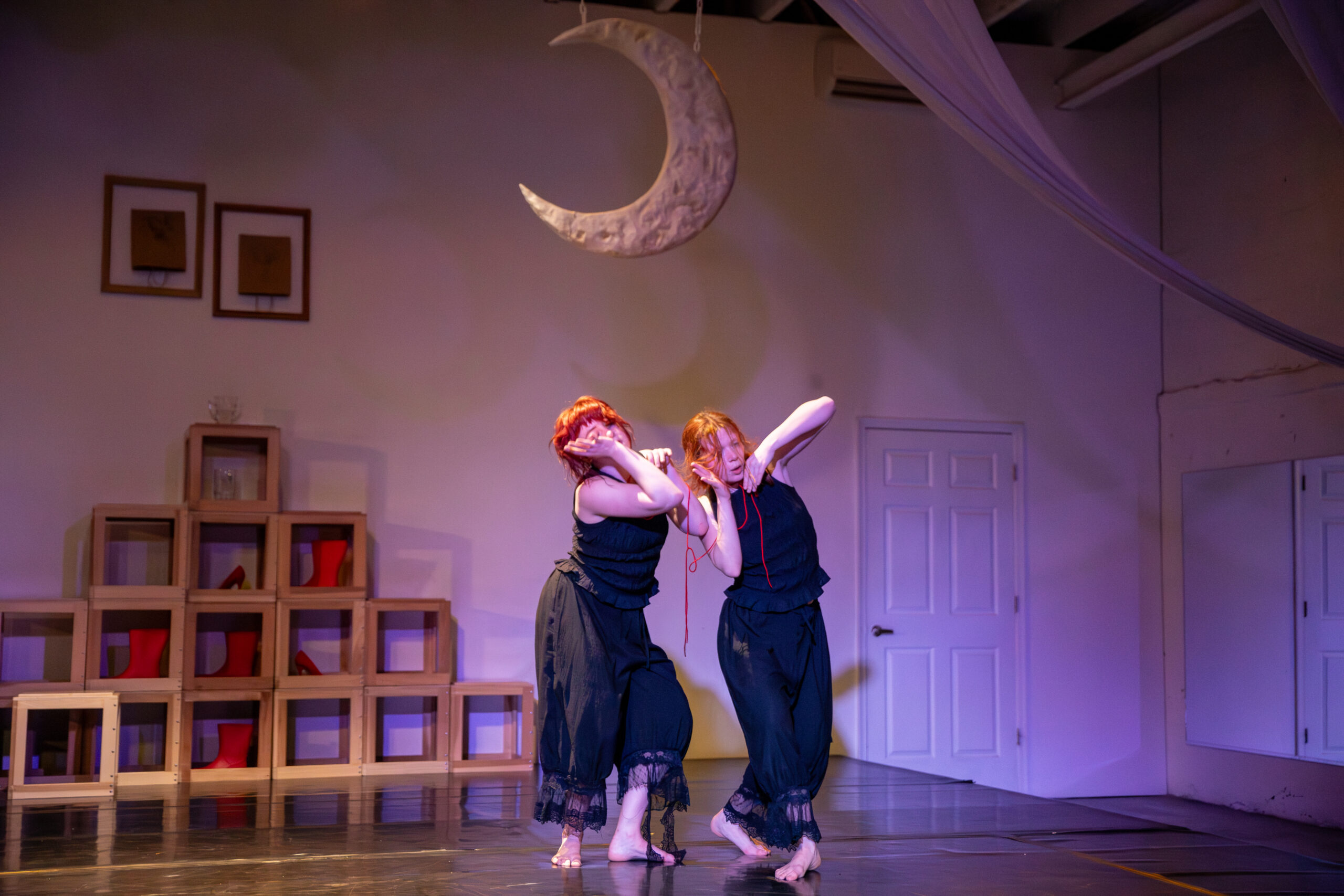
The two women begin on the floor with small gestures of shared touching, each move catalyzing a larger response that moves the bodies in space. It is an organic creep of universally symbolic mannerisms—a laying of hands on a shoulder, a hip, then an embrace—with dancers lying, sitting, and then standing. They are individuals, travel mates, like minds, comrades, engaged in sharing word and body-speak. The conversations echo the physical crescendo and structure of this work: the women soliloquize, dialogue, mirror, and declare. Individual stories about relationships gone wrong, delineated first on separate pathways, become shared experiences, delivered either in back and forth exchanges, or as performers to the public, or to the space itself. The constant exchange between these three elements adds layers to stories already sustained by exhaustively threshed-out movement sequences, brilliantly executed with Whitney Casal’s decisively strong, clear physicality and Ella Cuda’s emotionally-charged yet gentle stage presence. Cuda’s story is told more through her countenance than her body. Their contrasting movement style reminds us of the great diversity between close companions; watching them work side by side is a lesson in co-existence.
This conversation runs the gamut—self-confessional, kvetching, doubting, regenerative, motivational—using multiple settings to communicate meaning. At one point the duo, while dressing and undressing in articles pulled from a corner-stage pile, talk to the public. The awry skirt buttoning, shirt inside-out, and out-of-norm fashion pairings—all the result of purposeful distraction while multi-tasking—accompany the recounting of a fairly absurd story of chocolate crème pastries told with a humor and deftness that set up the next scene. Here we see Whitney and Ella as vixen-like, where they rule as stereotypes such as Charlie’s Angels, fashion models, vapid ladder climbers, and self-absorbed femme fatales. Bent over, bottoms to the audience, shimmying and looking at us upside-down, the double-edged self-acknowledgement works by means of keen timing and delivery, making the episode entertaining, even memorable. A soulful tale of loss and growth has Casal twitching, writhing, and slashing through floor rolls, runs, rushes, and ecstatic/desperate air-born reaches, first slowly, then frenetically, and suddenly we see her story, no words needed. In this evolution, Casal lets loose, revealing her remarkable expressivity and dynamism. Cuda’s spot-on, tongue-in-cheek delivery as talk-show host reporting on the ways women can avoid molestation and physical violence (“Ladies, realize that you actually bring rape upon yourselves! Avoid peak hours—in the early a.m., mid-morning, early afternoon, early evening and late evening, dead of night…”) fills in the blanks, as Whitney covers herself with every piece of clothing available.
Especially admirable are the thematic development and pacing of the raw movement material, the well-dosed verbal interventions, the strongly evident collaboration of the women, and their strong commitment to performance. How’s that for a coffee break?
Coffee?, Ella Cuda and Whitney Casal, Mama’s Wellness Joint, September 23-24, http://fringearts.com/event/coffee/