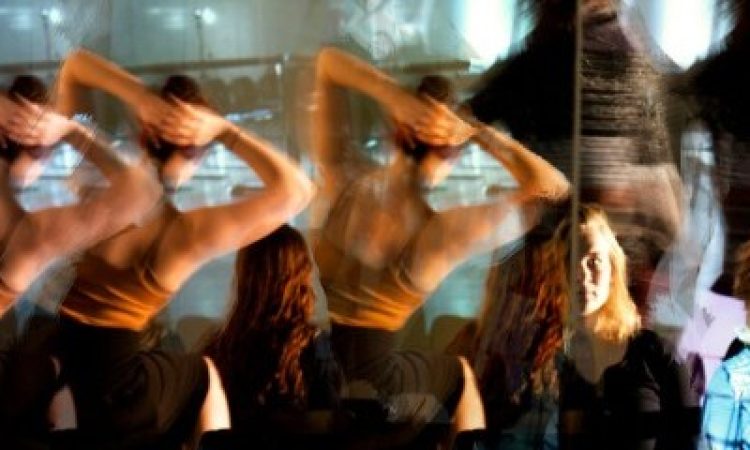
We sit in clumps of chairs, back-to-back and eye-to-eye, audience stacked upon audience with a foot and a half of space between rows. The audience fills up the tiny dance studio.
Performers stand in the bay windows, frozen in balletic stances, but more captivating are the images cast on the white walls. Cameras are positioned around the room, capturing live feed of the audience, casting us in grainy real-time onto walls and corners. Across from me, an entire wall is taken up with larger-than-life footage of a row of people who are deliberately not looking at themselves.
Erika Janko, the choreographer of The Performers and a current Swarthmore student, bills herself as “a movement artist who researches social phenomena through performance.” The subject is us, and how we are always looking at ourselves, projecting our images, curating our own public persona. Here, that impulse of self-projection is indulged, but we lose control, the ability to curate.
Behind me, another camera is trained directly on a college-aged woman. She sat casually for a while, but now she reclines on the empty seats to her right, now she holds her hand up to block her face, now she looks right at the camera and laughs with her friends, trying to take back control.
Suddenly five performers stand up from among the audience and begin to throw themselves around the room. They stagger through the little spaces along the walls and between audiences, crammed into narrow causeways, lurching forward in ungainly stumbles then pulling back, sheltering themselves from being seen, laughing with embarrassment. They are so earnest it is almost charming, if a little annoying, a little transparent. By one of the bay windows, a dancer is plagued by two gadflies: she is repeatedly lifted gently into ballet moves by a fellow dancer, and then pushed back down by another. This cycle repeats without pause.
I notice that the slightly sweaty smell of the dance studio is cut by something acrid and sweet. Sitting diagonally across from me, someone who appears to be an audience member applies nail polish to her nails—and then her fingers, and then her hands, and her wrist, and her arms. Every time I look away and look back, she is slashing red onto her arms while she cranes her neck to look around the room.
The Performers, Erica Janko, University City Arts League, 4226 Spruce Street, September 24, fringearts.com/the-performers/.