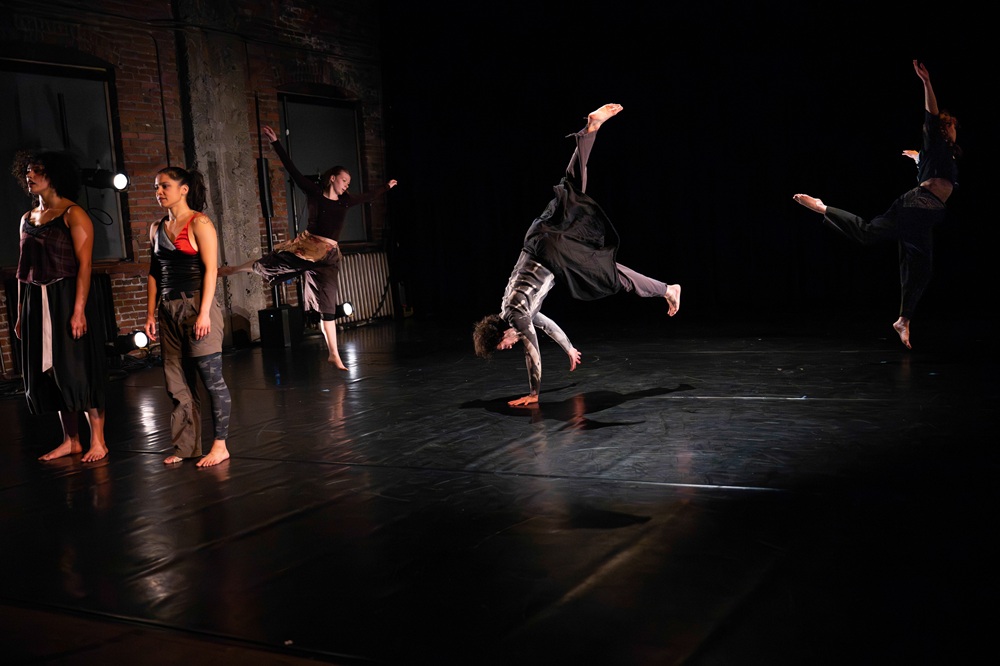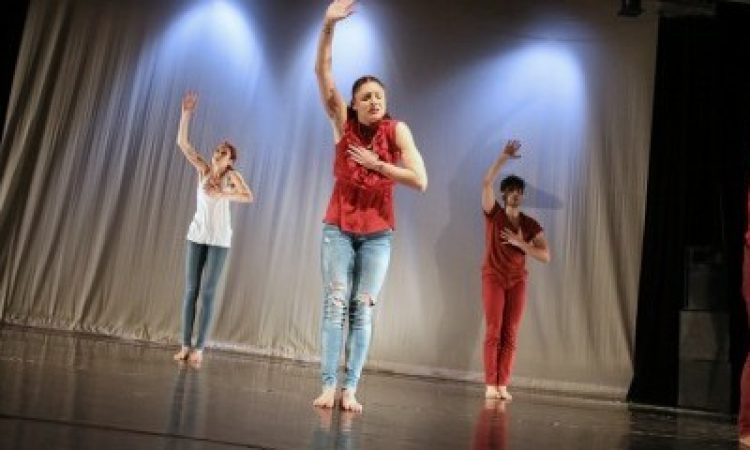
It’s a stormy Thursday morning and Putty Dance is rehearsing iStand: Stories of an American Civil Struggle, a collection of pieces to be performed on October 9 at the Painted Bride Art Center. Over the sound system, horns flare. Drums cascade gently. Sweat drips. A group of dancers reach, twist, and collapse in unison, as if driven by an invisible, collective force.
Then a siren rises, fast and shrill. The dancers stop and shudder. Hands tremble toward ears. Shoulders fall forward, chests slump to knees. I no longer see dancers, only bodies, shrinking from a sound we have all come to recognize and fear—though some more than others, maybe, and with different treacherous undercurrents.
By the time the siren fades, all unity is lost. Dancers eye one another suspiciously and evacuate the stage, except Chloe O. Davis, who remains, casting her head frantically in different directions. Is it paranoia or justifiable fear? At times, in the world we live in, it appears difficult—even irrelevant—to separate the two.
Lauren Putty White, artistic director of Putty Dance, choreographed iStand after witnessing the civil unrest in her hometown of Baltimore born out of the tragic death of Freddie Gray. Some of the most evident references to police brutality and the American fight for racial justice within iStand come from the soundtrack, a collection of musical scores composed by Lauren’s husband and creative partner Brent White. From sirens to clips of police commands (“Hands up!”) to a child’s recitation of the Pledge of Allegiance, I am confronted with the bitter irony of racism’s hold on a country that promises “liberty and justice for all.”
This sentiment emerges forcefully through the choreography as well. Joe Gonzalez performs a solo that starts with a singular pulsing of the chest, as if his heart is leaping toward autonomy. He raises his fist to the audience and undulates gleefully, giving the typically somber Black Power salute a decidedly jolly affect. Then he is shot. He stumbles backward. His hands stretch to the sky, a fearful surrender, and the solo ends as he places one hand over his heart, the same heart that struggled to fight its way to freedom.
But in iStand, humans rise up again and again. There are falls and recoveries. There is death and resurrection. There is dissolution and there is renewed unity. The body is at once victim and victor, home to both the evidence of injustice and the keys to salvation.
In these months and years of civil unrest, I have found words to be fragile, fleeting, at times wholly inadequate. This show’s presentation of the body as both a testament and a force left me burning to act, to move, to dance. It left me believing in the power of action, in the power of people joining forces. This victory over cynicism is no small thing. It is not the kind of thing I expect from a glimpse at a rehearsal, and I can only imagine the power of the show.
There is a moment, during a duet with Amanda Edwards and Colin Heininger, when Amanda flies into Colin’s waiting arms. He catches her, whirling with the fiery energy of her leap. Their bodies, intertwined, spring toward the back wall of the stage, narrowly avoiding a collision, prompting startled laughter from those observing. It’s a mistake, of course—and yet also, in the context of this show, it isn’t. I can almost imagine, in that moment, if they had kept going, they might have broken through that wall. They might have flown straight out of this building, through the wind and rain and on to something better, to somewhere brilliant and dazzling and new.
iStand: Stories of an American Civil Struggle, Putty Dance Project, Painted Bride Art Center, October 9 at 3 pm. paintedbride.org/events/istand/