Halfway through Rememberer, right around another funky, polyrhythmic breakdown, my notes stopped consisting of words and instead resembled a poorly drawn comic strip with stick figures and something that looks like Stonehenge. I wasn’t sure how else to keep track of what I was seeing.
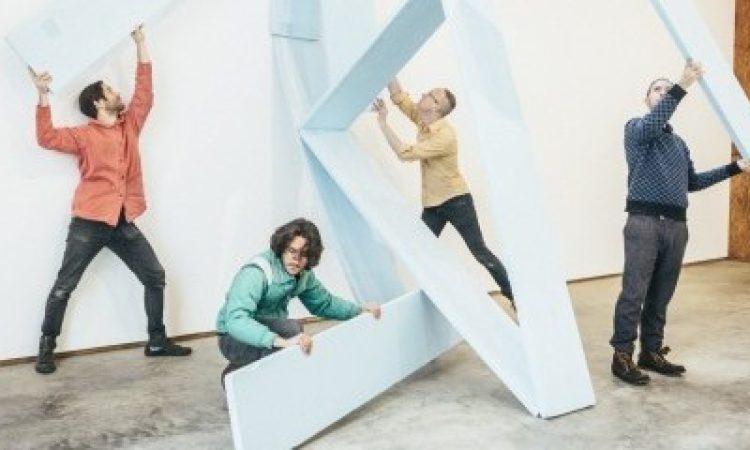
Over the course of the hour-long performance, director-performer Steven Reker and his band Open House (Matt Evans, Eliot Krimsky, and Ryan Seaton) built a sculpture out of long, flat foam boards balanced against each other and spanning the width of the stage. They did all this while also performing as musicians, seamlessly switching between stacking foam boards and playing guitars, drums, and synthesizers. This is how you smudge lines between live performance, performance art, sculpture, music videos, and fun.
The stage at American Dance Institute (ADI) in Rockville, Maryland, didn’t have much of a set. The foam boards were piled in 10-foot stacks and also served as surfaces for keyboards and synthesizers. A guitar hung neck-down from underneath a stepladder; in front of the stepladder was a snare drum with a cowbell attached. A single white balloon on a white string floated behind the drums. The set had the markings of earnest joy and roiling creativity; it looked like a shared practice room used by dozens of bands that have gigged and toured together for years.
Above all, Rememberer is joyful. These four guys clearly love making music together, and the same craft and precision that went into stitching together the guitar riffs, spaced-out synth bass lines, and triangle solos also went into creating a choreography of sorts that was more theater and world-building than it was movement-based. But the performance’s score and framework—essentially, a 55-minute pop song—left plenty of space for avant-garde noisemaking and surrealist sculpture building. Contact mics were placed on some of the foam board to create crackling textures. The guitar hanging under the ladder was pointed at an amplifier and allowed to feedback on itself.
As the musicians created the minimal structure, piece by piece, it was almost easy to forget that this was a live music performance—in fact, the music was one continuous piece. It was a veritable landscape of peaks and valleys, minimalist derivations, and thunderous crescendos. There was no formal verse-and-chorus structure but the composition was full of a melodic, pop sensibility—although with few discernible lyrics, the one real downside of the show, as it was a missing lens for the work and an unfortunate blemish on otherwise superb sound production. While the word “operatic” occurred to me, it tips the scales too far toward the “serious” side of the musical equation. Ultimately, Reker gets to have it both ways: making serious work without taking himself too seriously, and the result is an accessible art that is straight-up fun.
The sculptured world-building was also a loving tribute to the objects that make performance possible: a microphone, framed perfectly by a triangle of foam boards, glowed a golden yellow; the triangle player was spun around on a carpet; a vintage-looking white amp hung from the light rigs like a second moon; tambourines were hung on giant lengths of rope and swirled above the guys’ heads. And while the music itself often felt like “music for musicians”—technical polyrhythms and layered references to New York’s 1970s and ’80s rock and psychedelic scenes—there wasn’t any of the pretentiousness that usually goes along with that style. The audience bobbed along for the full hour and laughed with honest surprise as the piece progressed.
Nowadays it’s almost eye rolling when a performance describes itself as “genre-defying” or “genreless.” It seems few things aren’t hybrid in one way or another. While both the show’s program and the pre-show talk by ADI’s dramaturg Melanie George were deliberately vague, that kind of label nonetheless seemed appropriate in this case. As the other lights dimmed, one light remained, pointed at the active amp-as-moon, the remaining source of sound from the beat machine and synth. But when the lights cut completely, someone intentionally knocked over one of the boards, which knocked over the next; in the lingering murk of unlit smoke-machine fog, we peered at the dimly lit stage and watched the rest of the structure find the ground. “Experience first, contemplate later,” Melanie George advised in her pre-show talk. I did, and I still am.
Rememberer, Steven Reker / Open House, American Dance Institute, September 30 – October 1.