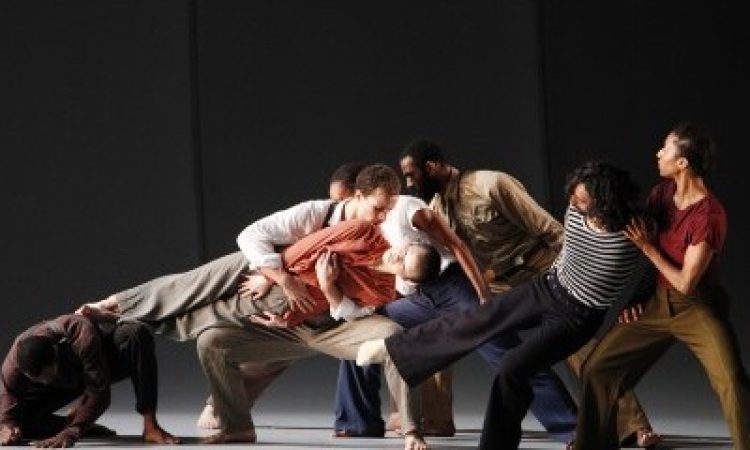
Through all the years I’ve viewed his works, Bill T. Jones has exposed what lies at the underbelly of his explorations, never stopping to nurse the discomfort of disturbed viewers.
Extolled with many accolades, including the Kennedy Center Honor, a MacArthur Fellowship, and two Tony Awards, Bill T. Jones is arguably one of the leading movement artists of our time.
Continuing to tell stories, he escorts audiences into politically charged worlds, even when confronted with criticism like that of Arlene Croce calling Still/Here, one of his seminal works, “victim art.” Employing decor, text, and technology, and presenting his works with rich history, deep biographical offerings, and raw honesty, Jones seldom shies away from topics some may consider controversial.
Opening DANCECleveland‘s 2016 season, Bill T. Jones/Arnie Zane Dance Company’s collaboration with the University of Akron ended a week-long residency with a performance of Analogy/Dora: Tramontane, the first installation in Jones’s proposed Analogy: A Trilogy.
The retelling of 95-year old Dora Amelan’s oral history, Tramontane (which translates as “a person who lives beyond the mountains”), is the product of interviews Jones conducted with Dora, the title character in the piece. Using a blend of theater, dance, and live music, Jones and his company of dancers tell the story of the Jewish nurse, who, during World War II, lived through her own activism in Vichy, France.
Bjorn Amelan (Jones’s husband, and Dora’s son), designed the wide sloping sheet of marley, stretching from the upstage fly loft to the edge of the stage, that serves as both backdrop and dance floor. Adding to the décor were two microphones planted on a table, framed by two stools downstage right, and three platform cut-outs, seemingly two inches thick, rising from the flat surface of the stark off-white marley. The almost empty space was inviting and desolate, waiting to be painted.
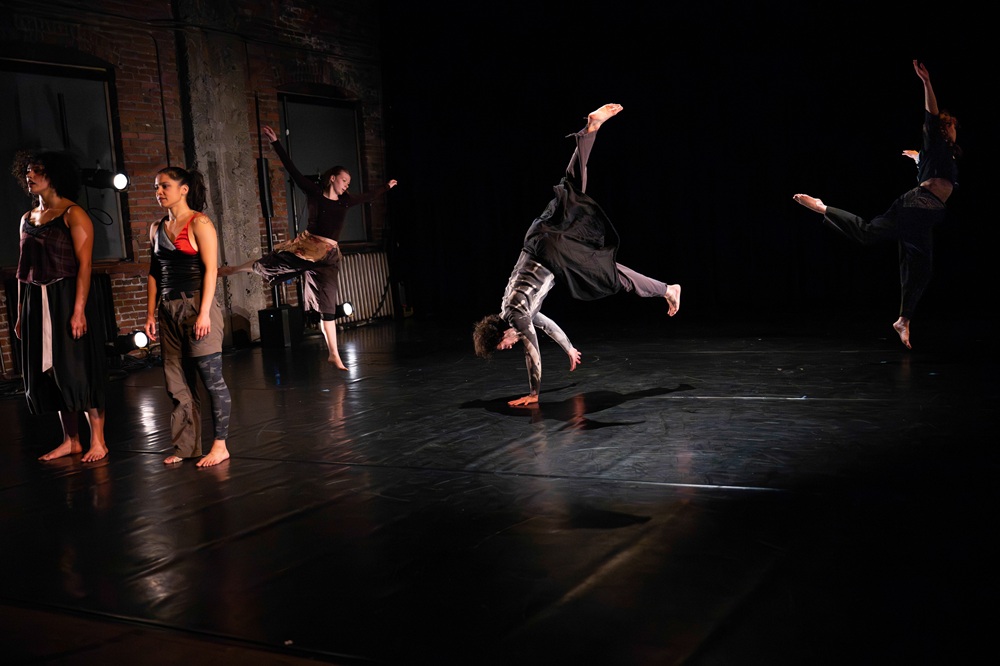
A lone spotlight illuminated the downstage table, while eight dancers stood in the dimly lit space before moving to rearrange the three platform pieces. They maneuvered through the space, lifting and shifting the cut-outs, shuffling and reconfiguring the pieces to create new environments—old memories repeatedly re-arranged. Layering the complexity of Dora’s story was the live musical soundscape by Nick Hallet, which combined German Romantic lieder and classic pop music from the 1980s and ’90s.
While I appreciated the dancers shifting roles between mover and narrator, sharing the microphone as they relived parts of Dora’s passage, her plight may have been easier to understand if the main character were relegated to one person—at least for those of us who needed help staying focused on the through-line Jones attempted to create.
Serving as an ellipsis at the end of each dancer’s recitation, the music erupted into chaotic trills, creating support for a hailstorm of movements. This cacophony of movement either recreated visible signs of Dora’s early life in Belgium, the death of her mother, her work at an underground Jewish organization in Vichy’s internment camps, or simply an energetic contrast to an otherwise tenderly told tale.
The dancers’ tempo slowed as the piece inched toward the finish line: the somber story of Dora’s sister’s failed abortion was delivered with melancholic tones as dancer I-Ling Liu stood with her back against a wall built from the cut-outs. She clawed at her lower abdomen with tension-ridden fingers, gathering the dress she wore as if to silence her pain.
With the intensity of the subject matter, the moving cutouts, and Jones’s choreography, Tramontane could benefit from some editing. Still, as the dancers revealed Dora’s story while parading against the backdrop of each strategically placed platform, it was easy for me to forget I was at a dance performance.
Bill T. Jones/ Arnie Zane Company, Analogy/Dora: Tramontane, E. J. Thomas Hall, University of Akron, October 9, www.dancecleveland.org