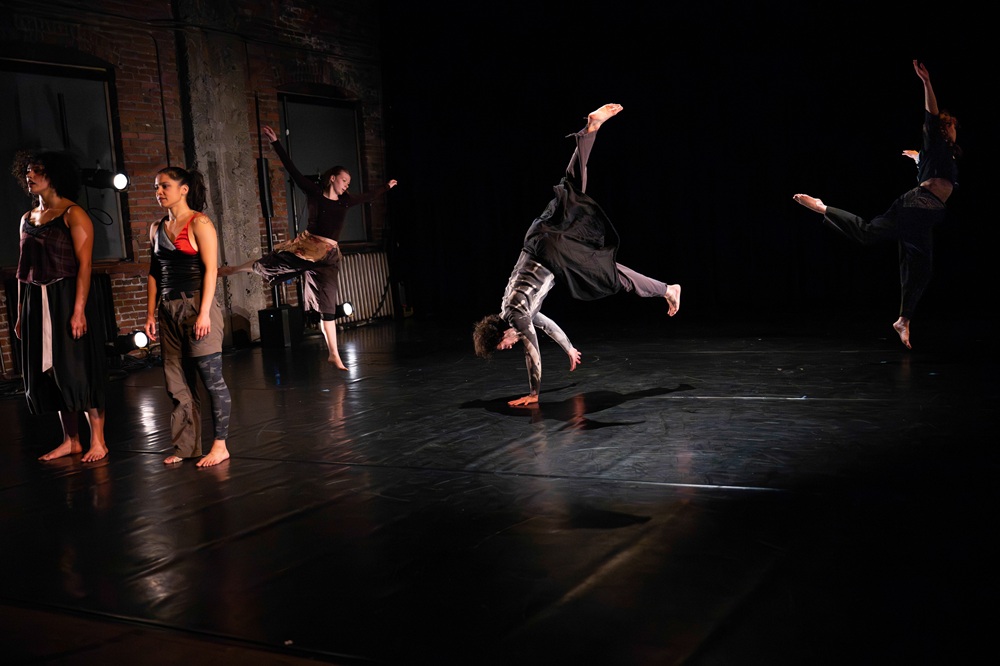
In the recent RUBBERBANDance Group workshop, offered free to Philadelphia dance professionals as part of the NextMove Dance Series, Victor Quijada focused his teaching fundamentally on a concept he called “spatial interaction.” Quijada’s choreographic style originates from his background as a b-boy who crossed over into the ballet and contemporary dance worlds as a member of Tharp!, Ballet Tech/Feld Ballets, and Les Grands Ballets Canadiens de Montréal. Quijada, artistic director and founder of the company, now in its fifteenth season, generated the RUBBERBAND Method in order to teach performers from varying backgrounds how to safely embody his style, a fusion between breaking and contemporary dance.
I imagine that the air surrounding my body is thicker. I feel pressure downward on top of my skull and shoulders. Instead of slouching to that pressure, I expand upward. Now I imagine the air pressing along the front of my body. I could cave to that pressure and collapse backward, but instead I send my body into it. My body now takes the shape of “superman” (head lifted, chest and ribs forward, on my tip toes), but air also pushes from behind, so to stay balanced, I have to inflate my ribs backward. I feel the density of the surrounding space pressing in toward me from all directions, so I channel Newton’s Third and meet it with equal and opposite expansion. All I am doing now is standing straight, aligned, and very still, but I am energized, vibrating, invisibly interacting with the negative space around me. I have experienced this feeling before, on stage as a performer. I call it presence. This is when Quijada’s RUBBERBAND Method clicks for me, when he names this invisible phenomenon as a feature of “spatial interaction.”
As a participant in the workshop, my impression of Quijada’s style is that it feels quieter than mainstream hip-hop. In one exercise, we isolate different joints and send them along linear pathways, stopping our motion every other count. While each dancer is doing his or her independent dance, the whole group is unified by a simple rhythmic structure. The movements reference “popping,” another technique under the umbrella of hip-hop. However, instead of “hitting” each shape with an energetic tensing of the whole body, Quijada asks us to simply arrive at stillness, without reverberation. I recognize this same energized quietness when viewing his choreography.
What I drew from this workshop was the idea that as dancers we can treat space with a kind of elasticity. Modern and contemporary dancers may be used to the idea that space is something to “carve” through; Quijada’s approach takes it a step further and allows this spatial density to be malleable, with different surfaces of the body being affected by different densities. He encouraged participants to fully understand this concept of “spatial interaction,” though an hour and a half of experimenting did not feel like enough time to truly embody it. But the workshop was exposure enough to recognize the method underneath Quijada’s choreographic work and the skill with which his dancers commanded the space.

RUBBERBAND Method Workshop, October 14, free class to professionals offered through the NextMove Dance Series. RUBBERBANDance Group, Prince Theater, October 13-16. Read Kirsten Kaschock’s review of RUBBERBANDance Group.