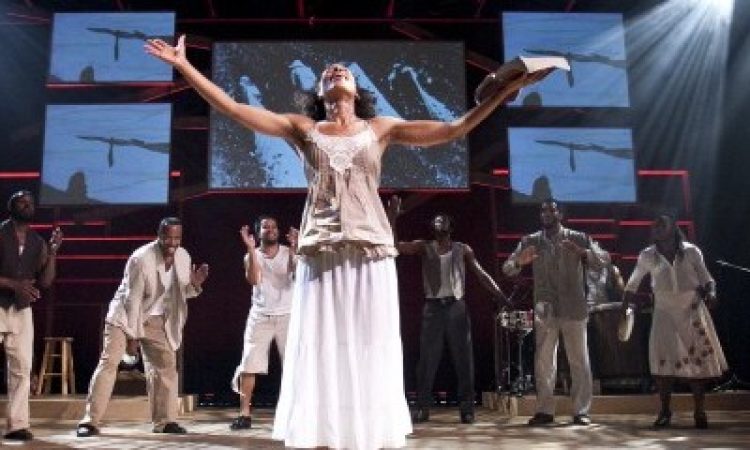
This performance communicated a sense of both struggle and accomplishment to the audience. Each scene powerfully depicted, through music, dance, and rhythm, African American struggles post-slavery. Step Afrika! is an emotional experience that clearly touched every member of the audience. (Erin McComb, Temple University student – The Philadelphia Dance Experience)
Can dance-theater be a means of educating, of drawing audiences to a visceral experience of narratives, of bringing to life concepts that, when experienced as text alone, can seem abstract and distant? Step Afrika!, a Washington, D.C.-based troupe of multi-talented performers, takes on that challenge. Two thINKingDANCE writers brought their undergraduate students to The Migration: Reflections on Jacob Lawrence, and culled student responses from several classes to this theatrical experience. We think they got it.
As a visual learner, being able to see the actual dances reinforced what I have read in Barbara Glass’s African American Dance (McFarland, 2012), conveying the important story of African Americans. I found the entire performance very moving and exciting; you could see the performers’ enjoyment actively displayed in their facial and corporeal expression. (Anthony Henderson, Temple University student – The Jazz Century in America)
How were the performers able to bring excitement to this story? What sources did C. Brian Williams (company founder and executive director) and Mfoniso Akpan (artistic director), and collaborators draw on to craft this powerful statement?
Step Afrika! leads the world into the twenty-first century with its specific fusion of West African traditional dance, step dance from historically black Greek organizations, and percussion. Each dancer commanded amazing technique and rhythm as well as a deep understanding of portrayed narrative. (Charley Johnson, Franklin & Marshall College student – Writing Dance)
From a thematic and design perspective, as the program title indicates, the narrative was driven by visual art works projected on large screens upstage of the performers. These images depicted the experiences of African Americans—a people in motion, under oppression, at work, and in transit, from their first brutal exposure to American soil to their migrations northward.
The choreographer’s intention was very direct: to illustrate, in dance form, Jacob Lawrence’s paintings. I believe it was also to show the liveliness each person had, even when up against all odds in the South and then in the emotion-filled journey as they moved to the North. We witnessed transformations in status, states of mind, culture, community, point-of-view, and so much more, always with the sense of open encouragement to explore, observe, and discover. (Ali Urusow, Temple University student – The Philadelphia Dance Experience)
And movement contributed powerfully to this theatrical collaboration, shaping and projecting this narrative entertainment.
The performance told stories through bodies—through the feet and hands of the narrators. The dancers’ hands clapped, hit, and waved. Feet stomped, slid, and tapped. Torsos swayed and grooved. The soulfully smooth, high-energy performance took sound and movement of black bodies and intertwined them to display the beauty and persistence of a culture. (Anna Kaiser, Franklin & Marshall College student – Writing Dance)
While impeccably rehearsed, the work’s drumming, singing, acting, and dancing never had a feeling of sameness, of a well-oiled machine ho-humming along. Rather, each performer told the story that poured from his or her depths, in a vibrantly woven tapestry of sound and movement.
Step Afrika! beautifully fused precision and individuality. Each dancer performed the same percussive movement with individuality and flair, never missing a beat, muffling the sounds, or mistaking the rhythms. (Alyssa Raifsnyder, Franklin & Marshall College student – Writing Dance)
The Step Afrika! performance was an ideal trigger for the deepening of student understanding of movement. It was like an I.V. shot, quickening our faith in the teaching/learning exchange and in the efficacy of movement as a viable language for all, especially vitalized by the deep connection percussion inevitably creates. The evening was a gift of the dance gods—ashe!
Step Afrika! Annenberg Center Live, University of Pennsylvania, Nov. 3-5, annenbergcenter.org/event/step-afrika