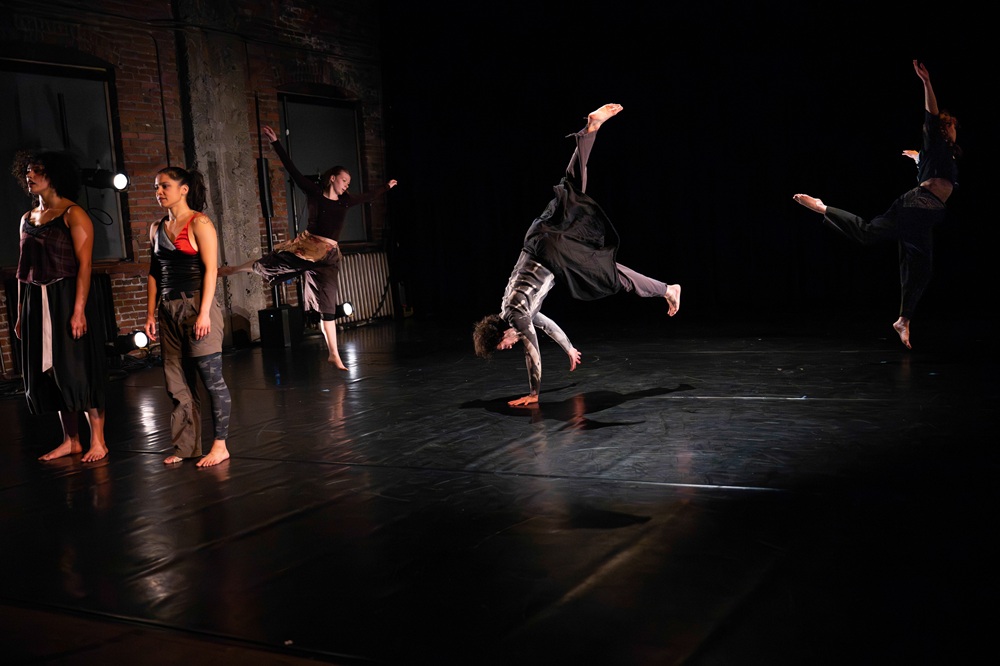
In The Fleecing, an immersive and interactive creation by Almanac Dance Circus Theater, the audience plays the part of a conclave gathered in a mystical world to participate in an elaborate ritual and test the performers, or “devotees.” Even the marketing materials are consistent with the fantasy, announcing the tragic death of the Bumblefish and urging us to come and do our duty to select the successor. It is a witty and alluring world where Douglas Adams meets Monty Python meets Almanac’s signature pairing of earnest, personal theatricality and circus feats. The setting is a raw basement, transformed by ornate lamps, vaguely occult statues and curiosities, velvet curtains, and ominous red lights.
The piece is a journey through hilarity, pomp and circumstance, and odd rituals. Performers execute circus tricks and inhabit intimate corners. There is a culminating song and dance number. Continuous surprises and unexpected jokes keep me delighted, and a little on edge.
The bulk of the evening is the testing of the devotees, played by a cast of diversely talented local artists, plus the visiting Adam Kerbel, a founding member of Almanac who now lives in LA. Each has their own station and the audience wanders freely between them, equipped with a handful of clear plastic gems, or “talistheys” (a gender neutral alternative to talisman).
At each station we are offered a choice, paid for by one of the gems, that elicits a change in the performance.
Words, or actions?
All as one, or all alone?
A number, or a place?
Tic tac, or guidance?
We try to figure out the game, to understand the enigmatic logic that governs the devotees’ behavior. Sometimes, we watch them struggle and, if we can figure out the rules, we have the power to push them further or to offer relief. Underneath the entertaining framework of the show, there is a pervading tension in the way the devotees, isolated in their islands and bound by their tasks, invite us into an intimacy that seems ultimately incomplete.
Nick Gillette, playing the Democratic Socialist, twists and twitches, fingers searching and eyes fervent, then swings from the banisters and tumbles on the floor. When I choose “words” he delivers a breathless monologue about the source of human cruelty and the impossibility of really understanding another person. He moves closer and becomes increasingly desperate, eventually grabbing my shoulders and almost in tears until someone else comes by and chooses “actions,” sucking him instantaneously away and into movement, which I now see as an equally impassioned and futile attempt at communication. Percussionist Karen Smith fills the space with her sensitive and nuanced beats, but sits behind her drum and a pair of dark glasses with a slightly removed smile. Melissa Krodman sits in a secluded booth and quietly transforms herself into whichever character I choose as my psychic medium. The intimacy here is tempered by how swiftly the first character vanishes and the next appears. There are a handful of others I could have chosen, written on cards laid out in front of us, and as we talk I feel an uneasy sense of impermanence and farce.
I have a vague notion through all of this that the gems are being collected and counted as votes, but I feel more like I’m at a carnival, being encouraged to spend tokens for treats and entertainment, which are actually covering up something deep and possibly dark. I keep getting transfixed and wind up not even seeing all of the performers. I have my doubts about the validity of this selection process—I’m unclear on the rules, and the number of gems each devotee receives seems more dependent on the nature of their game than on audience preference.
Perhaps this is the fleecing for which the show is named—a process absurd enough to mask its injustice, and so much fun we don’t mind the absurdity.
The Fleecing, Almanac Dance Circus Theater, the basement of Power Plant Productions, December 8-9, 2016, http://www.thealmanac.us/works/thefleecing/.