Ten minutes after the show is supposed to start, I raise my eyes to see Randy Swartz, artistic director of NextMove Dance, standing in the corner with two technicians communicating with the backstage crew. Soon after, David Parsons sneaks out from behind the stage curtain, and they both approach the microphone, apologizing for the delay, but the “Diva Drones” are acting up.
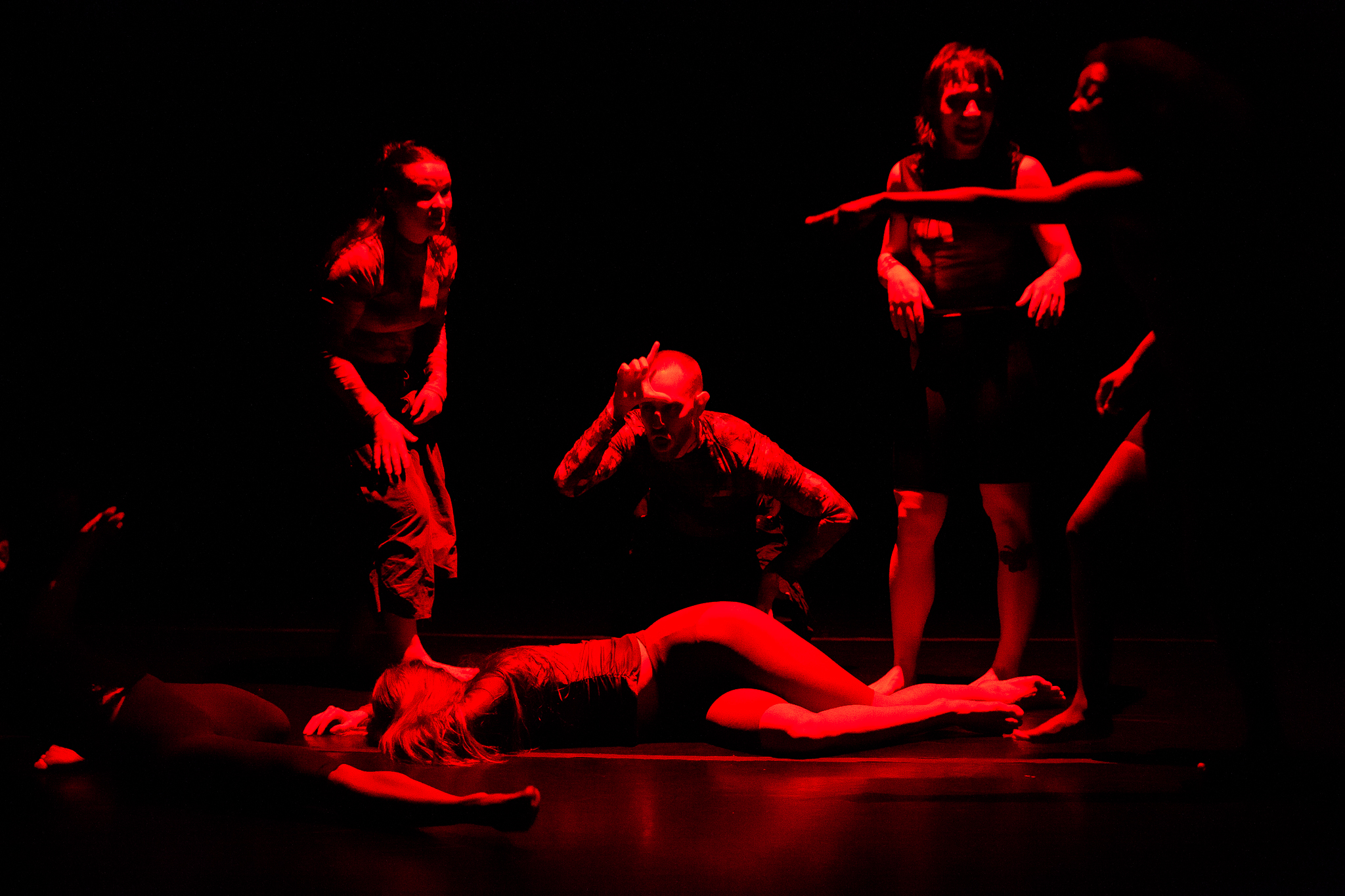
The Machines, a world premiere, is a collaboration between Parsons Dance and Drexel University student engineers, who built the computer-programmed drones using only $500 worth of materials. In the darkness, we hear fans whirl and see tiny reflections as the drones lift into the space. The low red lights, designed by Parsons Dance co-founder, Tony Award-winning Howell Binkley, fade in on a mass of dancers crawling downstage. They wear tight-fitting leotards and safety glasses, which glint as they glance suspiciously at the hovering machines. John Mackey’s musical score shapes this work, with blaring horns and musical phrases that sound sci-fi movie-esque. On a number of occasions, the music reminds me of the themes to Jurassic Park and Back to the Future. The dancers, responding to this score, shake, jump, teeter, and react to the subtle movements of the drones, sometimes appearing like robots themselves.
In the audience, I chuckle at the humor in this piece, though I’m not sure if Parsons’ comedy is intentional, as I hear no other laughter in the audience. In a moment I find particularly funny, the score shifts to a triumphant major-key fanfare. Six dancers stand with their arms in V shapes, three high, three low. They slowly press their arms down and up, respectively. A reel of sci-fi movie images pop into my head—the spaceship landing, the walkway lowering, a person lifted into an alien abduction. I’m thrilled by these references, though I don’t think they are intentional. My mom, my date for the night, doesn’t grasp this meaning from the work. Instead, she thinks the music overpowers the visual contrast between the dancers and the drones. My reaction is the opposite. The music makes this work—it creates a cinematic universe where it’s possible for drones and dancers to interact on stage.
As a safety check before the start of The Machines, we can see the technicians rehearse the drones’ programming onstage during intermission. They hover, shift side-to-side, drop suddenly, and almost collide with each other. They are interesting to watch and appear playful, less menacing than the music and the dancers seem to imply. Yet, when the same “choreography” is performed with high-energy dancers, these subtle movements feel tame and less noticeable. How could this collaboration appear more spontaneous and surprising? Could there be “live interaction” between the machine and dancer? As Drexel Engineering professor Dr. Youngmoo Kim states during a break, these scientific innovations take time to perfect and develop, but they become achievable when the arts and sciences are given opportunities to collaborate.
The Machines only makes use of eight and a half minutes of the evening’s program, which also presents more traditional dance works. Parsons’ technique includes modern dance themes—contractions of the spine, precise angular and curved shapes—but his style is “hyped up” with faster tempos, shoulder isolations, and more encouragement to “let loose” than one might see in Graham’s technique. I see traces of these modernistic themes in Parsons’ other works. Notable among these is his iconic solo, Caught (1982), which uses strobe light to capture the fabulous Ian Spring mid-jump, displaying image after image of Spring hovering in the air.
David Parsons sees the potential for drones to break the fourth wall and fly over the audience. His vision is to explore the choreographic potential of technology and to participate in its evolution, perhaps even to the extent that he no longer needs dancers. Ooof, that’s a scary thought. But given that many dance companies are facing declining audiences, perhaps it is important to consider the future of technology and dance.
I sense that Parsons’ work is committed to exploring flight in choreography, given the dancers’ stamina for jumping and Spring’s frozen airborne moments in Caught. Combining dance with drones seems to be the natural next step towards choreographing the air. I look forward to seeing how this concept will give rise to new collaborations between technique and technology.
Parsons Dance, The Prince Theater, December 7-11. http://www.parsonsdance.org