The embodied monuments by transmasculine artist Cassils in the PAFA exhibition Melt/Carve/Forge are heavy, a lot to hold, and are intended to be so. Across the room, a video installation of Cassils’ bare torso pressing against an ice casting of a Grecian male depicts a body melting into another form (an endurance work; a statement on the fluidity of shape as it correlates to gender; a jab at the classical, heteronormative, cisgender history of Western art). Across the rotunda, inside PAFA’s Frank Furness building, is a grid of photographs showing Cassils’ body from right side to center to left side, depicting their 23-week performance piece gaining 23 pounds of muscle (another endurance work and a statement on the power and agency of trans bodies).
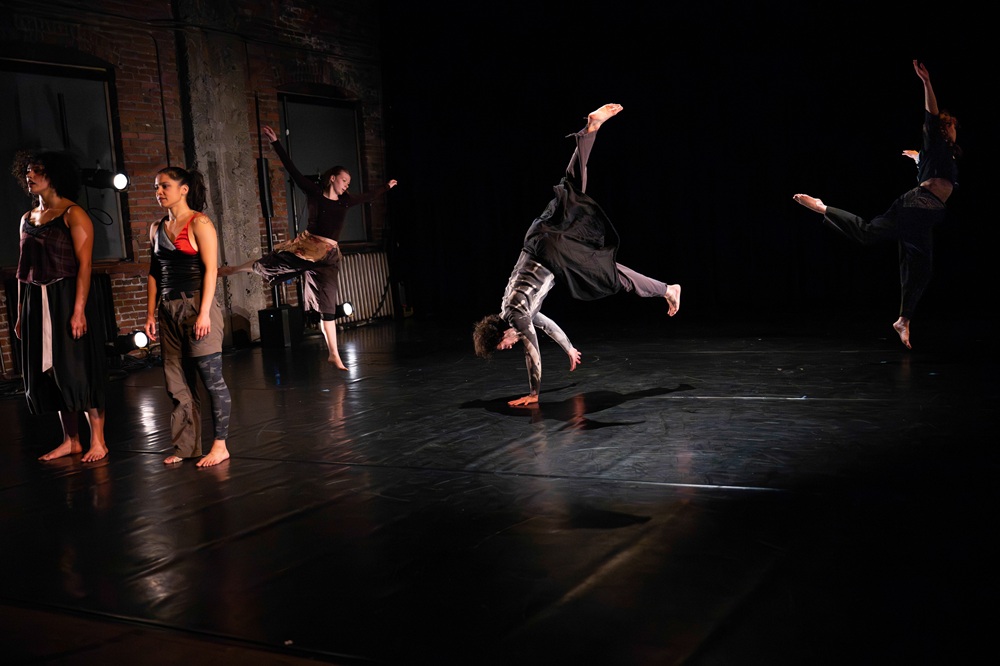
When Graffito Works begins the first set of their site-specific improvisation, I am standing beside the projection of the melting body forms, watching various members of the ensemble lay themselves atop Beau Hancock in the middle of the room. Lee Fogel steps aside to observe. The sound accompaniment of Julius Masri thrums with low, steady notes. The four dancers, including Hancock, begin a slow-motion slide off one another’s backs to the floor. Their slow but weighted action, and endurance, are gripping.
As I have been this week, as have many of us, my attention pulls back and forth between the gravity of the moment (the weight of trans bodies made visible, of the bodies in front of me responding in real time), and the gravity of Trump’s tenure as President (the weight of all of us, hurtling towards the unknown). I am afraid, I am so afraid.
I slip downstairs.
The gallery is wallpapered with images of the audience viewing of Cassils’ performance Becoming an Image during which the artist pummels and pounds a massive clay obelisk with taped wrists, forming a monument to trans victims of violence with their audience as witness. Photos of Cassils in the performance mounted on the walls are a testament to the artist’s persistence in performance. They are sweaty, the small muscles of their abdomen rippling outward like an echo, their face screwed in effort. In some of the photos, their chest is bound, in others they are clad only in a nude pair of underwear and protective wrist wraps. A gnarled bronze recasting of Cassils’ original clay monolith looms into my line of vision immediately entering the room. Up close, you can see the lines of fingerprints from hand-contact.
As I enter the room, I see Meg Foley first, walking with painstaking intention and slowness. Cassils’ soundscape Ghost is playing through speakers; a recording of their grunts, their yells, the thumps of their heart pounding, breath rattling, and, perhaps most sickeningly, the fleshy thwack of their body against the clay. Foley, Zornitsa Stoyanova, and Megan Mazarick all move agonizingly, tortuously. Their necks twist around and back on their spines; I see their tendons, and it looks like they might gag.
The very second the dance ends, the exact moment the last of the trio leaves, my fellow spectators swarm the room, frenzied in what felt to me like an attempt to clear the unsettled energy, to dissipate the weight.
I saw Graffito Works perform exactly 40 hours before Donald Trump was inaugurated as President. To the invisible bodies: I will be your audience. I will see you. You are not unwitnessed. You are not unloved.
Graffito Works, Pennsylvania Academy of the Fine Arts, Jan. 19t’. https://www.pafa.org/events/pafa-after-dark-themed-night-and-out