Thomas Choinacky is a movement artist. Thomas Choinacky is an architect. Thomas Choinacky is a time traveler. Thomas Choinacky is a man I saw perform a self-choreographed solo titled A User’s Manual in which he moved into the current-space, built the walls of previous-spaces, and envisioned the objects in future-spaces.
Thomas Choinacky is lanky as hell and I love the gawky intricacies of his movement; he stands, for example, with his hands positioned on his hips as if they were stuffed in pockets, but instead are merely lain atop his pants. I sense that kind of “heldness” in his body that people get when they know they are being watched, and it’s not bad. It’s just honest. He’s looked each of us in the eye, after all.
(Outside of The Beard Cave, located on Penn’s campus, Choinacky led us one- or two-at-a-time to a desk inside the performance space holding markers, clear sheets of plastic, and a wooden frame that housed three slabs of thick glass in different levels of grooves. After welcoming my boyfriend and me, he asked us to brood on our day and to create a movement map, on the plastic sheet, that reflects something of it, whatever we wanted. I thought of what I did, where I went, and what I saw, including the movement maps residing on small note cards and large sketching sheets in the hallway tonight, and began to mark down wavy lines. We placed our maps into one of the slots in the wooden frame and then were led to the center of the floor. Choinacky carried two foldout chairs for each of us. Gesturing to the lines of folks already seated, he explained that the audience would be set up with alley style seating, meaning two rows, and that we were free to pick where our two chairs would rest. We chose a corner. Choinacky placed our chairs down, watched us take our seats, and kindly thanked us for coming.)
(Still inside the Beard Cave, after all the bodies were on the chairs, Choinacky continued the ritualistic process of bringing the chairs out, guiding them through the set up, placing them intentionally, and thanking the objects for their presence. This repeated until the chairs ran out and Choinacky’s introductory script petered off into silences and pauses and the swoop of an arm added to a walk and so on.)
Although we did not receive the outline of Choinacky’s movement score until after the performance, I was able to guess the gist of it while watching. The beauty and endurance of A User’s Manual necessitates that viewers place themselves within Choinacky’s kinesthetic psyche, to not only ask, “What is he feeling?”, but also, “Where is he now?”, “Where was this object before?”, “Where will this go?” I feel sensitized watching him side step and shuffle into a jump with one leg in the air, suspended, before commenting that he’d like to “do that again,” and then doing it again.
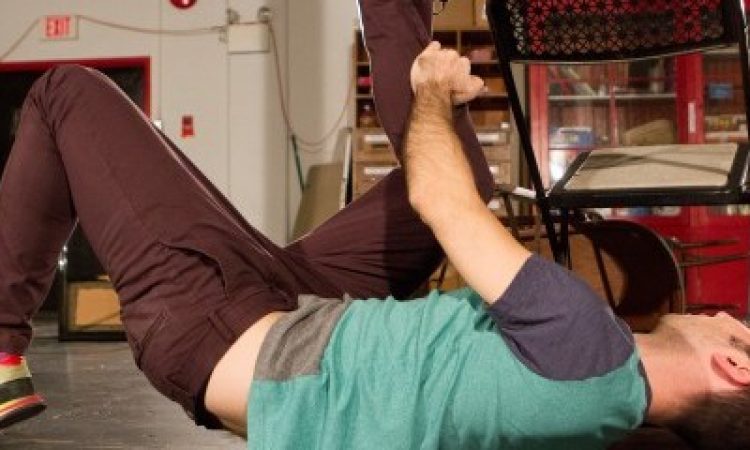
It is a beautiful puzzle, the attempt to construct the architecture from the outside in, watching Choinacky flit past the concrete pillars and pipes while trying to piece together what he’s experiencing, embodying, divulging. Curled in a heap on the floor, at one point, Choinacky recounts an eve before the performance of this solo when he got food poisoning, when he had “never performed with more care.” At another, he leaps into a rather leprechaun-ish hop and grabs at the air with a random “meow.” Later, he builds a river out of chairs that might have once run through The Beard Cave long ago.
The irony of my trying to recreate the space where Choinacky recreated many old and now and soon-to-be spaces isn’t lost on me. I suppose the tenderness, the meat of it, of A User’s Manual is in the doing, the using of it, in the construction.
A User’s Manual, Thomas Choinacky, The Beard Cave, February 9-18th, 2017. http://www.philadelphiadance.org/calendar/index.php?eID=9011