After a season comprised mostly of big-name choreographers presenting only their works, Aspen Santa Fe Ballet’s (ASFB) collection of repertory from three choreographers was a refreshing conclusion to NextMove’s 2016-17 Season. While any single artist can display great range, ASFB’s mixed bill reminded me of the value of multiple voices. The program showed Philly audiences three commissioned pieces, Eudaemonia (2017) by Cherice Barton, Silent Ghost (2015) by Alejandro Cerrudo, and Huma Rojo (2016) by Cayetano Soto.
As part of the company’s Philadelphia visit, Craig Black, in his sixth season with ASFB, led a traditional ballet master class, open to the public.* Black focused many of the combinations on shifting our weight between one foot and the next, asking us to engage our core muscles. In center floor, he challenged us to really travel and eat up the space—“because how often do you get to dance in a massive studio like this?” In demonstrating combinations, he twisted his spine and danced big, asking for a wider range of motion while still staying true to classical technique. “Don’t get too contemporary,” he said, over-crossing his legs and curving his spine; “save that for rep!”
It was clear from their performance that all of the dancers in ASFB had versatile training—they were grounded in ballet but experienced in contemporary forms. These dancers knew how to move from their pelvises, harness their weight, counterbalance and be off-balance, roll on the floor, and jump with spectacular ballet ballon.
The program began with Barton’s Eudaemonia, a series of vignettes about happiness: a mother with her children, dancing in a club, spiritual uplift, smiling even when sad. This work felt honest, sweet, and egalitarian, as if it was made with and for these dancers. Framing the stage floor with strings of soft bulbs, the lighting, designed by Seah Johnson, made a stunning visual environment. Though the dancers moved in and out of various duets, I was particularly struck that none of them felt like love duets (a theme so hard to avoid when two bodies interact non-verbally). To me, this was a choreographic success.
Cerrudo’s Silent Ghost, a seemingly themeless contemporary work, featured strong structural partnering and beautiful lines. In a notable duet (interpretable as a love duet), dancer Seia Rassenti Watson hugged Anthony Tiedeman from behind, and as he dipped his torso forward, all the way to the ground, she lifted her legs to the ceiling. The shape that resulted was a vertical X, with Tiedeman’s feet on the ground and Watson’s in the air. Yet, despite some beautiful moments in this work, it was, overall, monotone and unvarying. I also noticed gendered patterns: the men were choreographed to jump, fling, and roll, whereas the women mostly stayed low, knelt, and stretched with sleepy soft dynamics. I found these choices trite.
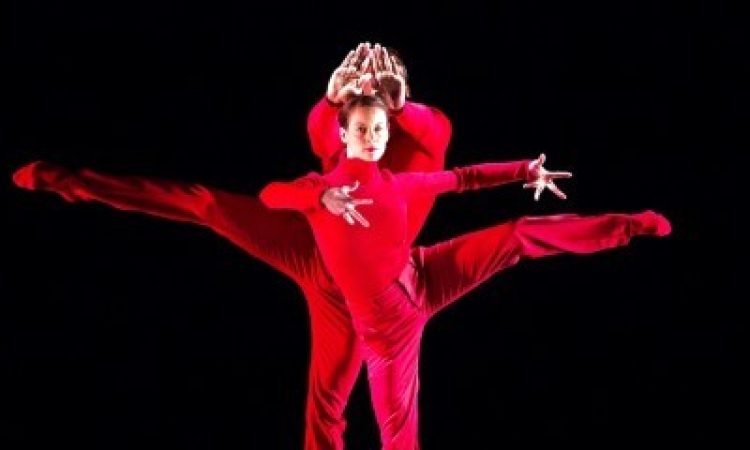
Finishing the evening with stunning hilarity was Soto’s Huma Rojo. The choreography featured campy gestural themes of sexuality—preening, peacocking, thrusting, covering and uncovering the genitals. Dancing to retro tunes with Latin rhythms, like “Quezás, Quezás, Quezás” and “Whatever Lola Wants,” the performers were dressed in bright red shirts, pants, and socks. They often focused their eyes directly forward, as if saying to the audience, “I know you’re looking at me, and I like it.” How different this was from the class I took earlier! Both male and female performers danced with the same bold, macho, and unabashedly sexual intensity, equally embodying the absurdity of seduction. It cunningly placed Spanish clichés of aggressive masculinity in a universal light. Are we not all “dressing up” our behaviors to attract that special someone?
*Prior class/performance explorations from the NextMove Studio: RUBBERBANDance Group, Doug Varone and Dancers, Malpaso Dance Company, and Jessica Lang Dance.
Aspen Santa Fe Ballet Master Class, Friday May 5, free class to Philadelphia dance professionals offered through NextMove Dance at University of the Arts. Aspen Santa Fe Ballet, Prince Theater, May 3-7, 2017.