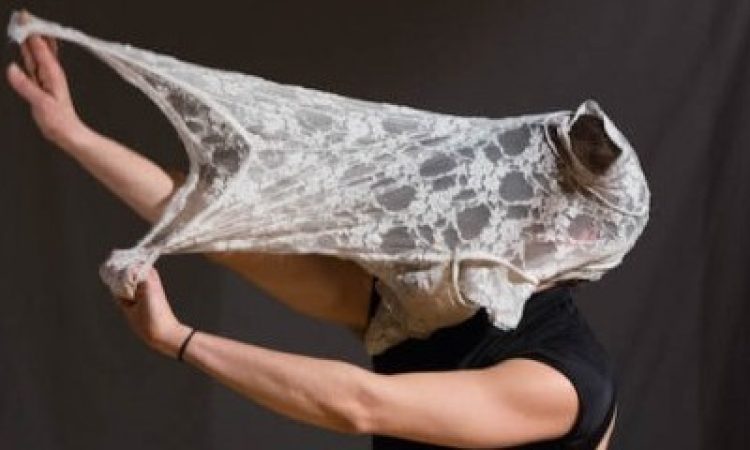
tD writer Nicole Bindler interviews Israeli-American circus and dance artist Noa Schnitzer about the content and motivation for her new interdisciplinary solo The Currency of Belief, to be presented at this year’s Fringe Festival.
Nicole Bindler: In your promo video I see I see dance, circus, clown, theater, puppetry . . . What is your training, and how do you hybridize different techniques in your work?
Noa Schnitzer: I started my training at Sandciel, a circus school in Israel. I got into working on skills and exploring possibilities on the trapeze. Throughout the year we had a variety of movement classes such as Contact Improvisation, contemporary dance, Laban Movement Analysis, Gaga, acro-dance, Yoga, and holistic ballet. Contact Improvisation and Gaga made a strong impression on me, and I find my home in these practices. After this training I moved to the pacific northwest of the U.S. where I grew as a performing artist, performing on local open stages. In my artistic process I ask the question, “What do I want to say, and what is the best way to say it?” I have my toolbox of different skills to draw on depending on what I want to say.
NB: What is your process for creating work, and what inspired The Currency of Belief?
NS: For the past couple of years my main drive for creating work is exploring the elements of change. Right now I’m asking questions about the gap between who we are and who we want to be.
When I first started talking about the show I had many ideas. When I shared them with Deanna, my director and co-creator, she was like, “Hold on, you have just described three different shows. Let’s just take one concept.” So we decided to focus on my Jewish heritage and upbringing.
There were some things I knew I wanted to work with, such as clown. I love storytelling and wanted to weave a tapestry of stories, some literal and some more abstract. Improvisation in dance and aerial are two important tools in my exploration.
NB: Who are your collaborators and what is your relationship to them?
NS: The Lookout Arts Quarry is a magical residential arts center established by artists, for artists near Bellingham, WA. I did an artist residency there, and created the bulk of the show in December.
Deanna Fleysher is a clown teacher, improviser, and performer. We met at the Lookout Arts Quarry. She was directing a spaghetti western and offering weekly clown classes. We got to know one another through her classes, and I learned that she’s into Pilates (I’m a Pilates instructor). I suggested a trade: I helped Deanna strengthen her abdominal core, and she helped me strengthen my clown core.
Heather Dawn Sparks (aka Noodles) lives at the Lookout Arts Quarry. She made the shadow props, and helped choreograph the shadow sections in the show. She creates anything from large scale installations to small, detailed shadow puppets. While living at the Lookout Arts Quarry I got into exploring the shadow world with her. We would have late night shadow/dance jams in the studio.
NB: Is there a political element to your work?
NS: The Currency of Belief touches on female oppression. That is the only oppression I have experienced. As a white Jew living in the U.S. or Israel, I have a privileged path behind and in front of me. My responsibility toward our collective human growth is to speak out and act out against injustices. This responsibility and ability to show up is a lifelong practice. To show up we need to acknowledge where we are are at. This is what I unpack in my work.
NB: How does your Jewish identity play a role in your work?
NS: My Jewish identity is like a small creek. Sometimes it feels like it’s flowing, and sometimes it feels dry. I grew up orthodox and no longer practice. I’m in search of the thing that will relight my spiritual wick. Lately I feel like I need to invest in reconstructing my wick. This show, in a way, holds space for that longing, to be reconstructed, to come to peace with who I was. My heritage is Jewish, but as the person I am now, how can I relate to Judaism?
The Currency of Belief, Noa Schnitzer, Christ Church Neighborhood House, September 7-9.