Faye (Tess Kunik) lies on her back behind the house where she spent so many of her summers as a girl. There is a malignancy growing in her gut. She lifts a metal bucket, her arms extended and tense, and tips it, pouring black soil over her belly. At the window, Honey (Bi Jean Ngo) opens her mouth in horror. Her knee lifts, wide eyes casting upward as her back extends. What is she seeing? Is this her nightmare, or Faye’s?
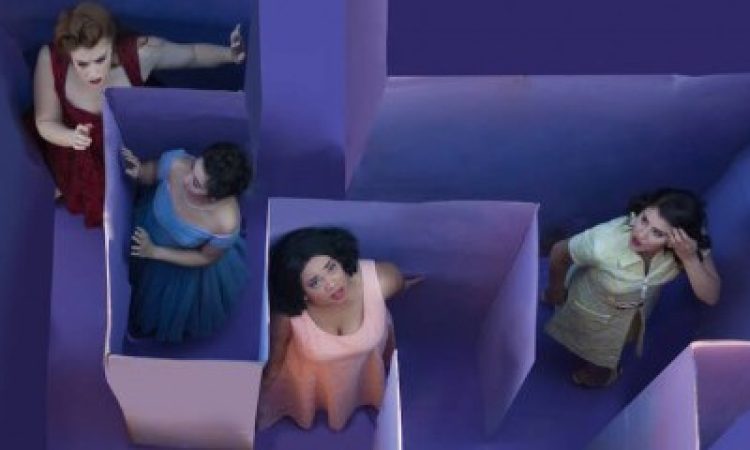
In Strange Tenants, Sam Tower + Ensemble’s first full-length performance since 901 Nowhere Street (2015), four women arrive at a ramshackle house, drawn together by a mysterious letter and a shared history. These estranged friends, once so close, each have something to hide; they tell lie after lie until they fall together into a confused nightmare.
Though Strange Tenants owes a lot to Hitchcockian thrillers and melodramatic tropes, its characters could be seen as alternate versions of the Nowhere Street women, who, instead of becoming film noir stereotypes, simply grew up in the 1940’s and ’50’s and became what many women at that time would have become.
The characters develop shared desperation for familial achievement, the demands of which are at odds with their true selves: one keeps getting dumped when her fiancés find out she’s a lesbian, another is having a child out of wedlock and lies about it, another kidnaps the son of a man who wouldn’t marry her because of her Armenian heritage.
Director and choreographer Sam Tower overlays dance and dramatic tools to tell stories co-created by the entire artistic team (I interviewed her last year to talk about this mixing). Narrative and plot provide framework, but the performers carry multiple physical languages in their bodies: naturalism, dance, and a sharp, stylized melodrama that both complicates and bridges the other two.
With these tools, Tower weaves together dream, interior emotion, and reality to obscure perspective, and we soon leave narrative behind. Sequences become less and less literal until the audience and characters are completely lost in distressing hallucinations that recall abstract, cinematic horror like Suspiria.
Strange Tenants is at its best when it’s a stylized nightmare. The sequences at times become muddled and unclear, the characters and plot can feel undefined, and its script is a bit repetitive. But there are more than enough moments of brilliance and clarity in this ambitious piece to make it worth seeing.
Strange Tenants, Sam Tower + Ensemble, Power Plant Productions, September 7-17.