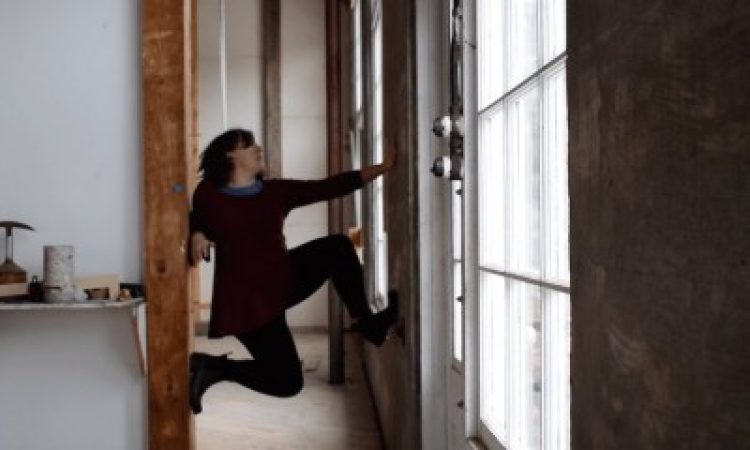
Our bodies are engaged in a constant struggle against invisible forces. In A1, a series of photos and videos accessible through an online portal (here!) via the 2017 Digital Fringe, performer Mira Treatman dramatizes her body’s conflict with gravity and time. In each video she faces a problem posed either by a preexisting formation—such as a tree or a doorway—or a problem deliberately produced—such as two A-frame ladders alongside one another, or a wooden log sliced in half.
In a video called Fulcrum, one half of a bisected log sits atop the other, so that together, they are round and rollable. Treatman lies on them, stomach-down, then eases her balance forward, placing her head on the ground, and begins to lift her legs into the air. The top half of the log shifts backward with gravity, and Treatman shudders downward with it. She readjusts the log and attempts the headstand again. Her attempt to find stasis becomes more visual drama than dance.
“[S]ome may not consider A1 to be dance,” says Treatman in an ABOUT tab on the website, “because there’s no dance-ing really at all. A1 offers numerous attempts at solving physical problems through dance thinking.”
Little in A1 is graceful. Treatman approaches her exercises like they are stretches, not dances. She works to create a particular visual image, and if she succeeds, she holds it for a moment, just long enough to take a photo, then progresses to the next image.
Yet there is a geometrical elegance to Treatman’s framing. We see the ladders at a 90-degree angle, so they appear two-dimensional. The wall is two-dimensional, and the spliced log, also, could just be a circle. When she performs on a sloped hill, she is in a clearing with the hill slanting down behind her, delineated by trees; it is as if the screen is slashed diagonally into two parts—grass and trees—which her body alone crosses. More than any live performance, these perfectly placed moments are meant for a single viewer.
These scenes and images are at rest until Treatman appears. While gravity is the problem she must solve, in these deliberately framed worlds that her body invades, she becomes gravity itself.
A1, Mira Treatman, online starting Sept 7 with a live performance Sept 24 at Da Vinci Art Alliance, http://fringearts.com/event/a1/