New York, NY– Circles are broken. Histories disappear. Names vanish. This is the legacy of the colonial and post-colonial Congo that Faustin Linyekula confronts as an artist of fierce, impassioned invention.
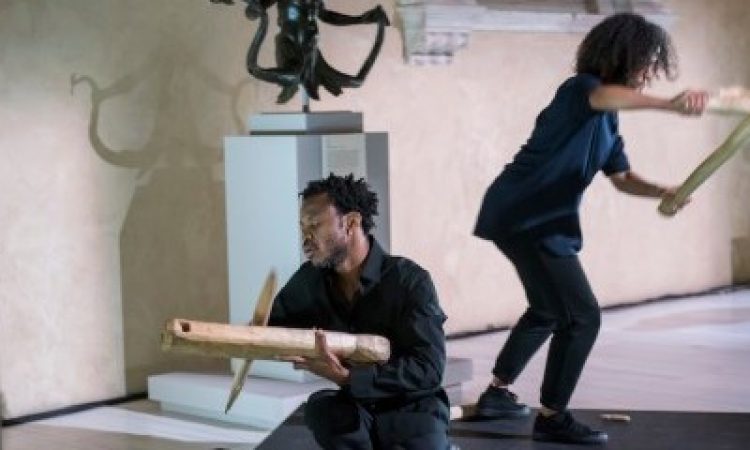
Linyekula’s newest work, Banataba, is a duet he choreographed for a Spanish Renaissance courtyard at the Metropolitan Museum of Art, co-presented by the Met and the French Institute Alliance Français as part of the Crossing the Line Festival 2017. Linyekula and South African dancer Moya Michael enter the mysteriously dark space in black flowing robes. Swaying along circular pathways, they gently transfer back and forth a cloth bundle bound in rope that could contain a child, a relic, or a gift.
The two dancers intermittently hum, sing, or speak, at times in coordination with pre-recorded music, to provide context and texture for Linyekula’s journey back in time. A video shows an African village with an informal group engaged in call and response singing and then a boat making its way down the broad Congo River. The video screen is a low plinth at the base of a large enigmatic sculptural form, covered with cloth and bound by rope.
When Linyekula and Michael unwrap the small bundle they reveal seven disassembled pieces of a male figure carved in wood. Linyekula in his research of the Met’s unexhibited African collections had found work from his own ancestral area, and he then visited his mother’s village of her Lengola tribe where he commissioned the sculpting of this figure. In the performance, the dancers strike the bare wood body parts on the marble floor, generating sounds that animate them. Linyekula and Michael shake and shudder in trance-like movements transcending human states. Later he sings a mournful incantation with eyes closed as she pats and slaps all parts of his body. When they move in unison, their straight unbent arms slap their thighs to ascend again as outstretched salutations.
When the dancers finally assemble the wooden figure and place him a few feet before the audience we see these same outstretched arms of the Lengola figure that inspired this dance and helped connect Linyekula to his past. We also see projected, within the frame of one of the courtyard’s marble windows, photos of faces of the children and adults in the village he visited. Artists like Linyekula mend broken circles.
Banataba, Faustin Linyekula, The Metropolitan Museum of Art, Sept. 9 & 10; In Search of Dinozord, co-presented with NYU Skirball, Sept. 22 & 23; Festival of Dreams, co-presented with Dancing in the Streets and 651 ARTS, Sept. 23 & 24, www.crossingtheline.org.
* thINKingDANCE reviewed Linyekula’s Le Cargo in the 2016 Fringe Festival.