Every now and again, adults need a little reminder that life is extraordinary and magical. In A Billion Nights on Earth, theatre director Thaddeus Phillips and visual artist Steven Dufala tell a tale of wonder through immense object theatre and shadow play to inspire adult and child alike. As this allegory shows, there is a world where only the child knows how to survive because adults have lost the natural instinct. At the heart of human evolution over a billion years—through ice, sea, land, and space—is creativity.
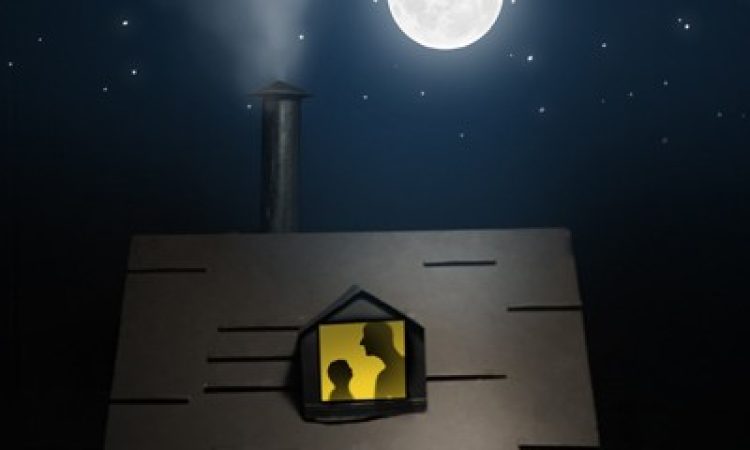
In the first few minutes, we meet father and son and all the elements around which this child’s imagination revolves: a rocket, a whale, a wooden ship, and a telescope. In a child’s experience, there is space and time to submerge oneself into the story and life of each thing, to see beyond it as an object. “Dad, the rocket is about to launch!” a kid yells from a slanted roof serving as our stage, with excitement.
As adults, we see the imagination of a child as larger than life. We know there is no real rocket, but for this kid, it is launching. How many times, when you were a child, did you see something extraordinary, only to find the adults didn’t have time to stop and see it too?
As dad falls asleep on his office desk, his son’s voice echoes: “Hoist the sails!” Two stagehands attach ropes to hooks on the edge of the roof and lift, revealing a refrigerator in a haze of fog. This ordinary object becomes a mysterious entryway. The dad steps through, coffee cup in hand, and stumbles, unprepared, into the Ice Age.
This is a dreamscape where child will teach parent, tracing the evolution of land, creatures, and humans all the way into space. They learn to make fire by listening to the sounds of sticks. They submerge into a vast ocean made of fabric. They seek out a broken rocket to fix. They trace steps through the subway system. All in the quest to find a lost stuffed whale.
This piece is full of delicious moments of beauty and awe as the actors interact with innovative stage-crafting, light and sound design. Though I feel a couple of these conventions to be slightly overhanded at times, I ultimately have to remember that I am an adult—my sight is obscured by years of adult-ing. A Billion Nights on Earth is an adult’s lesson in falling out of reality, into the expansiveness of a child’s imagination, in order to remind ourselves how extraordinary this world truly is.
A Billion Nights on Earth, Thaddeus Phillips and Steven Dufala, FringeArts, Sept. 14-17, http://fringearts.com/event/a-billion-nights-on-earth/