Mistress of the Maze, conceived and choreographed by dancer and fabric artist Sarah Carr, offers an interpretation of iconography found in Minoan archeological artifacts. Carr expresses in a program note that she wishes to “create a piece that evokes the power and beauty of the female principle central to Minoan religion, which Greek myth and European archeological interpretations ignored or deliberately pushed aside.*
The work begins with a slow prelude. Music plays while light shines on the empty space. This prelude seems out of place—it is more typical to three-act narrative ballets. I shift uncomfortably in my seat as I wait for something to happen.
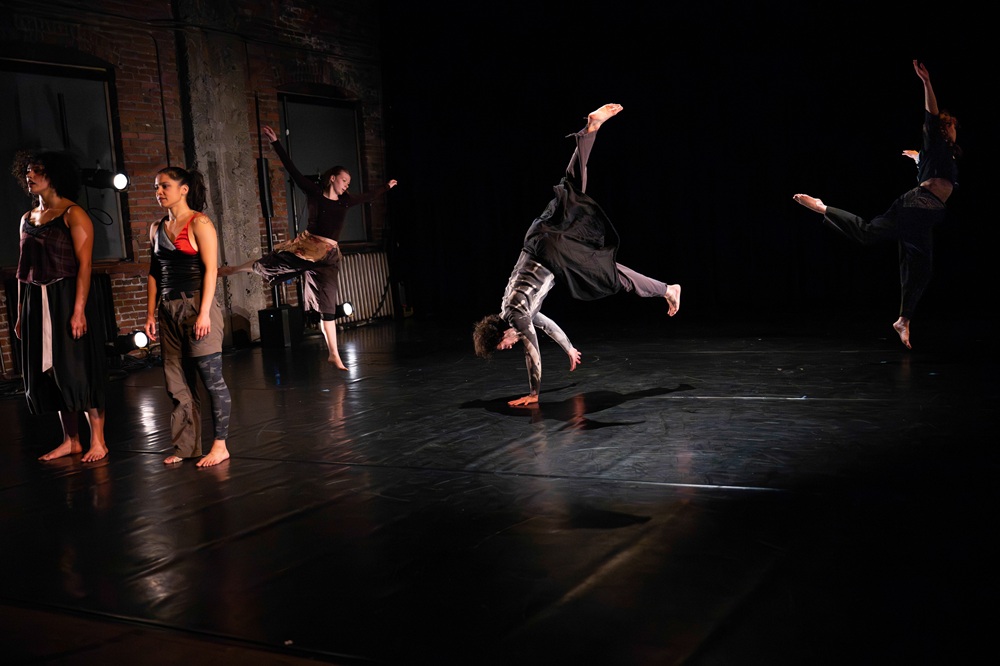
At last, a woman, draped in a sheer tunic, enters and pliés deeply in second position. She swoops her leg into an extended arabesque, swinging it to the side in a flexed foot attitude. She turns her body to profile, twisting so that we see her two-dimensionally. The choreography is languid, with one movement reserved for each beat, and I crave dynamic changes. Gradually, two women join her, performing similarly recognizable steps. Again, I’m reminded of classical ballets where narrative takes place in transitions between danced variations.
Each dancer performs a solo, and I’m struck by the lack of differentiation among their movement vocabularies. It is clear that they are meant to convey different characters: one dancer is wrapped with a snake-like rope, another dons fabric wings. But few of the movements convey meaning, and I soon lose interest. The dancers lack the performance qualities necessary to push past the amalgamation of steps into an embodiment of character.
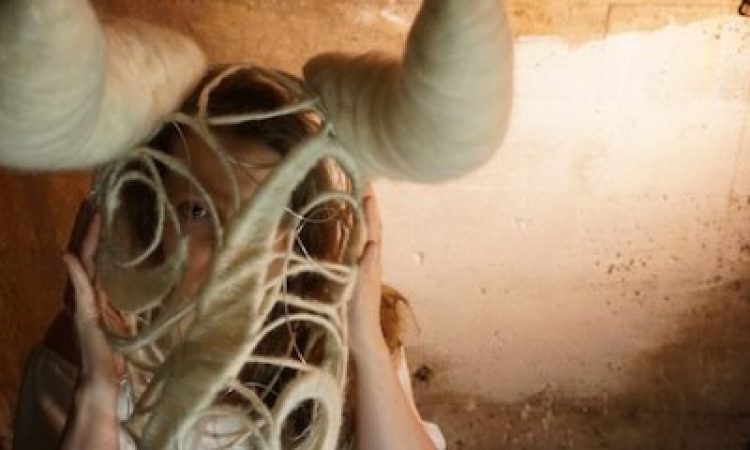
The handcrafted masks created by Carr carry this work forward. A man joins the three women in a brief pas de quatre. Soon, the women place a woven wired mask upon his head. It swirls before his face, creating an abstract shape of a snout with white felt-wrapped bullhorns. He is a Minotaur. Once this transformation is complete, I become more interested in his character. With his face obscured, meaning comes through, and I see his leaps across the stage as attempts to leave his prison.
While the masks clearly reference the Minoan story, Carr’s intention to convey feminine power falls short. The use of ballet vocabulary conjures an ideology that I see as historically oppressive to women. The performers display their strengths through leggy, yet wobbly, extensions, but in their blank faces and shifting eyes, I do not sense empowerment, only frailty.
* Yet there is Martha Graham’s large body of works, inspired by ancient myths, that feature powerful women. Indeed, Graham too grappled with the story of the minotaur and his deadly labyrinth in Errand into the Maze, a precedent mentioned nowhere in this show’s program.
Mistress of the Maze, WeftWorks, CHI Movement Arts Center, September 16-17 http://fringearts.com/event/mistress-of-the-maze/