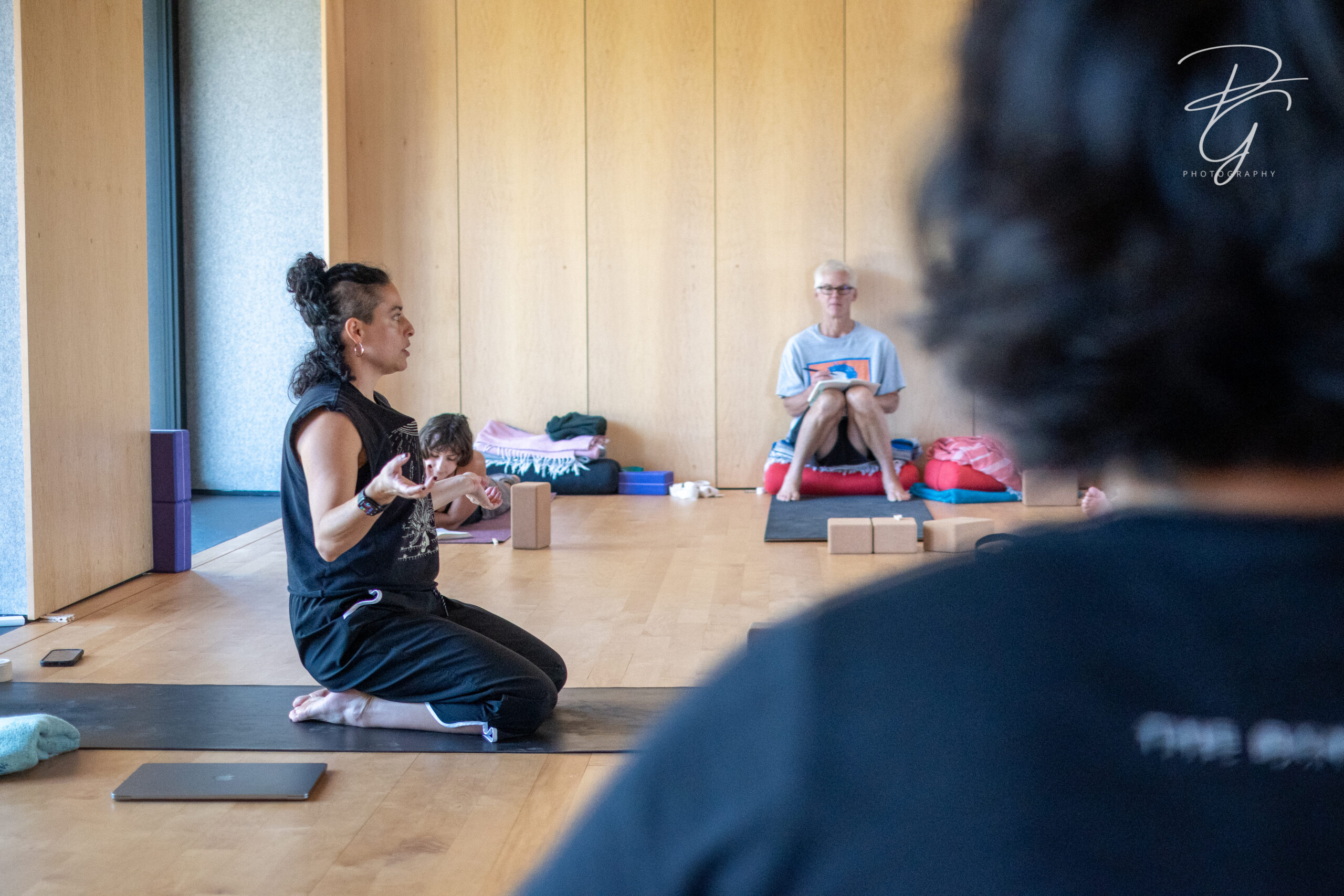
It was, for sure, an experience. After dutifully doffing shoes and bags, attendees at Close Music for Bodies (see the tD preview) were gently introduced to one another (by name) under the direction of individual performers, formed large and small circles to learn ground-rules and state special needs, then organized themselves at the southern end of the hall for the opening act of the show. A four-count from director Michael Kiley initiated the nine singers’ “Personal Resonance Song,” the text acquainting the audience with the anatomy of the breath. Soon, we were all—performers and audience alike—breathing together: “inhale, exhale; inhale, exhale….” No amplification, no pre-recorded sound, just breath, voice, pitches, and the squeaks and shuffles of people and old buildings in subtle motion.
Attendees were individually placed, by touch and gentle hand-holding, under a grid of low-lit bulbs. “The Story Song” began: snippets of each performers’ life stories, organized roughly by chronology from childhood onward. We moved around as instructed: sit, form a circle, open to the sides, go here or there. No rush, no insistence, no angst or confrontation. We were a well-behaved group, the performers kind to us—some of them exuberant, some focused on our responses, all alert to one another. When sections of the work concluded, the pitch for the next part sounded from a toy xylophone, rubbing a half-filled wine glass, or a Tibetan prayer bowl. Lovely. As the singers, moving among us, returned to the “Resonance Song,” we all grasped that we too could find these pitches within our chests, from our own lungs, through our very own breath. The hall filled with our hums and oms, oohs and aahs. Then, performers turned to open the windows facing Second Street, letting in daylight, breezes, and street sounds. They bowed, we clapped.
There was something wonderful about the simplicity of the work, the community created, the contact with our bodies, voices, and other attendees, the human-generated surround-sound.
And there were missed opportunities. The “Story Song” snippets lured us with narratives that never gelled, that at times seemed self-indulgent—tmi, or too little. The music, created by the performers under Kiley’s direction, often missed the rhythms, phrasing, even meanings of the words. And the singing, at first strangely beautiful in its pristine a capella clarity, established a sameness of tone, pacing, and harmonies that let my attention wander, my breath become the occasional yawn. A shortened version of this kind of work, with more range and drive, would be my suggestions for next efforts. And I hope there will be.
Close Music for Bodies, Christ Church Neighborhood House, Sept. 20-24, http://fringearts.com/event/close-music-for-bodies/