“This machine kills fascists,” this garden grows ketchup, and Alexandra Tatarsky is America’s horcrux—excuse me—your host in Americana Psychobabble, her solo show directed by Meryl Sands, which just closed its run at Berks Warehouse in the Philadelphia Fringe.
Americana Psychobabble’s logic is more 3-D Rorschach inkblot in motion than feel-good TED Talk. More mealy worms in your Happy Meal than Blue Apron in front of Saturday Night Live. This satire takes a step closer to horror, too uncomfortable to unwind in front of at 10pm.
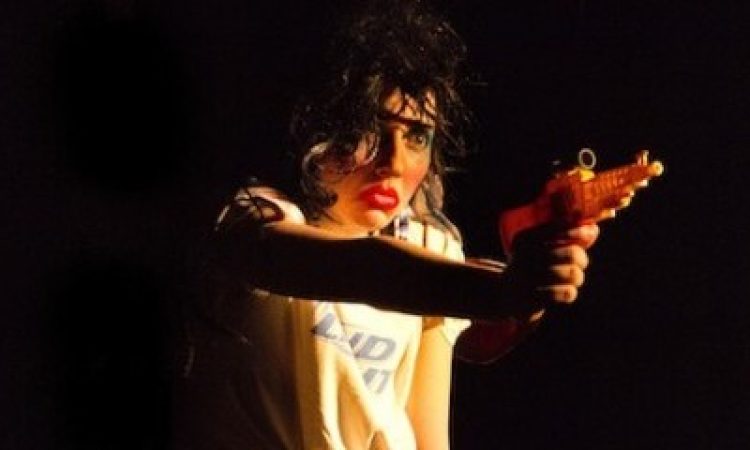
Tatarsky thrusts open the doors and emerges—part-insect, part-American flag on drugs, part-mangled ballerina ready to kill. Her body contorts and spasms through a kaleidoscope of characters from Gollum to Kali to Bozo the Clown. America’s psychic entrails come vomiting, shooting, gyrating through her—out the sides of her globular eyes, out the tips of her hyperextended fingers, from every pelvic thrust, but most predominantly from a wicked and robust babble—a finely crafted verbal diarrhea that would make Dario Fo proud. “Ca-ca” becomes “Ka-Ka” becomes “K K” becomes “K K K” becomes “Okay, K?” To write down Tatarsky’s language betrays its aural liquidity.
The projectile verbal barrage goes on for near half the show—like a nauseating roller coaster ride where everyone feels queasy, but no one can get off. The duration seems essential; some dynamics within it feel not yet fully utilized. The ride comes to an awkward halt. Tatarsky invites us to check in with how we’re feeling, directs us to wretch, sob, laugh, or scream. She says I can fake it, but I feel jolted by the shift from onslaught to inclusion. Maybe that’s the point. Maybe it isn’t. I can’t tell. Meanwhile, Tatarsky, transforms into the Angel of Death, birthed through the shell of a TV, and sings “Daddy Song” on the guitar—the one with Woody Guthrie’s “this machine kills fascists” scrawled in permanent marker around the mouth.
Light descends on the Rauschenbergian set—a collage of dollar store delights, Walmart 2-for-1s, and the bodega around the corner. The energetic blister popped, the stone passed, the enema used. The softer and gravelly tones of Tatarsky’s voice in the final song bring a small relief, even despite the bleak tone. A flicker of human feeling amidst a wreckage.
Americana Psychobabble, Berks Warehouse, fringearts.com/event/americana-psychobabble/