Friday, 5:25pm: Savasana. “Let go of memory, identity. Forget about labels, attachments.”
Week prior: Ghost in my machine. Blast from the past, smiling at me from the far beyond.
Day prior: Post farewell blessing to my first tango teacher.
Friday, 5:30pm: Namaste. Bow to the angel on my fridge.
7:40pm: On NPR, MacArthur winner Nikole Hannah-Jones on public schools and segregation: “I don’t think my kid deserves more than others.” Wonder where non-attachment ends and all-encompassing love begins.
7:52pm: Settle into the theater. Take in the mudcloth backdrop, West African pop music. Remember Mali. Tall grass, a red dress, threat of snakes, smiling faces, entire days for greetings.
7:54pm: Hug an old friend and share sad news.
8:13pm:
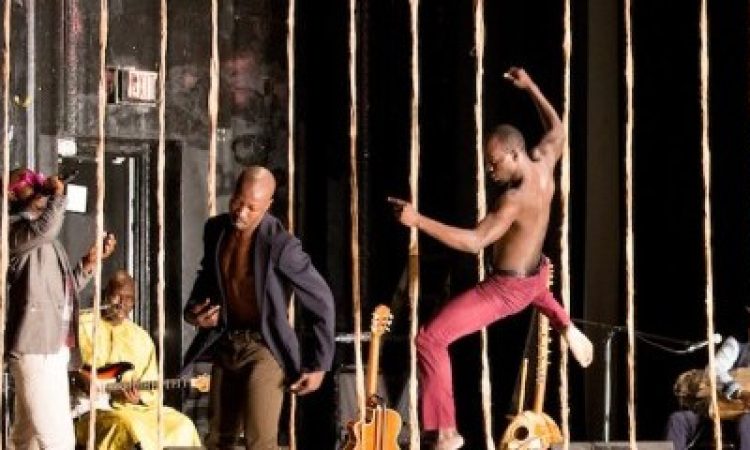
House lights and West African pop fade against the rising sounds of crowds and bullets. I struggle to glean some French from the shouting—it is an actual recording of the 2014 million-person uprising in Burkina Faso. Little solidifies to my ears but panic, chaos. One thing is instantly clear as the cast of Declassified Memory Fragment take the stage of FringeArts: we are in the realm of MEN. An exploration of the multi-faceted and contradictory realities of life in certain African countries like his home, Burkina Faso, Olivier Tarpaga’s dazzling work features an all male cast—dancers Ousséni Dabaré, Aziz Dermé, Jérôme Kaboré, Adonis Nébié, Tarpaga, and the Dafra Kura band—with dramaturgy by his wife, Esther Baker-Tarpaga. Together the men transport the room to joy, laughter, fear, heartbreak again and again.
Three men sit on a motorcycle frame. One behind the other, they circle arms forward, not quite embracing, resting in a rigid first position. Like the hands of an electric clock, their arms jerk up, down, open. Their torsos tilt sideways, as if dipping with the bike around a sharp curve. A hand emerges from the middle, rests above the heart before him. An anatomy lesson in motion: pecs, trapezius, deltoids, biceps, triceps, abdominals ripple and recede under their rolling shoulders, arms, torsos.
Like children at play, they animate the bike with gesture and sound—gak gak gak gak gak gak the engine’s rumble, vroom vroom vroom the throttle revs as wrists pump. One marches the length of upstage, tense as a ticking-timebomb soldier. Another slings the bike like a gun. It bobs in sync with his rat tat tat tat tat. Theatre, efficiency (of automation), and horror intertwine, freeze me.
Two men wrestle within a single suit jacket, each with one arm in a sleeve. They jockey for our attention, step forward and toss the other aside. One points proudly to his chest, raises a thumb—I’ll jump higher. The other rolls his hands—I’ll flip for you. I have seen this jockeying elsewhere. On the playground. On the dance floor. Surely there is an element of this in the evolution of most anything.
A preview explains the suit jacket: political rivals sparring for power, and the not-uncommon tactic of winners inviting opponents into the fold of a new government. It is charming, a rather lovely pissing contest. Until it escalates. Until it isn’t. One dancer yanks another’s mouth open wide as it will go. An image of terror. He rests his head to his victim’s cheek, and the meaning is complicated, ambiguous.
Amidst all of this, there is breathtaking song and dance that melds and transcends labels: African/diasporic/contemporary/traditional/modern. Pounding his chest and backbending to the floor, Tarpaga howls, “Sometimes I CRYYYYYY!” He points at us and cries, “You, you, you, you….” “WHY? NEWTOWN!” Circling the space supine, a dancer sweeps his arms overhead along the floor, the momentum flipping him belly to back, back to belly, again and again. With each turn energy weaves through his limbs, out his neck and head in bewitching, snaky, circuitous movements. Mid-flight, the men flip to land flat on their backs without a sound. A shoulder roll unfurls to tiptoes, to bending back to the edge of falling.
Later, an Afrobeat disco. The room spins as pink and purple light refracts round the theater. Tarpaga dons giant rainbow-colored peace-sign sunglasses. A dancer squeezes his buttcheeks to the rhythm and Tarpaga points and spanks. He bangs another on the head with his mic. We travel in time to the golden age of breakdancing, revel in the worm right side up and upside down.
A whistle blows. A man is on his knees, a foot on his back.
Red petals fall from above. The suit jacket floats with them, a dancer pulls it over his head. Suffocating, alienating—power ultimately breaks the bonds of brotherhood.
____________
11:15pm: Death lies around the corner. Dance in celebration and in sorrow.
Next Monday: ‘Me Too’ sweeps through my virtual village.
____________
Days later: My memory, declassified
I can’t get my mind off the men, their jockeying. I think of many things. Shakespeare in the Bush, an anthropologist’s story of discussing Hamlet in West Africa, where the near absence of women says as much as all the men’s talk. Tango history, men competing over women, challenging one another in ongoing bouts of one-upmanship, pushing the dance forward. The awkward instances and downright predation that plague women in tango to this day. My never-ending push-pull of attraction and revulsion towards a dance seeped in nostalgia, that magically reflects back all that we are now. The complicated nature of any family or community.
I marvel at the power of memory, my attachment to everything I’ve seen, felt, experienced. Everyone I’ve loved. How it grounds me in this world.
I wonder at the phrase political instability. The limitations of language, the perspective and power of terms like underdevelopment, modernity. The blinding force of power. The ritual male sacrifice maintained by patriarchy.
Declassified Memory Fragment, Baker & Tarpaga Dance Project, FringeArts, Oct. 12-14.